Product Owner Resume: Examples and Tips (2026)

Explain backlog decisions, product goals and stakeholder evidence with a fictional product owner resume, practical advice and a free template.

Template:

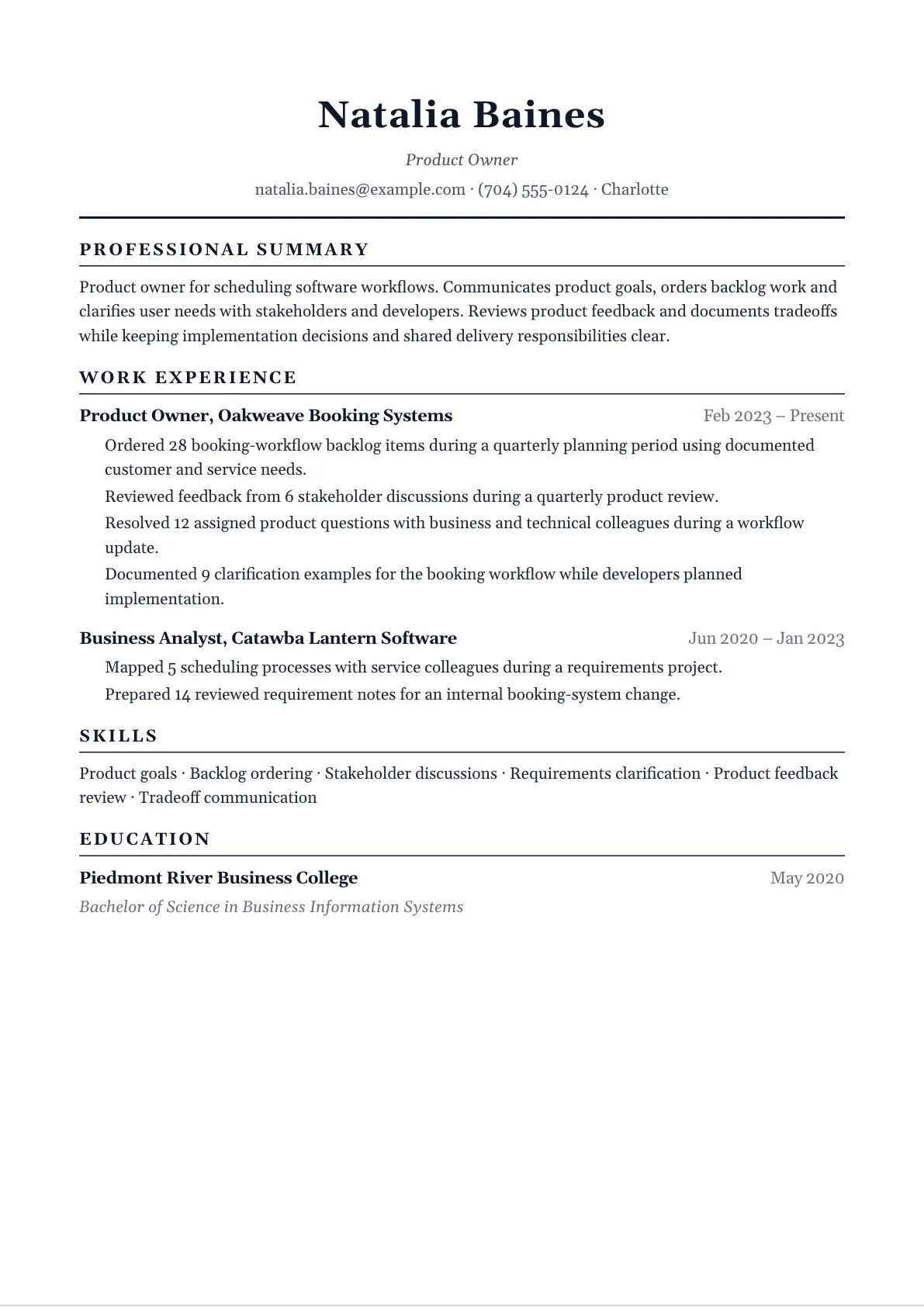
Fictional product owner Natalia Baines applying to a Charlotte scheduling software team. Employers, education, product work and counts are invented illustrations.

Why this resume works

  • The summary identifies a scheduling product and responsibility for product goals and backlog decisions.
  • Backlog items, stakeholder discussions and clarification examples remain activities rather than invented business outcomes.
  • The earlier analyst role is distinct, and the sample leaves implementation planning with the development team.
Edit & download this resume

Create a free account to edit this example and download a PDF with no watermark. Classic is free; Compact, Creative, and Bold require a Job Search Pass.

A product owner resume should explain what product you worked on, how you made ordering decisions and how you learned whether the work was useful. A long list of meetings or backlog tickets does not establish product value. Show the user problem, the evidence considered and the responsibility you held. Keep the actual organization's job title distinct from claims about what every Product Owner does under Scrum.

The fictional example follows Natalia Baines applying to a Charlotte scheduling software team. Her employers, degree, backlog work and counts are invented. She moved from business analysis into product ownership for a booking workflow. The sample separates backlog decisions from developer implementation and does not claim that writing more items caused revenue growth. Its selectable text, image and editable data describe the same applicant; use the structure and replace the invented facts with your own evidence.

Product owner resume example: text version

This is the fictional example shown above in selectable text. Use its structure, then replace every sample detail with your own. The image and editable example use the same resume data.

Natalia Baines

Product Owner

natalia.baines@example.com

(704) 555-0124

Charlotte, NC, US

Summary

Product owner for scheduling software workflows. Communicates product goals, orders backlog work and clarifies user needs with stakeholders and developers. Reviews product feedback and documents tradeoffs while keeping implementation decisions and shared delivery responsibilities clear.

Experience

Product Owner

Oakweave Booking Systems

From: Feb 2023

To: Present

  • Ordered 28 booking-workflow backlog items during a quarterly planning period using documented customer and service needs.
  • Reviewed feedback from 6 stakeholder discussions during a quarterly product review.
  • Resolved 12 assigned product questions with business and technical colleagues during a workflow update.
  • Documented 9 clarification examples for the booking workflow while developers planned implementation.

Business Analyst

Catawba Lantern Software

From: Jun 2020

To: Jan 2023

  • Mapped 5 scheduling processes with service colleagues during a requirements project.
  • Prepared 14 reviewed requirement notes for an internal booking-system change.

Skills

Product goals

Backlog ordering

Stakeholder discussions

Requirements clarification

Product feedback review

Tradeoff communication

Education

Bachelor of Science

Business Information Systems

Piedmont River Business College

To: May 2020

Product ownership within Scrum

Official figures for Product Owner accountability in Scrum.

Product focus
Value and a clearly communicated Product Goal
Backlog focus
Ordering and transparency of Product Backlog work

The Scrum Guide defines accountabilities within Scrum. Employers may use the title differently; explain your actual work and avoid treating the Product Owner as the person who assigns every developer task.

Sources: Scrum Guides: The 2020 Scrum Guide, checked October 2026; Scrum.org: Product Owner certifications, checked October 2026.

How to show product ownership on a resume

1

Identify the product and users

Name the product area and the user or business problem relevant to the opening. Booking software for service teams needs a different story from an internal data platform. Explain the actual scope you owned rather than implying responsibility for every product in the company. Use the employer's title accurately, and clarify the context when the organization used Scrum terminology differently.

2

Describe an ordering decision

Show how evidence, risk, dependencies and product goals influenced the order of work. Explain a choice or tradeoff instead of listing a ticket tool as proof of product judgment. A strong description can say why one problem was addressed before another and what remained uncertain. Do not invent user research, revenue or authority over another product to make the decision sound larger.

3

Distinguish product and developer responsibilities

Within Scrum, the Product Owner is accountable for value and effective Product Backlog management. Developers plan the implementation work, including the Sprint Backlog. Describe your collaboration without claiming that you assigned every coding task or single-handedly delivered the Increment. If you also had a separate management role, state that actual responsibility rather than attributing it automatically to product ownership.

4

Connect feedback to the next choice

Explain how you reviewed observations, support questions or stakeholder feedback and what that changed in the product discussion. A meeting count describes activity, not proof of adoption or customer satisfaction. Keep interviews, individual participants and organizations distinct. Describe the limits of the evidence, especially when feedback came from a small group or an internal demonstration rather than a released product.

5

Use product measures carefully

If you claim an outcome, define the population, period, comparison and contribution. Adoption, active users, account creation, retention and revenue are different measures. A larger backlog or higher velocity does not automatically mean more product value. When reliable outcome data is unavailable, describe the decision and validation plan instead of inventing a commercial result or borrowing a team total.

6

Reconcile the application and export

Follow the actual file instructions and any separate product questions. In CVPoet, create an account or sign in, open the fictional sample in the builder, replace its details and select Update. Download the PDF and inspect the chronology, role boundaries, selectable text and final sections. Classic is free with an account; premium designs require a Job Search Pass.

Skills and keywords for a product owner resume

Choose skills that explain the decisions and conversations you actually handled. Backlog ordering, product-goal communication, clarification and feedback review are useful when supported by examples. Knowing a ticket tool is different from deciding what should be built. Keep technical literacy separate from coding or architecture ownership, and describe research participation accurately. The skill list should point to evidence in your work rather than repeat every phrase in an agile glossary.

Hard skills

  • Product Backlog ordering
  • Product Goal communication
  • Requirements clarification
  • Interpreting product feedback

Soft skills

  • Explaining competing needs
  • Discussing tradeoffs
  • Listening to stakeholders

Tools and software

  • Backlog tools actually used
  • Product documentation and review tools
  • Relevant analytics at the level used

Product owner resume summary examples

These separate fictional introductions illustrate different routes into the role. They do not add authority, credentials or outcomes to Natalia's history.

Analyst moving into ownership

Business analyst with relevant requirements and stakeholder experience seeking a first product ownership role. Describes actual decision participation and product preparation without presenting analyst support as established accountability for the whole product.

Workflow product owner

Product owner working on a defined scheduling workflow. Communicates the product goal, orders backlog work and reviews feedback with stakeholders and developers. Explains decisions and uncertainty while keeping shared delivery and implementation responsibilities visible.

Experienced product contributor

Product professional with supported responsibility for product direction and difficult ordering choices. Describes the evidence, constraints and collaboration behind those choices, with portfolio scope and commercial results attributed accurately rather than inferred from a senior title.

Product owner resume bullet examples

These fictional activity examples show how to describe product work. They are not targets for backlog size, meeting volume or team velocity. Replace them with your own evidence, and use a clear qualitative decision when a trustworthy number is unavailable.

  • Ordered 17 backlog items after reviewing documented service and customer needs.
  • Reviewed feedback from 4 stakeholder discussions during a product planning period.
  • Clarified 11 workflow questions with business and development colleagues.
  • Documented 7 product tradeoffs with their assumptions and follow-up questions.
  • Mapped 3 alternative service journeys before discussing the next product focus.
  • Prepared 8 permitted clarification examples for a scheduled workflow review.
  • Reconciled 13 product terms with the team glossary during a requirements change.
  • Reviewed 5 support themes before updating the backlog discussion.
  • Recorded 10 product assumptions for a planned evaluation of a prototype.
  • Compared 2 proposed workflow options against the stated product goal.

Product ownership learning and certifications

The 2020 Scrum Guide is the primary source for the accountabilities described here. Scrum.org explains its Professional Scrum Product Owner certifications. A credential, a course and experience in an employer's product role are different facts.

  • State the exact certification and issuer only when earned. Scrum.org describes PSPO I as demonstrating fundamental Scrum and Product Owner knowledge; do not rename an uncompleted course or practice assessment as that award.
  • Verify the current issuer details and any employer requirement before making a credential claim. This fictional applicant does not claim PSPO, another certification or attendance at a named provider course.
  • Use actual education and completion stage. Natalia's business information systems degree precedes the displayed analyst role. Learning can explain preparation, but it is not proof of commercial results or authority over every team decision.

The example, line by line

Product scope: Natalia works on booking workflows within scheduling software. The summary identifies goals, ordering and clarification without claiming executive ownership of the whole business.

Backlog: twenty-eight items were ordered during a quarterly planning period. This is a scope description, not a product-value score or proof that all items were implemented. It does not prescribe a particular backlog size for another team.

Feedback: six stakeholder discussions are a quarterly input to review. They do not establish six unique customers, an unbiased market sample or a satisfaction rate. Twelve questions resolved and nine clarification examples are different forms of work, not revenue or adoption measures.

Team boundaries: the clarification examples supported shared understanding while developers planned implementation. Natalia does not claim that she personally assigned every task or performed all engineering, testing and release work.

Earlier role: five mapped processes and fourteen requirement notes describe analysis work before the product owner role. The May 2020 degree is completed before the June start. This sequence shows a plausible transition without retrospectively changing the earlier title.

Worked revision: show judgment instead of ticket volume

A fictional rough claim says, "Wrote lots of tickets and guaranteed product success." A clearer version is, "Ordered booking-workflow items after comparing customer needs and dependencies, and recorded the tradeoffs for review." The revision describes a real reader task: understanding how a choice was made. It removes an unsupported guarantee and does not pretend that producing more backlog text establishes a better product.

When a measured result exists: include the actual definition, period and your contribution. A rise in registrations is not automatically growth in retained users or paid customers. Keep a proposed benefit separate from a measured outcome after release.

Product owner claims that need closer review

  • Backlog volume treated as value: describe the decision and evidence. More tickets, story points or meetings do not by themselves establish a useful product outcome.
  • Every developer task assigned by the Product Owner: distinguish Scrum accountabilities and the actual organization's roles. Do not imply implementation control merely from the title.
  • Shared delivery presented as individual output: explain your contribution to goals, ordering and feedback, and keep the work of developers, designers and researchers visible.
  • Adoption and revenue used interchangeably: define the measure and population. A sign-up, an active user, a retained account and a payment are different observations.
  • Internal customer evidence published without permission: check restrictions before sharing a roadmap, backlog or research summary. Label synthetic demonstrations and avoid real user records.
  • Certificates substituted for experience: keep issuer awards, course work and employer responsibilities separate. Follow the opening instead of claiming a universal product-owner qualification rule.

Compare related roles without assuming their titles or responsibilities are interchangeable.

Every example is in the resume examples hub, grouped by job and situation.

Build it free, no watermark

Create a free CVPoet account before editing. Start from this example in the free Classic template or start a blank page, and download a PDF with no watermark. Compact, Creative, and Bold are available with a Job Search Pass.

Frequently asked questions

What should a product owner resume explain?

Identify the product, users, responsibility and an evidence-informed ordering decision. Describe feedback and what you learned. Backlog or meeting counts can show scope, but do not treat them as proof of product value or guaranteed commercial success.

Is a Product Owner the same as a product manager?

Employer titles and responsibilities vary. Explain the role you actually held and the opening you want. Within Scrum, Product Owner has defined accountabilities. Do not assume that a title automatically includes every product strategy, marketing, staffing and engineering responsibility.

Does a Scrum Product Owner assign developer tasks?

The Scrum Guide distinguishes Product Backlog accountability from the Developers' implementation planning and Sprint Backlog. Describe collaboration and actual responsibilities accurately. If you also held a separate line-management position, state that separately rather than implying it follows from product ownership.

How can I show value without revenue data?

Explain the user problem, choice, evidence and constraints, plus how feedback informed the next step. Use verified outcomes when available and permitted. Without those records, a clear decision or validation plan is more useful than an invented revenue increase.

Can a business analyst use this structure?

Yes, retain the real analyst title and describe relevant requirements, stakeholder and decision-support work. Explain a genuine move into ownership. Do not relabel every earlier task as Product Owner accountability or claim authority you did not have.

Should I include velocity or story points?

Use them only with accurate team context and a clear reason. They are not universal productivity or product-value measures. Keep backlog items, completed work, adoption and commercial outcomes distinct, and do not present team estimates as your individual output.

Do I need a named Scrum certification?

Check the actual opening and issuer. List an earned award by its exact title; keep courses and practice assessments distinct. This fictional sample claims no certification. Knowledge of a framework and responsibility for an employer's product are related but different evidence.

Can I share an internal roadmap or backlog?

Verify permission before sharing employer or client documents, user feedback or sensitive priorities. A synthetic demonstration should be labeled accurately and should not imply a client approved or shipped it. Follow the employer-approved process for confidential evidence.

How do I edit and download the sample?

Sign in or create a CVPoet account, open the fictional example in the builder and replace its data. Select Update to save, then download the PDF. Classic is free with an account; premium designs require a Job Search Pass.

How should I check the final application?

Reconcile titles, dates, product scope, credential wording and outcomes against your records. Keep length and section order appropriate to relevant history and application limits. Inspect selectable text and complete sections in the exported PDF and follow the requested file format.

Build your product owner resume

Open the fictional sample with an account, add your own product decisions and evidence, save with Update and download the PDF. Classic is free.

Build your resume, free
Booking workflow product owner example
Booking workflow product owner example The example above as an image, to save or share. To change it, use Edit & download this resume at the top of the page. Open the full-size image
Premium

More ways to make your CV yours

Unlock all three premium designs with a Job Search Pass. Your written content stays exactly as it is. Classic is always free.

Included with your pass

$12 once for 30 days

No subscription. Nothing renews. A 90-day pass is also available.

See Job Search Passes

Pass options open in a new tab. Your draft stays here.