Network Engineer Resume: Examples (2026)

Network engineer resume example with routing, switching and security skills, CCNA and CCNP guidance, bullet examples, official pay data and a free template.

Template:

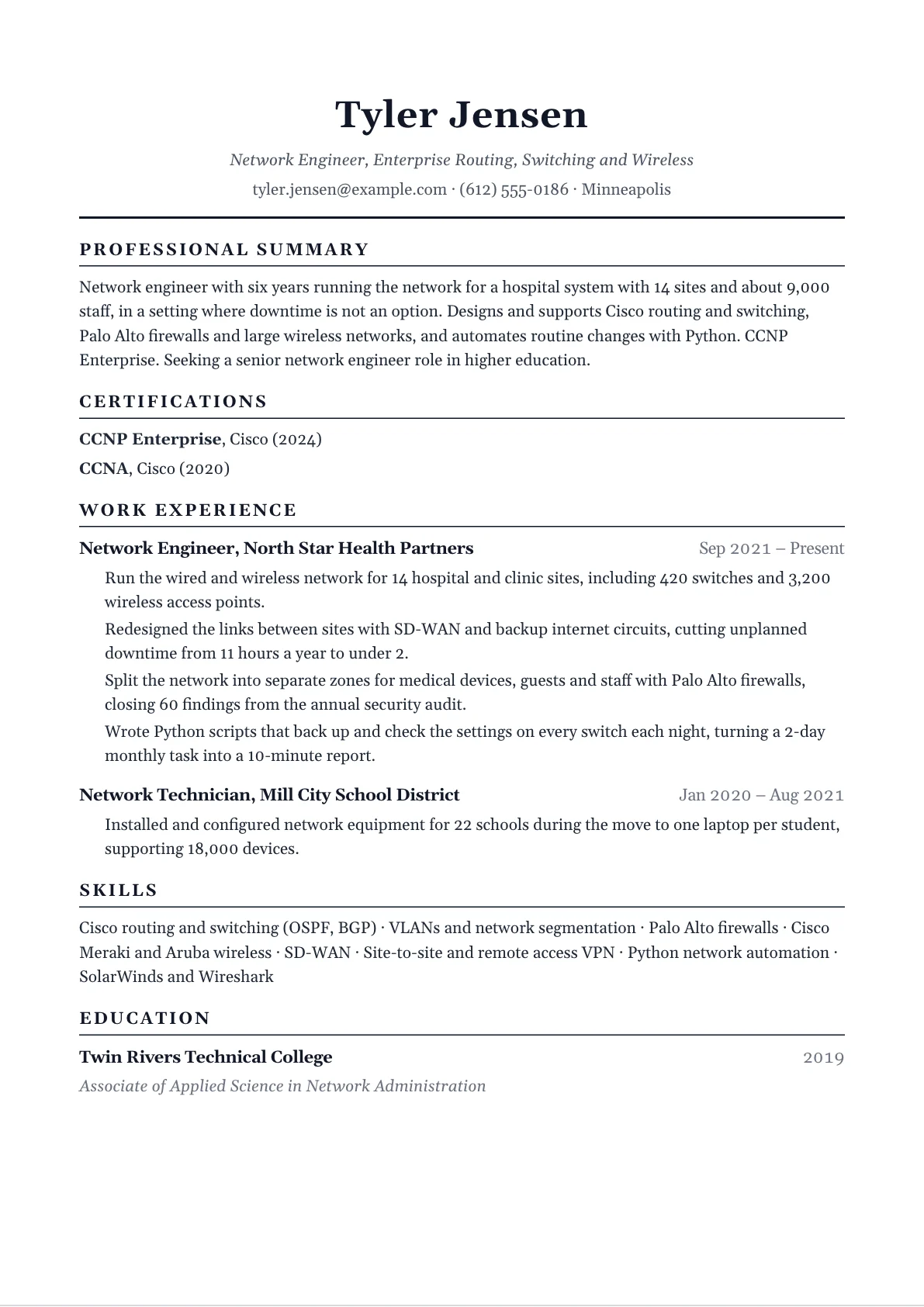
A network engineer with six years at a regional hospital system applying for a senior network engineer role at a state university.

Why this resume works

  • Certifications sit right under the summary, because CCNA and CCNP are the first thing network postings screen for.
  • Every bullet gives the size of the network and a result: 14 sites, 3,200 wireless access points, and unplanned downtime cut from 11 hours a year to under 2.
  • The firewall and segmentation work shows security skills a university needs, and the round-the-clock hospital setting proves he can make changes without taking anything down.
Edit & download this resume

Edit it in the free builder, then download the PDF with no watermark. A free account is only needed to download.

Nobody notices the network until it stops. A network engineer designs, builds and fixes the connections that let an organization's computers, phones, cameras and cloud services talk to each other: the switches and routers, the firewalls, the Wi-Fi, the links between buildings. Hiring managers reading a network engineer resume want to know how big a network you have run, which vendors' equipment you know, how you keep it secure, and what happens when something fails on your watch.

This guide covers the sections and order that work, the networking skills postings ask for (with plain explanations of the jargon), summary and bullet examples for junior, mid-level and senior engineers, the certifications employers actually name, and a full example for a hospital network engineer applying for a senior role at a university. If you mostly build software rather than networks, see the software engineer resume example.

Network engineer pay and job outlook

Official figures for Computer Network Architects.

Median pay (2025)
$134,050 per year ($64.45 per hour)
Jobs in 2025
181,800
Job outlook, 2025 to 2035
8%, much faster than average
Change in jobs, 2025 to 2035
+14,100
Typical entry-level education
Bachelor's degree
Work experience needed
5 years or more

Network engineer is not a separate official occupation. These figures are for Computer Network Architects, the government group for people who design and build data networks; O*NET lists titles such as Networking Systems Engineer and WAN Engineer under it.

Sources: U.S. Bureau of Labor Statistics, Occupational Outlook Handbook: Computer Network Architects, checked September 2026; O*NET OnLine: Computer Network Architects, checked September 2026.

How to write a network engineer resume

1

Name your networking focus in the headline

Network engineers specialize: enterprise routing and switching, wireless, security, data centers, cloud networking or service provider networks. Put Network Engineer plus your area under your name, for example Network Engineer, Enterprise Routing, Switching and Wireless, so a recruiter can match you to the right opening.

2

Put certifications near the top

Network postings often list a Cisco or CompTIA certification as required or preferred, and recruiters screen for it first. Give each certification its full name, the issuer and the year, in a section right after the summary. If you are studying for one, add it with the month you plan to take the exam.

3

Describe the network by its size

Size is how a manager judges your level: number of sites, users, switches, access points and firewalls, and the kinds of links between them. Put it in your summary and your first bullet. Run the network for 14 sites with 420 switches tells the reader more than any title does.

4

Write bullets about uptime, security and speed

Organizations measure their networks by how rarely they fail, how well they are protected and how fast problems are fixed. Build bullets around those: downtime reduced, audit findings closed, tickets resolved, faster connections, projects finished during short change windows. Name the vendors and tools, and explain anything unusual in a few plain words.

5

Show automation and documentation

Networks are increasingly managed with scripts rather than by typing commands into each device one at a time. If you use Python, Ansible or vendor tools to automate changes or backups, say what you automated and how much time it saved. Network diagrams and runbooks you wrote are worth a line too.

6

Finish with skills and education

List eight to twelve skills with vendor names (Cisco, Juniper, Aruba, Palo Alto, Fortinet), protocols and tools. Then your education: a degree, a technical college program or military training all count. Keep the resume to one page unless you have ten or more years or a long list of large projects.

Skills and keywords for a network engineer resume

These skills appear most often in network engineer postings. Use the ones you have and match the posting's vendor names.

Hard skills

  • Routing and switching: moving traffic between and within networks
  • Routing protocols such as OSPF and BGP, which let routers choose paths
  • VLANs and segmentation: splitting one network into separate, protected parts
  • Firewall configuration and security policies
  • Wireless design, surveys and troubleshooting
  • VPNs: secure connections for remote staff and between sites
  • SD-WAN for connecting branch offices
  • Network monitoring and troubleshooting with packet captures
  • Cloud networking in AWS or Azure
  • Automation with Python or Ansible

Soft skills

  • Calm troubleshooting during outages
  • Planning changes carefully and working in maintenance windows
  • Writing clear diagrams and documentation
  • Explaining network problems to non-technical staff
  • Working with vendors and internet providers
  • Training help desk and junior staff

Tools and software

  • Cisco IOS and Catalyst switches, Juniper or Arista
  • Palo Alto Networks, Fortinet or Cisco firewalls
  • Cisco Meraki, Aruba or Juniper Mist wireless
  • SolarWinds, PRTG or LogicMonitor monitoring
  • Wireshark for packet analysis
  • ServiceNow for tickets and change requests

Network engineer resume summary examples

Choose the one closest to where you are and change the details. Each covers the size of the network, your main skills, your certification and the job you want.

Entry-level network engineer

CCNA-certified network technician with two years on a managed IT team, supporting networks for 40 small business clients. Set up switches, firewalls and Wi-Fi for new offices and resolve about 30 network tickets a week. Seeking a junior network engineer role where I can grow into design work.

Experienced network engineer

Network engineer with five years supporting a manufacturing company's network across 9 plants, including the connections to factory equipment. Skilled in Cisco switching, Fortinet firewalls and site-to-site VPNs, and led the rollout of new wireless at every plant. CCNA and Network+ certified; seeking a network engineer role in a larger enterprise.

Senior network engineer

Senior network engineer with twelve years, leading network design for a bank with 150 branches and 2 data centers. Designed the move to SD-WAN and a new firewall platform, and set the team's change and automation standards. CCNP Enterprise; seeking a network architect or lead role.

Network engineer resume bullet examples

Each bullet names the network work, adds a number and, where possible, gives a result. Keep the pattern and use your own facts.

  • Replaced core switches at 2 data centers over 6 overnight windows with no unplanned downtime.
  • Designed wireless for a 300,000 square foot distribution center, cutting dropped scanner connections by 80 percent.
  • Moved 45 branch offices from leased lines to SD-WAN, saving $210,000 a year in circuit costs.
  • Resolved an average of 25 network tickets a week, with 95 percent closed within the service target.
  • Built site-to-site VPNs to 12 partner networks with documented settings and yearly reviews.
  • Rolled out network access control for 5,000 devices so only approved equipment can connect.
  • Automated switch configuration backups for 600 devices with Ansible, replacing manual copies.
  • Led the network part of an office move for 1,200 employees, finished over one weekend.
  • Set up monitoring alerts for 300 devices that cut the time to find outages from about an hour to 5 minutes.
  • Wrote 40 runbooks and network diagrams used by the help desk for first-line troubleshooting.
  • Mentored 3 help desk technicians who went on to earn their CCNA.

Certifications for network engineers

No state license is required to work as a network engineer, but certifications carry real weight in networking: many postings list one as required or preferred. These are the ones that come up in postings:

  • CCNA from Cisco: Cisco's associate-level networking certification and a common requirement in postings, earned by passing one exam (200-301 as of September 2026) on network basics, IP connectivity, security and automation.
  • CCNP Enterprise from Cisco: earned by passing two exams, a core exam on enterprise network technologies and one concentration exam you choose, such as advanced routing, SD-WAN, design or automation. Common for mid-level and senior roles.
  • CompTIA Network+ from CompTIA: a vendor-neutral certification covering networking basics; CompTIA recommends A+ and 9 to 12 months of hands-on experience first. Often requested for entry-level and government contractor roles.
  • Vendor certifications for the equipment an employer uses, such as Palo Alto Networks, Fortinet, Juniper or Aruba, are worth listing when the posting names that vendor.

The example, line by line

The example is for Tyler, a network engineer at a hospital system who wants a senior role at a university. Here is what each part does.

Headline: Network Engineer, Enterprise Routing, Switching and Wireless. Universities run large campus and wireless networks, so these are the words their postings use.

Summary: six years, the size of the network (14 sites, about 9,000 staff) and why it is demanding, then his vendors and automation, then CCNP Enterprise and the field he wants.

Certifications: right after the summary, with CCNP Enterprise from 2024 and CCNA from 2020, so the screening question is answered first.

Experience: four bullets for his current job. The first gives the scale (420 switches, 3,200 access points). The next three are results: downtime from 11 hours a year to under 2, 60 audit findings closed through segmentation, and a 2-day task cut to a 10-minute report with Python. His school district job keeps one bullet about 22 schools and 18,000 devices, which shows campus experience a university will value.

Skills and education: eight skills with vendor and protocol names, then his associate degree in network administration from 2019.

Mistakes that cost network engineers interviews

  • Burying the certification. If the posting requires CCNA and yours is at the bottom of page two, it may be missed. Put certifications near the top.
  • No network size. Maintained the company network could be one office or a hundred sites. Give sites, users and device counts.
  • A list of every command you know. Protocols and vendors matter; individual commands do not. Show what you built or fixed instead.
  • Only listing tickets. Help desk volume is fine early on, but engineers are hired for design and improvement. Add at least one project with a result.
  • Sharing sensitive details. Do not name internal IP ranges, device names or specific security weaknesses from a past employer. Describe the work in general terms.
  • Listing expired certifications as current. Many networking certifications expire unless you renew them. If one has lapsed, give the years you held it or leave it off.

Other tech resume examples close to this one:

Every example is in the resume examples hub, grouped by job and situation.

Build it free, no watermark

CVPoet's resume builder is free to use without an account. Start from this example or a blank page, pick one of four ATS-friendly designs, and download a PDF with no watermark on any plan.

Frequently asked questions

What should a network engineer put on a resume?

Contact details, a headline naming your networking focus, a short summary with the size of the networks you run, your certifications near the top, your experience with results, a skills section with vendors and protocols, and your education.

Is CCNA required for network engineer jobs?

It is not a legal requirement, but many postings list CCNA or an equivalent as required or preferred, especially for entry-level and mid-level roles. Senior roles often ask for CCNP or years of experience instead.

How do I write a network engineer resume with no experience?

Lead with any certification (CCNA or Network+), then help desk, technician or military communications work, written with numbers. Add a home lab or school project where you built and secured a small network, and describe what you set up.

Should I list a home lab on my resume?

Yes if you are early in your career. Describe it like a project: the equipment or virtual tools, what you configured (routing, VLANs, firewall rules, VPN) and what you learned. Leave it off once you have solid job experience.

What skills are most important for a network engineer?

Routing and switching, a routing protocol such as OSPF or BGP, VLANs, firewalls, wireless, VPNs and troubleshooting. Automation with Python or Ansible and cloud networking are growing fast in postings.

How do I show uptime on a resume?

Give the before and after: unplanned downtime cut from 11 hours a year to under 2, or zero outages during a core switch replacement. If you track uptime as a percentage, use it, but hours are easier for most readers.

Should I include the network vendors I have used?

Yes. Postings are often tied to a vendor, such as Cisco, Juniper, Aruba, Palo Alto or Fortinet. Name them in your skills and inside your bullets.

How long should a network engineer resume be?

One page for most engineers. Senior engineers and architects with many large projects can use two, with certifications and the latest role on the first page.

What is the difference between a network engineer and a network administrator resume?

A network administrator resume centers on day-to-day operation and support. A network engineer resume adds design, projects and improvements. Many jobs mix both, so use the title the posting uses.

Do I need a degree to be a network engineer?

Many postings ask for a bachelor's degree, but plenty accept an associate degree, military training or certifications with experience. List whatever education you have, and let certifications and results carry the rest.

Build your network engineer resume now

Start from Tyler's example or a blank page. Free, no account needed, and the PDF has no watermark.

Build your resume, free
Network engineer resume example
Network engineer resume example The example above as an image, to save or share. To change it, use Edit & download this resume at the top of the page. Open the full-size image