Information Security Analyst Resume (2026)

Information Security Analyst resume example with role-specific skills, summaries, work bullets and practical writing advice. Edit the free Classic template.

Template:

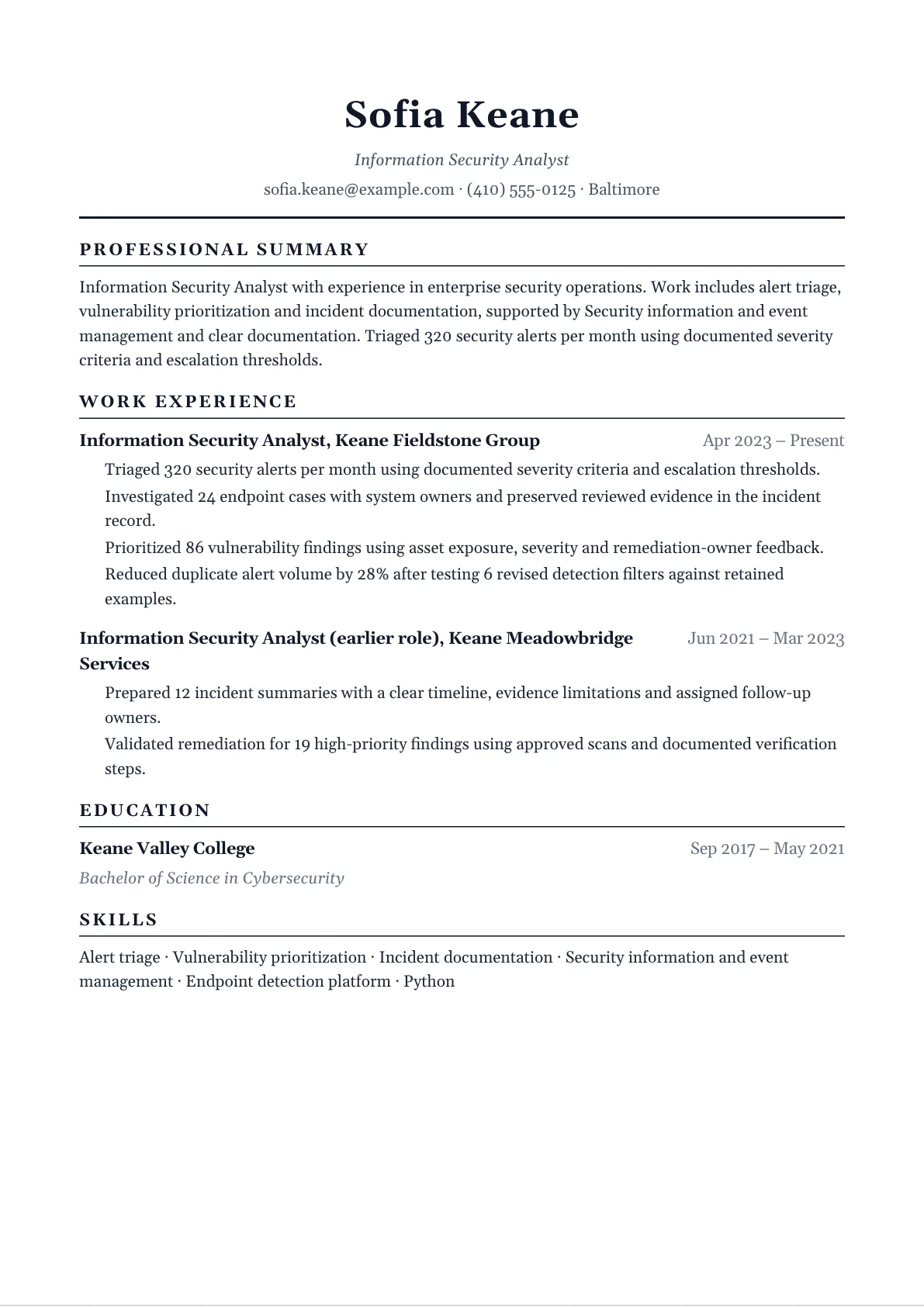
Fictional information security analyst candidate in Baltimore, MD, applying for work in enterprise security operations.

Why this resume works

  • Sofia's fictional enterprise-operations setting makes alert triage, case investigation and vulnerability prioritization relevant to the target role.
  • Monthly alert volume is separated from case and finding counts. These measures show different tasks, not a single incident-prevention rate.
  • The sample names escalation criteria, evidence records and approved verification. It describes analyst responsibilities without claiming incident-command or penetration-testing authority.
Edit & download this resume

Create a free account to edit this example and download a PDF with no watermark. Classic is free; Compact, Creative, and Bold require a Job Search Pass.

Editorial date: September 29, 2026.

A security analyst resume should explain investigation and risk decisions within an authorized environment. Show what you reviewed, how you validated findings and where you escalated, without publishing attack paths or claiming that no breach could occur.

Fictional sample: replace Sofia Keane's employers, education and results with your own verified history.

Information security analyst resume example: text version

This is the fictional example shown above in selectable text. Use its structure, then replace every sample detail with your own. The image and editable example use the same resume data.

Sofia Keane

Information Security Analyst

sofia.keane@example.com

(410) 555-0125

Baltimore, MD, US

Summary

Information Security Analyst with experience in enterprise security operations. Work includes alert triage, vulnerability prioritization and incident documentation, supported by Security information and event management and clear documentation. Triaged 320 security alerts per month using documented severity criteria and escalation thresholds.

Experience

Information Security Analyst

Keane Fieldstone Group

From: Apr 2023

To: Present

  • Triaged 320 security alerts per month using documented severity criteria and escalation thresholds.
  • Investigated 24 endpoint cases with system owners and preserved reviewed evidence in the incident record.
  • Prioritized 86 vulnerability findings using asset exposure, severity and remediation-owner feedback.
  • Reduced duplicate alert volume by 28% after testing 6 revised detection filters against retained examples.

Information Security Analyst (earlier role)

Keane Meadowbridge Services

From: Jun 2021

To: Mar 2023

  • Prepared 12 incident summaries with a clear timeline, evidence limitations and assigned follow-up owners.
  • Validated remediation for 19 high-priority findings using approved scans and documented verification steps.

Education

Bachelor of Science

Cybersecurity

Keane Valley College

From: Sep 2017

To: May 2021

Skills

Alert triage

Vulnerability prioritization

Incident documentation

Security information and event management

Endpoint detection platform

Python

Choose SOC, vulnerability or governance evidence

  • SOC and response: telemetry reviewed, triage criteria, investigation reasoning, escalation and accurate case records.
  • Vulnerability work: asset exposure, prioritization, owner coordination, approved retesting and unresolved exceptions.
  • Governance and risk: actual policy, risk, evidence or control-review contribution. Do not relabel this as hands-on incident response.
  • Early career: an authorized lab with simulated data, individual actions and explicit limitations.

Worked detection revision

Overstated: Prevented twenty-eight percent of attacks and saved the company from a breach.

Supported by the fictional sample: Reduced duplicate alert volume by twenty-eight percent after testing six revised detection filters against retained examples.

A real investigation project can use the structure environment, objective, telemetry, checks, decision, output and limitations. State whether the data are simulated and what you personally did. A lab is not a client incident, and sensitive indicators or unresolved defenses need permission before sharing.

Use actual vendor tools where relevant and supported by experience. Replace Sofia's record in free Classic, save with Update and inspect the PDF for confidentiality, dates, selectable text and accurate credential status.

Information Security Analyst occupation reference

Official figures for Information Security Analysts.

O*NET classification
15-1212.00

The information security analyst example uses this related occupation as background. Its scope can be broader; no salary is inferred.

Source: O*NET OnLine occupational profile 15-1212.00, checked October 2026.

How to write your information security analyst resume

1

Focus on enterprise security operations

State the security setting, such as internal operations, a managed service or a lab, and name the assets within your assigned scope.

2

Show your use of Security information and event management

Describe how you used a monitoring or endpoint platform to investigate, not just which vendor dashboards you opened.

3

Support alert triage claims

Alert reductions need context about false positives and retained detection coverage; fewer alerts alone do not prove better security.

4

Describe early information security analyst experience

A beginner can feature a legal lab with simulated logs and a documented investigation, clearly labeling the environment and permissions.

5

Explain incident documentation responsibility

Separate triage, incident command, penetration testing and remediation approval so your authority and practical experience remain credible.

6

Share permitted enterprise security operations material

Share sanitized investigation reasoning rather than exploit details, customer names, live indicators or internal controls that an employer has not approved for release.

Skills for your information security analyst resume

Describe how you used a monitoring or endpoint platform to investigate, not just which vendor dashboards you opened.

Hard skills

  • Alert triage
  • Vulnerability prioritization
  • Incident documentation

Soft skills

  • Clear handoffs: Separate triage, incident command, penetration testing and remediation approval so your authority and practical experience remain credible.
  • Evidence and judgment: Alert reductions need context about false positives and retained detection coverage; fewer alerts alone do not prove better security.

Tools and software

  • Security information and event management
  • Endpoint detection platform
  • Python

Information security analyst resume summary examples

These are separate fictional openings, not additional facts about Sofia. Choose the security responsibility you can substantiate.

Junior SOC applicant

Cybersecurity graduate with a simulated-log investigation project documenting alert context, alternative explanations and escalation decisions. Seeking a junior SOC role with supervised triage and incident-record responsibilities.

Enterprise operations analyst

Information security analyst in enterprise operations, triaging three hundred twenty monthly alerts against documented severity and escalation criteria. Investigates endpoint cases and coordinates vulnerability follow-up with system owners.

Vulnerability management analyst

Security analyst focused on finding prioritization and remediation verification. Combines exposure, severity and owner feedback, records exceptions and retests approved changes without presenting every closed finding as a prevented breach.

Information security analyst resume bullet examples

These information security analyst bullets are fictional illustrations. Replace tasks and figures with your own permitted evidence.

  • Triaged 320 security alerts per month using documented severity criteria and escalation thresholds.
  • Investigated 24 endpoint cases with system owners and preserved reviewed evidence in the incident record.
  • Prioritized 86 vulnerability findings using asset exposure, severity and remediation-owner feedback.
  • Reduced duplicate alert volume by 28% after testing 6 revised detection filters against retained examples.
  • Prepared 12 incident summaries with a clear timeline, evidence limitations and assigned follow-up owners.
  • Validated remediation for 19 high-priority findings using approved scans and documented verification steps.
  • Reviewed access changes for 140 accounts during a scheduled entitlement review with application owners.
  • Built 5 Python helpers for log normalization that retained source timestamps and parsing errors.
  • Participated in 3 tabletop exercises and recorded gaps in response contacts and recovery assumptions.
  • Updated 9 detection runbooks with reproducible queries and expected investigation outputs.
  • Coordinated 7 phishing-report investigations with messaging administrators and the incident lead.
  • Briefed 4 operations teams on recurring findings using sanitized examples and practical mitigation steps.

Information Security Analyst credential checks

List credentials actually awarded and current, with issuer and status. Exam preparation, course completion and a professional certification are different. Sofia's fictional sample does not list CISSP or another security certification.

  • ISC2 publishes CISSP experience requirements and an Associate of ISC2 route for candidates who pass the exam without the required experience. Do not label an exam pass or Associate status as CISSP certification.
  • NIST NICE describes cybersecurity work and knowledge and skills. Using its terminology does not make you NIST-certified.
  • Follow the vacancy's actual credential, access and employment requirements. Do not infer a security clearance or permission to test systems from a degree or lab project.

The example, line by line

Sofia is fictional and works in enterprise security operations. The degree is background, while triage, investigation and verification describe practical work. No certification, security clearance or penetration engagement appears in the sample.

The alert volume is three hundred twenty per month. Twenty-four endpoint cases and eighty-six findings are separate counts without a stated common period, so do not calculate a case-conversion rate from them.

The duplicate alert volume falls by twenty-eight percent after six filters were tested against retained examples. That is not a reduction in confirmed incidents or a guarantee that every attack remained detectable. A real application should explain the comparison window, duplicate definition and validation coverage.

The earlier role contains twelve incident summaries and nineteen high-priority findings verified through approved scans. Case documentation and remediation checks show different outputs. Preserve evidence limitations and your own authority when replacing the example.

Choose stronger information security analyst evidence

Choose an investigation with a clear evidence chain. State the alert or finding at a safe level, the checks you performed and why the case was escalated, closed or assigned for remediation. Avoid listing sensitive indicators or unresolved control weaknesses. The reader needs your reasoning and scope, not a map of an employer's defenses.

Detection measures can move for several reasons. Fewer alerts may reflect better filtering, but they may also reflect missing telemetry or disabled rules. If you describe a reduction, explain the validation that preserved useful detection. Likewise, a vulnerability marked resolved needs an appropriate verification step; an owner saying work is complete is not always the final technical check.

For a portfolio, a simulated investigation can be effective when the environment and permissions are explicit. Use synthetic logs, document the limitations and explain alternative interpretations. Do not imply that a lab exercise was a customer incident or an authorized penetration engagement. Distinguish your participation from the incident lead's decisions. This gives an employer evidence of careful analysis and professional restraint, both of which are more useful than an unsupported claim that you prevented every possible attack.

Mistakes that weaken your information security analyst application

  • A claim that you prevented all breaches cannot be established merely because your team recorded no confirmed incidents.
  • Publishing live vulnerabilities or internal detection gaps in a portfolio can expose systems you were trusted to protect.
  • Calling a tutorial scan an authorized penetration test exaggerates scope, validation and responsibility.
  • Alert reductions need context about false positives and retained detection coverage; fewer alerts alone do not prove better security.
  • Share sanitized investigation reasoning rather than exploit details, customer names, live indicators or internal controls that an employer has not approved for release.

State the security setting, such as internal operations, a managed service or a lab, and name the assets within your assigned scope.

Every example is in the resume examples hub, grouped by job and situation.

Build it free, no watermark

Create a free CVPoet account before editing. Start from this example in the free Classic template or start a blank page, and download a PDF with no watermark. Compact, Creative, and Bold are available with a Job Search Pass.

Frequently asked questions

What should an information security analyst resume show?

Name the security setting and your actual responsibility, then explain relevant investigations, prioritization, documentation and verification. Tie tools to work and protect sensitive system details.

How should I choose between SOC, vulnerability and GRC evidence?

Match the vacancy to work you actually performed. Triage, remediation coordination and governance reviews can overlap, but they do not establish identical responsibilities or authority.

What if I have only a home lab?

Label it as a lab, identify simulated data and authorized systems, explain your individual checks and record limitations. Do not present exercises as employment or a real customer incident.

Do fewer alerts prove better security?

No. State what changed, the comparison period and how useful detection was checked. Duplicate suppression differs from confirmed incident reduction, and missing telemetry can also lower counts.

Should I list every security tool from the posting?

List tools you can substantiate and describe how you used them. Reading a tutorial or opening a dashboard is different from deployment, investigation or tuning.

Can I claim CISSP after passing the exam?

Do not assume an exam pass alone grants CISSP. Check ISC2's current experience and award requirements, and use your actual awarded certification or Associate status accurately.

Does NIST NICE make me certified?

No. NICE is a framework for describing cybersecurity work and relevant knowledge and skills. It is not a personal certification or a grant of testing authority.

How long should the resume be?

Follow application limits and keep relevant evidence readable. A concise document can still include a useful project, credential status and investigation context without a rigid universal page rule.

Can I share incident examples?

Use permitted sanitized or synthetic material and state its status. Avoid identifying customers, live indicators, vulnerabilities or internal controls without authorization.

How do I edit Sofia's example?

Create a free account, choose Classic and replace every fictional detail. Save with Update, then inspect the PDF for confidential information, accurate scope and credential claims.

Build your information security analyst resume

Edit the fictional enterprise security operations example in free Classic.

Build your resume, free
Information Security Analyst resume example
Information Security Analyst resume example The example above as an image, to save or share. To change it, use Edit & download this resume at the top of the page. Open the full-size image
Premium

More ways to make your CV yours

Unlock all three premium designs with a Job Search Pass. Your written content stays exactly as it is. Classic is always free.

Included with your pass

$12 once for 30 days

No subscription. Nothing renews. A 90-day pass is also available.

See Job Search Passes

Pass options open in a new tab. Your draft stays here.