Truck Driver Resume: CDL Examples (2026)

CDL truck driver resume example: license class, endorsements, medical card, safety record, bullets with miles and loads, skills and a free template.

Template:

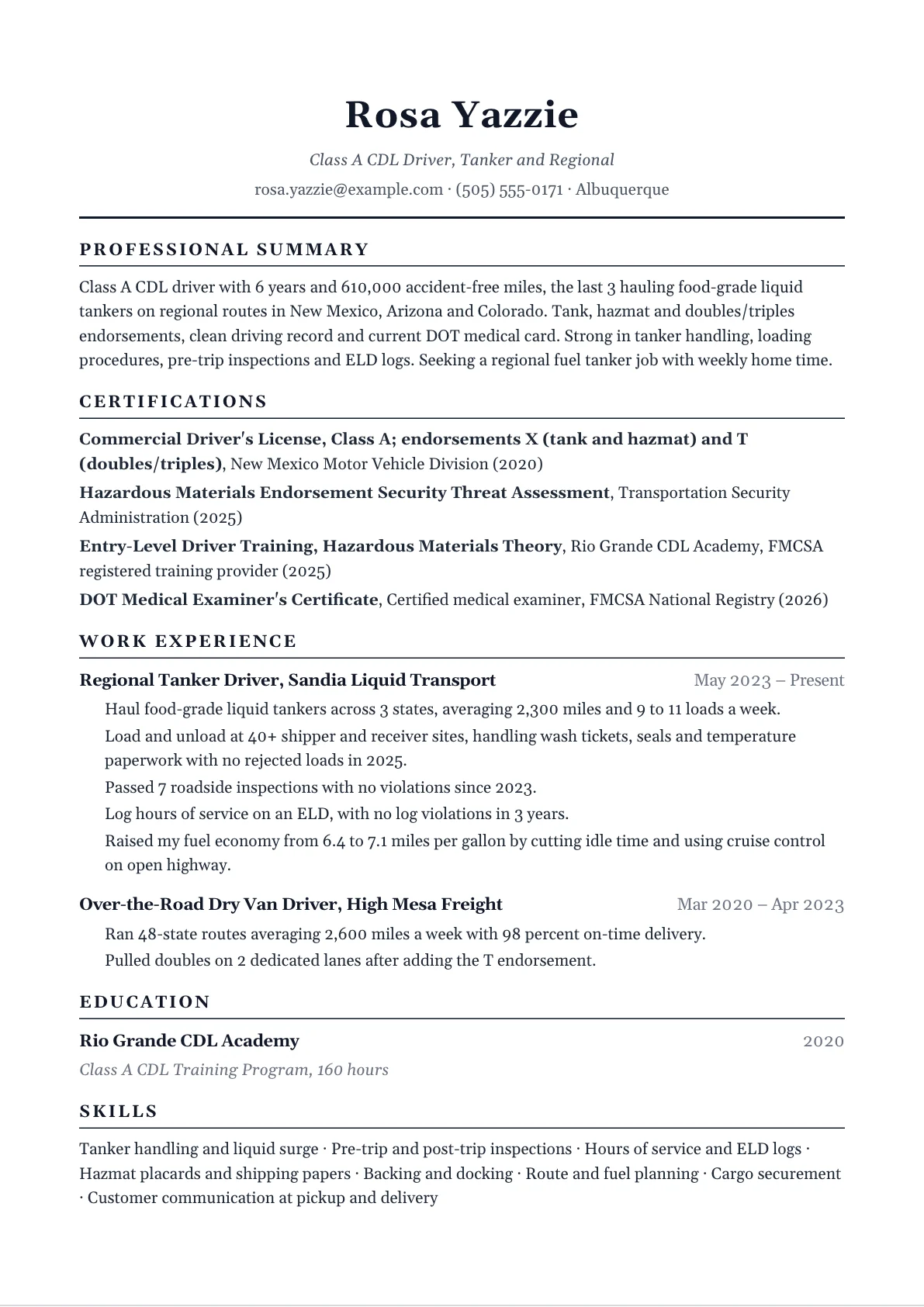
Fictional example: a Class A CDL driver with 6 years of experience, the last 3 in regional food-grade tankers, applying for a regional fuel tanker driver job. Names and career details in the samples are invented for illustration.

Why this resume works

  • The fictional sample separates license class and endorsements from food-grade tanker experience.
  • Accident-free mileage, roadside inspections and log history are different safety measures.
  • Route, load and equipment details give context without treating training entries as proof of complete fuel-hauling qualification.
Edit & download this resume

Create a free account to edit this example and download a PDF with no watermark. Classic is free; Compact, Creative, and Bold require a Job Search Pass.

A truck driver resume should make license class, endorsements, restrictions, equipment and route experience easy to find. Use supported mileage and safety measures and keep the page consistent with the records supplied through the carrier's application.

This guide covers where the CDL, endorsements and medical card go, how to write driving jobs with miles, loads and inspections instead of drove truck, summaries for new, experienced and specialized drivers, the skills carriers look for, and a full example for a Class A tanker driver in Albuquerque moving into fuel hauling. Driving a van or box truck instead? See the delivery driver resume example.

Truck driver resume example: text version

This is the fictional example shown above in selectable text. Use its structure, then replace every sample detail with your own. The image and editable example use the same resume data.

Rosa Yazzie

Class A CDL Driver, Tanker and Regional

rosa.yazzie@example.com

(505) 555-0171

Albuquerque, NM, US

Summary

Class A CDL driver with 6 years and 610,000 accident-free miles, the last 3 hauling food-grade liquid tankers on regional routes in New Mexico, Arizona and Colorado. Tank, hazmat and doubles/triples endorsements, clean driving record and current DOT medical card. Strong in tanker handling, loading procedures, pre-trip inspections and ELD logs. Seeking a regional fuel tanker job with weekly home time.

Training and certificates

Commercial Driver's License, Class A; endorsements X (tank and hazmat) and T (doubles/triples)

New Mexico Motor Vehicle Division

2020

Hazardous Materials Endorsement Security Threat Assessment

Transportation Security Administration

2025

Entry-Level Driver Training, Hazardous Materials Theory

Rio Grande CDL Academy, FMCSA registered training provider

2025

DOT Medical Examiner's Certificate

Certified medical examiner, FMCSA National Registry

2026

Experience

Regional Tanker Driver

Sandia Liquid Transport

From: May 2023

To: Present

  • Haul food-grade liquid tankers across 3 states, averaging 2,300 miles and 9 to 11 loads a week.
  • Load and unload at 40+ shipper and receiver sites, handling wash tickets, seals and temperature paperwork with no rejected loads in 2025.
  • Passed 7 roadside inspections with no violations since 2023.
  • Log hours of service on an ELD, with no log violations in 3 years.
  • Raised my fuel economy from 6.4 to 7.1 miles per gallon by cutting idle time and using cruise control on open highway.

Over-the-Road Dry Van Driver

High Mesa Freight

From: Mar 2020

To: Apr 2023

  • Ran 48-state routes averaging 2,600 miles a week with 98 percent on-time delivery.
  • Pulled doubles on 2 dedicated lanes after adding the T endorsement.

Education

Class A CDL Training Program, 160 hours

Rio Grande CDL Academy

To: 2020

Skills

Tanker handling and liquid surge

Pre-trip and post-trip inspections

Hours of service and ELD logs

Hazmat placards and shipping papers

Backing and docking

Route and fuel planning

Cargo securement

Customer communication at pickup and delivery
Choose driving evidence for the equipment and route

Match the license, equipment and route to the vacancy. A history of food-grade tankers is relevant to fuel hauling, but it does not establish every task-specific qualification for hazardous cargo.

New CDL driver

List the license actually issued, restrictions and completed training. Separate classroom, range and road practice from paid driving miles. Label a permit accurately rather than presenting it as a full CDL.

Regional or over-the-road driver

Name actual freight, route coverage and equipment. Give a supported mileage period and define on-time performance. Do not imply that faster driving or exceeding work limits is an achievement.

Tanker or specialized freight

Explain relevant handling, paperwork and site procedures within your training. Rosa's food-grade experience includes wash tickets and seals. Her endorsement and theory entries should not be used to imply completed employer-specific fuel-hauling qualification.

Trainer or lead driver

State the training responsibilities and approval actually held. Operating experience does not automatically make someone an instructor or authorize every equipment evaluation.

Make the inspection claim precise

Too broad: Perfect safety record.

Better, from the fictional sample: Passed 7 roadside inspections with no violations since 2023.

The revision identifies a count and period. It is separate from accident-free mileage, log compliance and cargo claims. It does not establish that every aspect of the driving record was reviewed or that future trips are risk-free.

Truck driver pay and job outlook

Official figures for Heavy and Tractor-Trailer Truck Drivers.

Median pay (2025)
$58,640 per year ($28.19 per hour)
Jobs in 2025
2,221,200
Job outlook, 2025 to 2035
4%, as fast as average
Change in jobs, 2025 to 2035
+83,800
Typical entry-level education
Postsecondary nondegree award
On-the-job training
Short-term on-the-job training

These figures are for heavy and tractor-trailer truck drivers, the drivers who need a CDL; delivery and light truck drivers are counted separately.

Sources: U.S. Bureau of Labor Statistics, Occupational Outlook Handbook: Heavy and Tractor-Trailer Truck Drivers, checked October 2026; O*NET OnLine: Heavy and Tractor-Trailer Truck Drivers, checked September 2026.

How to write a truck driver resume

1

Name the actual license and route

Match class, equipment and freight experience to the vacancy without inventing endorsements or unrestricted operation.

2

Verify current qualifications

Check endorsements, restrictions and applicable medical status through the authority and employer, not only a training year.

3

Give mileage with a period

Separate career, job and training mileage and define accident-free or on-time measures accurately.

4

Explain freight and site work

Describe loading, inspection, paperwork and dispatch tasks within actual training and authority.

5

Prepare consistent history

Use accurate month/year entries and supply the carrier's required history separately. A resume is not a substitute for all application records.

6

Inspect the application

Follow requested format and limits, protect license and medical details, and review the complete PDF.

Skills and keywords for a truck driver resume

These skills come up most often in CDL driver postings for over-the-road, regional and local jobs. Use the ones that fit the equipment and freight you know.

Hard skills

  • Pre-trip, en-route and post-trip inspections
  • Hours of service and electronic logging devices
  • Backing, docking and tight-space maneuvering
  • Cargo securement (straps, chains, tarps)
  • Tanker handling and liquid surge
  • Reefer temperature monitoring
  • Hazmat placarding and shipping papers
  • Mountain and winter driving
  • Route planning and fuel stops
  • Bills of lading and delivery paperwork

Soft skills

  • Patience and calm in traffic and delays
  • Clear check-ins with dispatch
  • Courtesy with shippers and receivers
  • Self-discipline on long runs alone
  • Following company safety rules every time
  • Problem solving on the road

Tools and software

  • Electronic logging devices such as Samsara or Motive
  • Truck GPS and route apps
  • Fleet messaging tablets
  • Fuel cards and expense apps
  • Tire gauges and inspection tools
  • Load straps, chains, binders and tarps

Truck driver resume summary examples

These fictional openings illustrate different backgrounds. Replace the details with your own license, route and supported record.

New CDL driver

New Class A CDL driver with completed provider training and supervised road practice. Lists actual endorsements and restrictions and seeks a carrier role with an appropriate finishing program.

Experienced OTR driver

Over-the-road driver experienced in dry-van routes, trip planning and dispatch communication. Explains mileage and delivery measures with their periods and maintains accurate inspection and log records.

Specialized or lead driver

Tanker driver experienced in loading paperwork, site procedures and liquid handling within assigned training. Describes current license status and any approved mentoring duties separately from broader instructor qualification.

Truck driver resume bullet examples

These fictional bullet illustrations cover different routes and equipment. Replace every figure and responsibility with your own verified history; distinguish measured results from estimates.

  • Drove 125,000 miles a year on OTR dry van routes with 99 percent on-time delivery.
  • Delivered to 12 to 15 grocery stores a day on a local Class A route, unloading with a pallet jack.
  • Hauled refrigerated produce across 11 western states, keeping trailer temperatures within spec on every load.
  • Secured and tarped 500+ flatbed loads of steel and lumber with no cargo claims.
  • Trained 18 new drivers during their first 4 weeks on the road as a company driver trainer.
  • Earned the carrier's 1 million safe mile award in 2024.
  • Passed 12 DOT roadside inspections over 3 years with no out-of-service violations.
  • Cut idle time from 30 to 12 percent by using the auxiliary power unit, saving about $4,000 in fuel a year.
  • Ran a dedicated lane for a beverage distributor, averaging 5 drops a day with a 26-foot trailer and no damaged product.
  • Kept hours-of-service logs on an ELD with no violations across 4 years of audits.
  • Handled pickups at 3 ports with a TWIC card, cutting wait times by pre-booking appointments.

CDL, endorsements and medical card for truck drivers

State the license class, issuing state, actual endorsements, restrictions and current status. Verify the vehicle and operation with the licensing authority and employer. A training date alone does not prove a current credential.

  • FMCSA's driver guide defines classes using vehicle weight or rating, configuration and certain passenger or hazardous-material operations. X combines tank and hazmat endorsements; T covers double/triple trailers. Restrictions remain important. Use the official definitions rather than assuming every box truck or tanker has the same class.
  • ELDT guidance covers first Class A/B, B-to-A upgrades and first H/P/S endorsements, with grandfathering and specified exceptions. Registered-provider training precedes the applicable test, with hazmat theory before the knowledge test. Rosa's 2020 base CDL and later hazmat training are distinct entries.
  • Medical requirements depend on operation and self-certification category, with state requirements relevant to intrastate work. Where a DOT examination is required, the National Registry examiner may issue a certificate for up to 24 months or a shorter period. Check the actual expiry, not only the award year.
  • For hazmat, check current TSA enrollment guidance and state licensing status. The threat assessment and endorsement are separate from a training certificate. Transfer arrangements can recognize a still-valid assessment; do not assume every transfer needs a new assessment.

The example, line by line

Rosa is a fictional Albuquerque driver. Her dry-van role runs from March 2020 to April 2023, followed by regional tankers from May 2023. Six years overall and about three in tankers fit that chronology as reviewed in October two thousand twenty-six.

The 610,000 accident-free miles are an overall career measure, not all tanker miles. Current averages are 2,300 miles and 9 to 11 loads weekly across 3 states. Earlier dry-van work averaged 2,600 miles weekly on 48-state routes with 98 percent on-time delivery. Those periods and equipment scopes should remain separate.

Work at 40+ shipper and receiver sites is not a count of unique customers or weekly stops. No rejected loads refers to 2025. The 7 roadside inspections without violations since 2023 and 3 years without log violations are distinct from accident history.

Fuel economy moved from 6.4 to 7.1 miles per gallon. The sample names reduced idling and open-highway cruise use but gives no measurement period, annual fuel value or matched operating conditions. Do not invent those outcomes.

The CDL entry uses 2020 for the base license, while the TSA assessment and hazmat theory entries use 2025. They do not independently verify endorsement issuance, status or complete fuel-hauling training. The 2026 medical-certificate entry supplies no expiry date, so an actual applicant should verify current validity.

The earlier job includes doubles on 2 dedicated lanes and the school entry states a 160-hour program. School hours are not a mileage total or a universal training-hour requirement. Keep license numbers, private records and medical details out of public examples.

Mistakes that cost truck drivers interviews

  • Treating classroom or supervised practice as paid career mileage inflates experience.
  • Calling one inspection count a perfect safety record combines different measures.
  • Assuming a medical-certificate year proves current validity ignores the actual expiry.
  • Presenting theory training or a threat assessment as complete employer-specific cargo qualification overstates readiness.
  • Hiding restrictions or changing dates makes the resume inconsistent with verification records.
  • Adding private medical reasons for a gap gives information the resume usually does not need. Supply required history accurately through the carrier's application.

Other trades and transport resume examples close to this one:

Every example is in the resume examples hub, grouped by job and situation.

Build it free, no watermark

Create a free CVPoet account before editing. Start from this example in the free Classic template or start a blank page, and download a PDF with no watermark. Compact, Creative, and Bold are available with a Job Search Pass.

Frequently asked questions

What belongs on a truck driver resume?

State actual license class, endorsements, restrictions, equipment and route experience. Add supported mileage and distinct safety measures, relevant training and accurate employment dates.

How do I apply as a new CDL driver?

List the license actually issued and completed training, with supervised practice separate from paid experience. Use relevant delivery or equipment work without inventing commercial miles.

How do I list X and T endorsements?

Give the actual letter and name with the issuing state. X combines tank and hazmat; T covers double/triple trailers. Include restrictions and verify current status.

Does ELDT apply to every experienced driver?

No. Check FMCSA's first-license, upgrade and endorsement scope, grandfathering and exceptions. A later first hazmat endorsement can have requirements separate from an older base CDL.

Does a medical-certificate year prove it is current?

No. Check actual expiry and the requirements for the operation and self-certification category. A certificate can be issued for less than the maximum period.

Does food-grade tanker work prove fuel-hauling qualification?

It is relevant experience, but describe actual cargo, handling and training. Endorsements, a threat assessment and theory training do not by themselves establish every employer-specific qualification.

Should I include accident-free miles?

Use them when supported and define the period and scope. Keep career mileage separate from a single role, roadside inspection results and log history.

How do I explain work-history gaps?

Give accurate dates and complete required carrier application history. A short neutral explanation may help when relevant; private medical or family details usually do not belong on a public resume.

What if I do not know a precise performance number?

Use a specific task, equipment type or responsibility you can support. Do not invent mileage, inspection counts or fuel savings merely to add a metric.

How do I edit Rosa's example?

Create a free CVPoet account and choose Classic. Replace the fictional dates, license and safety claims, save with Update and inspect the PDF and requested application format.

Build your truck driver resume now

Start from Rosa's example or a blank page. Free, a free account is required to edit, and the PDF has no watermark.

Build your resume, free
Truck driver resume example
Truck driver resume example The example above as an image, to save or share. To change it, use Edit & download this resume at the top of the page. Open the full-size image
Premium

More ways to make your CV yours

Unlock all three premium designs with a Job Search Pass. Your written content stays exactly as it is. Classic is always free.

Included with your pass

$12 once for 30 days

No subscription. Nothing renews. A 90-day pass is also available.

See Job Search Passes

Pass options open in a new tab. Your draft stays here.