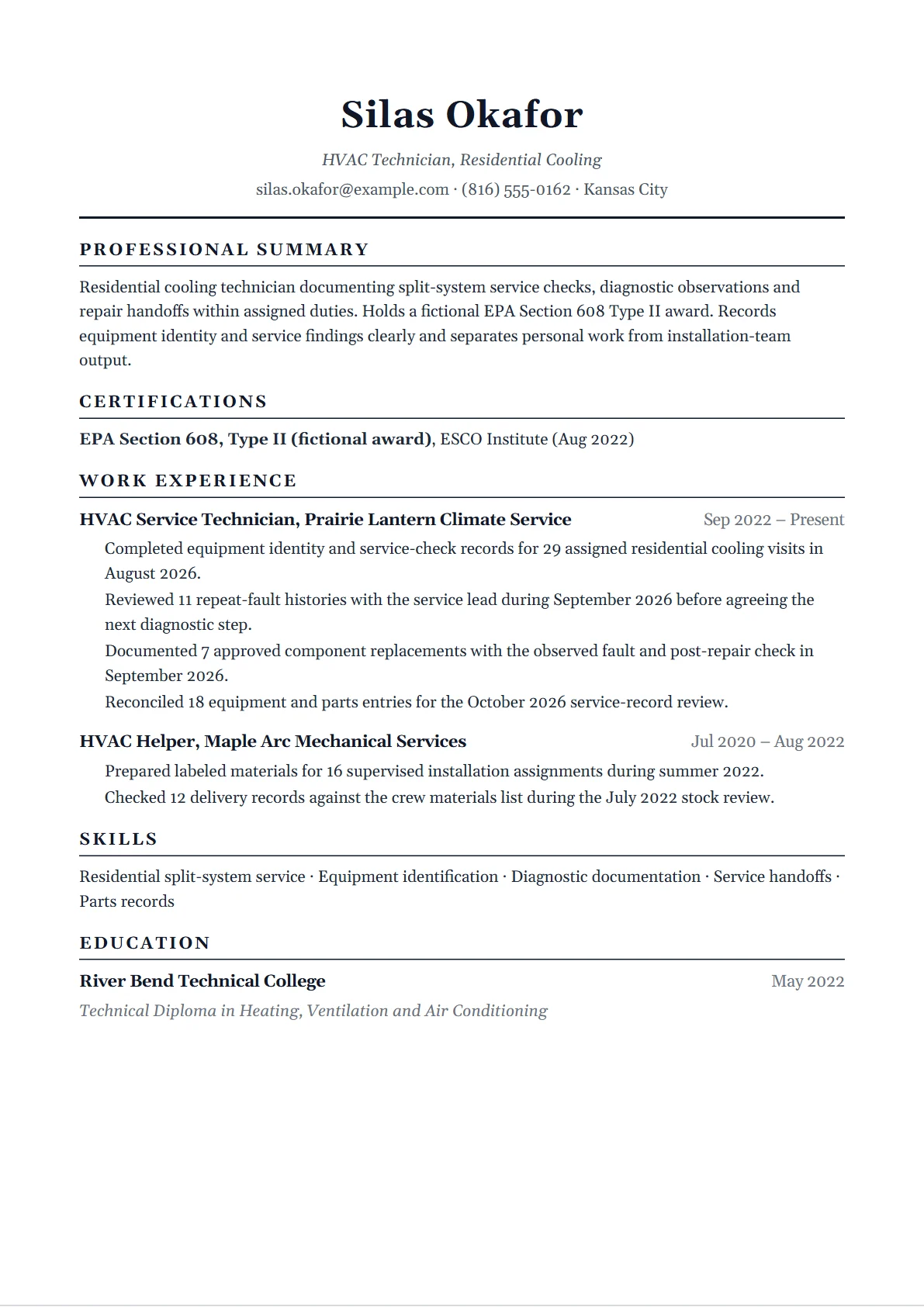
Service direction: Silas is presented as a residential cooling technician. The summary does not claim commercial chillers, building automation, boilers or every refrigerant system. That choice makes the sample useful for a defined opening while leaving room for a real applicant to substitute the equipment they actually know.
Career dates: helper work runs from July 2020 through August 2022. The fictional technical diploma ended in May 2022 and the Type II award is dated August 2022. The service-technician role starts in September 2022. Earlier materials work is not counted as independent service experience, and school attendance is not presented as a completed registered apprenticeship.
Qualification line: the resume names EPA Section 608 Type II and a fictional award through ESCO Institute. The award belongs only to the invented example. No genuine certification record has been verified for this applicant. The line does not imply Universal coverage, a Missouri contractor credential, local authorization or mastery of every system. Real applicants should reproduce their own actual record and confirm what the position requires.
Visit and review measures: 29 August 2026 visits produced equipment and service-check records. Eleven September repeat-fault histories were reviewed with the service lead. Those are records and reviews, not an independently measured first-time fix rate or proof that repeat faults disappeared. Seven September replacements name approved component work and the final check without asserting a universal diagnosis.
Supporting tasks: 18 October equipment and parts entries describe record reconciliation. Sixteen supervised installation assignments and 12 delivery records belong to the earlier helper role. They are not 16 systems personally installed and commissioned. Keep crew contribution and final responsibility visible in your own application.
Worked revision: explain the diagnostic contribution
A separate fictional draft says, "Solved every cooling fault on the first visit." The available evidence shows a repeated fault history reviewed with the lead technician and an agreed next check. A more accurate version is, "Reviewed the repeated fault history with the service lead and documented the agreed diagnostic follow-up." It tells the reader what changed in the work without manufacturing a successful repair or a percentage.
When a callback figure is available
Before using it, ask what counts as a callback. Does the report include a return for a delayed part, a separate fault or a customer-requested adjustment? Check which visits and technicians belong in the denominator and whether the review period is comparable. Use the organization's actual definition and explain your share of the result. Without that evidence, use task records, service decisions and supervisor-reviewed work instead.
Service documentation can also contain private addresses, entry details and customer contact information. Do not attach raw work orders to an application. Explain a representative assignment without identifying the property or exposing proprietary procedures. A resume is evidence of experience, not a substitute for practical assessment, workplace training or the permissions required for the job.