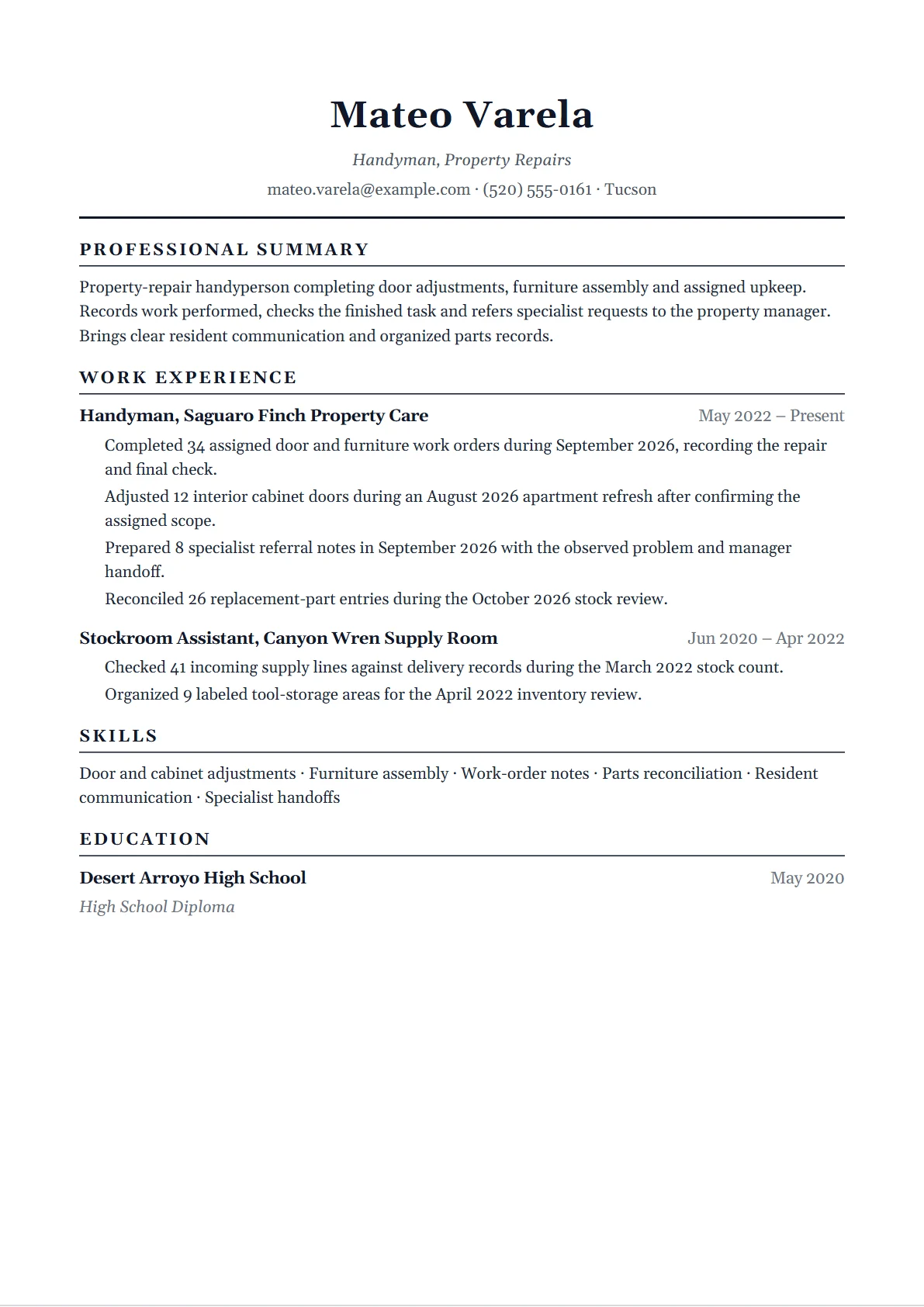
Target and chronology: Mateo finished his fictional high school diploma in May 2020. Stockroom work runs from June 2020 through April 2022, followed by the handyman role from May 2022. The summary describes property-repair work without counting the entire stockroom period as repair experience. No business ownership or specialist license is invented to strengthen the opening.
Personal completed work: the 34 September 2026 work orders describe assigned door and furniture tasks. They do not identify 34 distinct customers, properties or successful first visits. Some repairs could involve more than one visit or item. Use a count only at the level your records actually support, and do not turn a closed ticket into a customer-satisfaction result.
A separate assignment: the 12 cabinet doors belong to an August apartment refresh. They are components adjusted, not 12 full kitchen renovations. The bullet retains the scope check rather than claiming design, structural or installation responsibility. That specificity gives the reader a useful question to ask in an interview.
Referral and parts records: eight September referral notes are not completed specialist repairs. The notes document what Mateo observed and handed to the manager. Twenty-six October parts entries are inventory records, not additional repair jobs. Keeping those units separate avoids inflating output by adding unlike activities together.
Earlier work: 41 incoming supply lines and nine storage areas belong to the stockroom position. They show organization and record checking under that title. Neither count establishes a trade qualification or a repair outcome. The skills section reflects tasks visible in these entries, and the education section claims only a completed diploma.
Worked revision: make the repair claim checkable
A separate fictional draft says, "Fixed every building problem and reduced costs by half." The available record shows a sticking cabinet door, an assigned adjustment and a final operation check. A defensible revision is, "Adjusted the cabinet door within the assigned repair scope and recorded the final operation check in the work order." It provides a concrete action without inventing cost savings or claiming expertise in every building system.
How self-employed work differs
If you genuinely worked for yourself, use a clear self-employed label, your actual service name if relevant and honest dates. Describe representative permitted work and how you agreed the scope, quoted the job and documented completion. Do not name a private household as an employer without permission. Keep subcontractor tasks and business-wide revenue separate from repairs you personally completed. A short permitted project description can be more useful than a broad list of trades.
When choosing supporting photographs, obtain the appropriate permission and remove private addresses, access arrangements and identifying details. Explain what the picture shows and what your contribution was. Before-and-after images do not automatically prove savings, compliance or long-term performance. If permission is unavailable, explain the task in words rather than sharing restricted records.