Supply Chain Analyst Resume: Examples (2026)

Supply Chain Analyst resume example with role-specific skills, summaries, work bullets and practical writing advice. Edit the free Classic template.

Template:

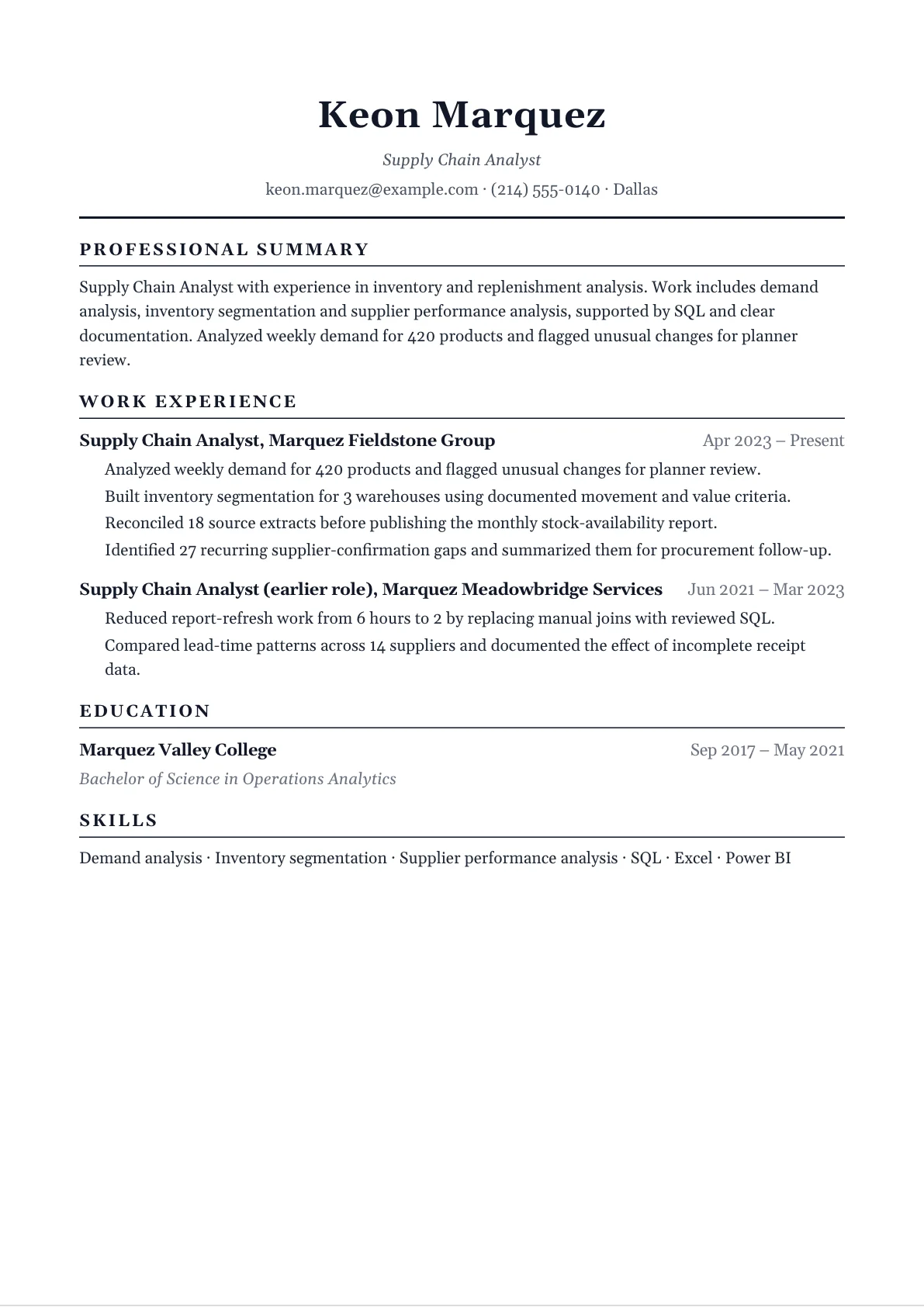
Fictional supply chain analyst candidate in Dallas, TX, applying for work in inventory and replenishment analysis.

Why this resume works

  • The fictional example gives product, warehouse and supplier scopes without claiming operational management.
  • Source reconciliation and incomplete receipt data make the validation work visible.
  • The report-refresh comparison describes analyst work rather than an unverified financial outcome.
Edit & download this resume

Create a free account to edit this example and download a PDF with no watermark. Classic is free; Compact, Creative, and Bold require a Job Search Pass.

Editorial date: October 4, 2026.

A supply chain analyst resume should explain the data question, checks and operational recommendation. Show what you analyzed and who used it, rather than letting dashboard counts imply that you controlled procurement or fulfillment decisions.

Fictional sample: replace Keon Marquez's employers, education and results with your own verified history.

Supply chain analyst resume example: text version

This is the fictional example shown above in selectable text. Use its structure, then replace every sample detail with your own. The image and editable example use the same resume data.

Keon Marquez

Supply Chain Analyst

keon.marquez@example.com

(214) 555-0140

Dallas, TX, US

Summary

Supply Chain Analyst with experience in inventory and replenishment analysis. Work includes demand analysis, inventory segmentation and supplier performance analysis, supported by SQL and clear documentation. Analyzed weekly demand for 420 products and flagged unusual changes for planner review.

Experience

Supply Chain Analyst

Marquez Fieldstone Group

From: Apr 2023

To: Present

  • Analyzed weekly demand for 420 products and flagged unusual changes for planner review.
  • Built inventory segmentation for 3 warehouses using documented movement and value criteria.
  • Reconciled 18 source extracts before publishing the monthly stock-availability report.
  • Identified 27 recurring supplier-confirmation gaps and summarized them for procurement follow-up.

Supply Chain Analyst (earlier role)

Marquez Meadowbridge Services

From: Jun 2021

To: Mar 2023

  • Reduced report-refresh work from 6 hours to 2 by replacing manual joins with reviewed SQL.
  • Compared lead-time patterns across 14 suppliers and documented the effect of incomplete receipt data.

Education

Bachelor of Science

Operations Analytics

Marquez Valley College

From: Sep 2017

To: May 2021

Skills

Demand analysis

Inventory segmentation

Supplier performance analysis

SQL

Excel

Power BI

Choose a supply chain analysis story with a decision path

A useful analyst example connects an operational question, checked data and a recommendation. The method matters, but so does explaining who made the eventual inventory or supplier decision.

First analyst application

Use a clearly labeled academic or personal project with a fictional or permitted dataset. Explain the question, units, missing values and one check before showing the recommendation. A classroom model is not a live implementation or a realized saving.

Inventory and replenishment

Describe movement, availability and value definitions consistently across locations. Keon's segmentation spans warehouses; it does not establish that he managed their staff or approved every replenishment order.

Demand planning

Identify the product and time level, source period and comparison used. Distinguish sales history, demand assumptions and a forecast. A more attractive dashboard alone does not demonstrate forecast accuracy or fewer stockouts.

Supplier analysis

Separate missing confirmations and incomplete receipts from verified delivery failures. State which date or status you checked and how procurement used the finding. Do not label every data gap a supplier delay.

Show the reporting change precisely

Too broad: Automated reports and saved the business time.

Better, from the fictional sample: Reduced report-refresh work from 6 hours to 2 by replacing manual joins with reviewed SQL.

The revision gives an observed refresh comparison and a method. It does not establish daily frequency, annual labor savings or fewer stockouts. Explain those separately only if measured.

Supply Chain Analyst occupation reference

Official figures for Logisticians.

O*NET classification
13-1081.00

The supply chain analyst example uses this related occupation as background. Its scope can be broader; no salary is inferred.

Source: O*NET OnLine occupational profile 13-1081.00, checked October 2026.

How to write your supply chain analyst resume

1

Choose the operational question

Name the inventory, demand, replenishment or supplier problem and its product, location and time scope.

2

Explain the data checks

Identify sources, units, missing values and join or reconciliation checks rather than only naming SQL.

3

Connect analysis to a decision

State what you recommended, who approved action and whether the result was proposed or measured.

4

Separate the measures

Distinguish products, extracts, reports and suppliers. Define the period and do not annualize without frequency.

5

Select relevant tools and training

List methods and platforms actually used, with completed credentials separate from courses in progress.

6

Review permitted evidence

Use fictional or authorized portfolio data, check links and application format, and inspect the full PDF.

Skills for your supply chain analyst resume

Explain joins, validation and reporting logic in SQL or spreadsheets so a hiring manager can see how you checked the inputs.

Hard skills

  • Demand analysis
  • Inventory segmentation
  • Supplier performance analysis

Soft skills

  • Clear handoffs: Show communication with planners, buyers and warehouse staff; a technically correct report is more useful when its limitations and action are understood.
  • Evidence and judgment: Separate a recommendation's estimated effect from an implemented result, and identify the decision owner where operational action belonged to another team.

Tools and software

  • SQL
  • Excel
  • Power BI

Supply chain analyst resume summary examples

These fictional openings illustrate different backgrounds. Replace the details with your own evidence and keep project work distinct from employment.

Early career

Supply chain analyst applicant with an operations analytics project using a fictional inventory dataset. Documents movement categories, checks missing receipts and explains replenishment assumptions before presenting recommendations.

Experienced

Supply chain analyst experienced in inventory segmentation and recurring stock reporting. Uses SQL and spreadsheet checks to reconcile inputs, flags unusual demand changes and communicates data limitations to planners.

Greater responsibility

Supply chain analyst coordinating reporting definitions with planning, procurement and warehouse teams. Separates proposed parameter changes from approved actions and follows up on how recommendations are evaluated.

Supply chain analyst resume bullet examples

Illustrative supply chain analyst bullets. Replace every example figure with your own evidence.

  • Analyzed weekly demand for 420 products and flagged unusual changes for planner review.
  • Built inventory segmentation for 3 warehouses using documented movement and value criteria.
  • Reconciled 18 source extracts before publishing the monthly stock-availability report.
  • Identified 27 recurring supplier-confirmation gaps and summarized them for procurement follow-up.
  • Reduced report-refresh work from 6 hours to 2 by replacing manual joins with reviewed SQL.
  • Compared lead-time patterns across 14 suppliers and documented the effect of incomplete receipt data.
  • Prepared 8 replenishment scenario summaries with assumptions and service-risk notes.
  • Investigated 35 stock discrepancies with warehouse teams and separated timing differences from record errors.
  • Maintained a dashboard of 7 agreed supply measures with documented definitions and source owners.
  • Reviewed 90 slow-moving items for a quarterly inventory discussion without assuming every item was obsolete.
  • Supported 4 planning workshops with product-level analysis and tracked recommendation decisions separately.
  • Documented validation checks for 12 recurring data fields used in supply reporting.

Supply Chain Analyst credential checks

List completed education and credentials accurately and compare them with the vacancy. Keon's fictional sample contains an Operations Analytics degree and no certification, so the guide does not imply that he holds CPIM, CSCP or another credential.

  • O*NET's Logisticians profile provides related occupational background. Its broader responsibilities do not establish every analyst's purchasing, supervisory or compliance authority.
  • A course completion certificate and a professional certification are distinct. Verify the issuer, current award name and status before listing one as earned.
  • Use relevant projects to demonstrate methods you can explain. A tool keyword or credential alone does not establish competence in every planning system or guarantee employment.

The example, line by line

Keon is a fictional Dallas analyst. His Operations Analytics degree ends in May 2021, the earlier analyst role runs from June 2021 to March 2023, and the current role begins in April 2023. The education and employment dates form a consistent progression.

The weekly analysis covers 420 products and flags unusual changes for planner review. It does not claim every change was an error or that Keon owned purchasing. Segmentation spans 3 warehouses using movement and value criteria; that is an analytical scope, not a staff-management claim.

The 18 source extracts are reconciled before a monthly stock-availability report. They are not 18 monthly reports. The 27 recurring confirmation gaps are summarized for procurement follow-up, not proven to be late deliveries or already resolved exceptions.

Refresh work fell from 6 hours to 2 using reviewed SQL joins. The sample gives no run frequency, so do not multiply the difference into an annual saving. The 14-supplier lead-time comparison explicitly notes incomplete receipt data, which limits conclusions about vendor performance.

SQL, Excel and Power BI are stated tools. The sample does not establish particular ERP platforms, forecasting models or certifications. A portfolio should explain permitted methods and checks while keeping forecasts, supplier terms and margins private.

Choose stronger supply chain analyst evidence

Choose an analysis with a decision path. Explain the operational question, the source checks and the recommendation made to planners or buyers. A useful dashboard should make a constraint visible, but building it is different from owning the eventual stock or supplier decision.

Check the meaning of timestamps and status fields. An order date, promised date, receipt date and system-entry date may describe different events. Treat missing or late data explicitly rather than turning it into a supplier performance conclusion. If you compare inventory across locations, use consistent units and clarify whether the data reflects available, reserved or total stock.

A portfolio case can use fictional products and documented assumptions. Show the baseline, a simple validation and the tradeoff behind the recommendation. Do not present a proposed parameter change as an achieved improvement unless someone implemented and measured it. At interview, explain one instance when operational feedback changed your analysis. That demonstrates an ability to connect data to real work rather than simply produce a chart. Keep forecasts, product margins and negotiated supplier terms private; the reasoning can be illustrated without publishing the business's planning data.

Mistakes that weaken your supply chain analyst application

  • Calling a recommendation a realized saving hides whether it was implemented and measured.
  • Mixing order, promised, receipt and system-entry dates can misstate supplier performance.
  • Counting products or warehouses as people managed changes analytical scope into authority.
  • Annualizing a refresh-time reduction without run frequency invents a larger outcome.
  • Listing every ERP or analytical language obscures the tools you actually used.
  • Publishing confidential forecasts, margins or supplier terms exposes data the resume does not need.

Identify the planning question and data scope, such as replenishment, supplier timing or inventory segmentation, instead of using analysis as a vague label.

Every example is in the resume examples hub, grouped by job and situation.

Build it free, no watermark

Create a free CVPoet account before editing. Start from this example in the free Classic template or start a blank page, and download a PDF with no watermark. Compact, Creative, and Bold are available with a Job Search Pass.

Frequently asked questions

What should a supply chain analyst resume emphasize?

Connect an operational question to checked data, a method and a recommendation. Show who used the work and distinguish analytical support from the authority to buy, schedule or manage staff.

Can I apply with a college project?

Yes, label it as academic or personal work and explain the dataset, assumptions and checks. Do not present a fictional inventory model as live employer results or realized savings.

How do I show SQL experience?

Explain a relevant join, validation or reporting task and how you checked the output. Naming SQL without a task does not show whether the analysis was reliable.

Should I include Power BI or Excel?

Include tools you actually used and connect them to the decision or report. The sample lists both, but it does not establish experience with every advanced function or enterprise platform.

How do I describe inventory segmentation?

State the location and product scope, criteria and how planners used the categories. Keep analytical recommendations distinct from operational management or purchasing approval.

Can supplier data gaps count as an achievement?

Yes, explain what you identified and how it was escalated. Missing confirmations or incomplete receipts are not automatically evidence of late delivery, and follow-up is not the same as resolution.

How do I report forecast accuracy?

Use a defined measure, comparison period and product level with appropriate checks. Distinguish actual measured accuracy from a model proposal and avoid claiming that a dashboard alone improved demand planning.

Can I turn time saved into annual savings?

Only when the run frequency, measurement and calculation support it. Keon's refresh comparison supplies no frequency, so it does not establish an annual labor or monetary saving.

Do I need to publish business data in a portfolio?

No. Use a fictional or authorized dataset and explain the method, limitations and recommendation. Keep confidential demand forecasts, product margins and negotiated supplier terms private.

How do I edit this fictional example?

Create a free CVPoet account and choose Classic. Replace Keon's history, tools and figures, save with Update and inspect the PDF before applying.

Build your supply chain analyst resume

Edit the fictional inventory and replenishment analysis example in free Classic.

Build your resume, free
Supply Chain Analyst resume example
Supply Chain Analyst resume example The example above as an image, to save or share. To change it, use Edit & download this resume at the top of the page. Open the full-size image
Premium

More ways to make your CV yours

Unlock all three premium designs with a Job Search Pass. Your written content stays exactly as it is. Classic is always free.

Included with your pass

$12 once for 30 days

No subscription. Nothing renews. A 90-day pass is also available.

See Job Search Passes

Pass options open in a new tab. Your draft stays here.