Recruiter Resume: Examples (2026)

Recruiter resume example for agency and in-house recruiters, with summaries, bullets, skills, optional certifications, official pay and a free template.

Template:

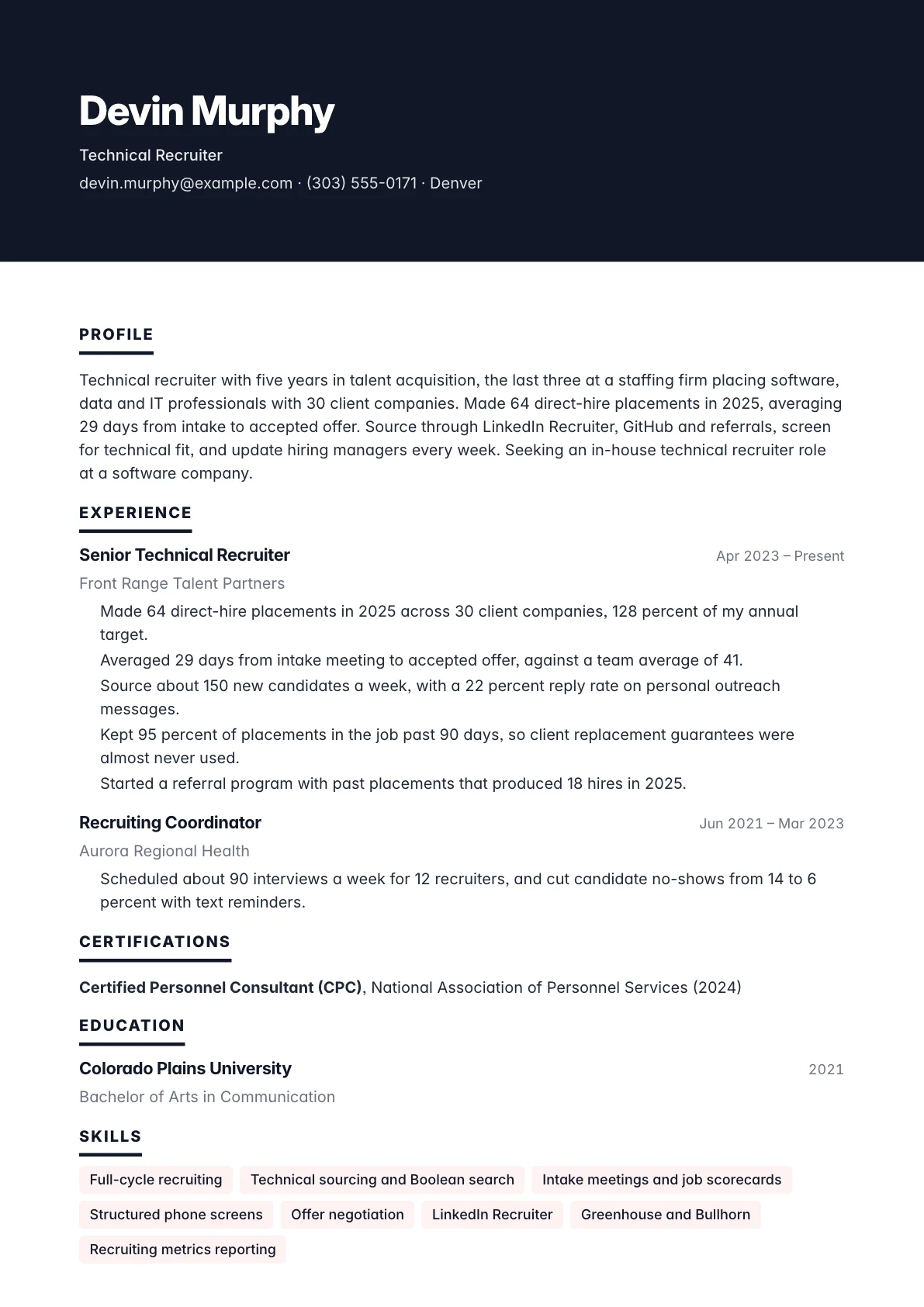
A technical recruiter at a staffing firm, applying for an in-house technical recruiter job at a software company.

Why this resume works

  • Placements come first with a target attached: 64 direct hires in 2025 at 128 percent of target, the number every talent leader asks for in the first call.
  • Speed and quality sit side by side: 29 days from intake to accepted offer against a team average of 41, and 95 percent of placements still in the job after 90 days.
  • Experience comes before the certification in this example, because recruiting managers hire on results first; the CPC is listed after as supporting proof.
Edit & download this resume

Edit it in the free builder, then download the PDF with no watermark. A free account is only needed to download.

Recruiters read more resumes than anyone, so yours will be judged by someone who knows every trick. What a head of talent acquisition or an agency owner wants to see is simple: how many hires you made, for which kinds of roles, how fast, and whether hiring managers and candidates would work with you again. A recruiter resume is closer to a sales resume than to an HR generalist's: it lives on your numbers.

This page shows what goes on a recruiter resume, how to present placements and time to fill, the difference between agency and in-house framing, summary and bullet examples from coordinator to talent acquisition lead, the skills and tools postings ask for, optional certifications, and a full example for an agency technical recruiter moving in-house. If your HR work is broader (employee relations, benefits, policy), see the human resources resume example.

Recruiter pay and job outlook

Official figures for Human Resources Specialists.

Median pay (2025)
$75,940 per year ($36.51 per hour)
Jobs in 2025
939,700
Job outlook, 2025 to 2035
6%, faster than average
Change in jobs, 2025 to 2035
+60,100
Typical entry-level education
Bachelor's degree

The Bureau of Labor Statistics counts recruiters under human resources specialists, so these figures cover HR generalists too.

Sources: U.S. Bureau of Labor Statistics, Occupational Outlook Handbook: Human Resources Specialists, checked September 2026; O*NET OnLine: Human Resources Specialists, checked September 2026.

How to write a recruiter resume

1

Say what kind of roles you recruit for

Technical, healthcare, sales, executive, hourly and high-volume, campus: each is its own skill. Put it in your headline (Technical Recruiter, Healthcare Recruiter) and in the first line of your summary, along with agency or in-house, because the two jobs are measured differently.

2

Lead with hires, not activity

Calls made and resumes screened show effort; hires show results. Give your placements or hires per year, the number of open roles you carried at once, and your performance against target. Agency recruiters can add revenue or fees billed; in-house recruiters can add requisitions closed.

3

Pair speed with quality

Time to fill or time to offer shows you move fast. Offer acceptance rate, 90-day retention and hiring manager satisfaction show the hires were right. A resume with both answers the worry that a fast recruiter cuts corners.

4

Show where your candidates come from

Name the channels you use well: LinkedIn Recruiter, job boards, GitHub or other niche sites, referrals, events, campus programs. Put numbers on one or two: reply rates, referral hires, pipeline built for a hard role. Sourcing skill is what separates strong recruiters.

5

Name your applicant tracking system and tools

In-house teams run Greenhouse, Lever, Workday Recruiting, iCIMS or SmartRecruiters; agencies often use Bullhorn. Add scheduling and assessment tools you use. Use the exact names, because the employer's own hiring software will look for them.

6

Add certifications and education last

No license is needed to recruit, and most teams hire on track record. If you hold a certification, list it after your experience with the issuing body and year. Then your degree and a short skills list. One page is usually right.

Skills and keywords for a recruiter resume

These are the skills recruiter postings name most. Use the ones you can prove, in the posting's words, and put your numbers behind the key ones.

Hard skills

  • Full-cycle recruiting from intake to offer
  • Sourcing with Boolean and X-ray search
  • Intake meetings and writing job descriptions
  • Phone screens and structured interviews
  • Offer negotiation and closing candidates
  • Pipeline and requisition management
  • Recruiting metrics (time to fill, acceptance rate, source of hire)
  • Employer branding and job ad writing
  • Campus and event recruiting
  • Fair and consistent hiring practices

Soft skills

  • Persuasive, honest communication
  • Resilience when candidates or deals fall through
  • Managing hiring manager expectations
  • Reading people quickly and fairly
  • Juggling many open roles at once
  • Keeping candidates informed, even with bad news

Tools and software

  • LinkedIn Recruiter
  • Greenhouse, Lever, Workday Recruiting or iCIMS
  • Bullhorn for agency recruiting
  • Calendly or GoodTime for scheduling
  • Indeed and niche job boards
  • Excel or Looker Studio for recruiting reports

Recruiter resume summary examples

Take the one nearest your level and put in your own facts. Each says what roles you fill, how many and how fast, and what job you want next.

Recruiting coordinator moving up

Recruiting coordinator with two years at a 2,000-employee retailer, scheduling about 70 interviews a week and running phone screens for hourly store roles. Filled 40 seasonal positions on my own during the 2025 holiday peak. Seeking a recruiter or associate recruiter role in high-volume hiring.

Experienced corporate recruiter

In-house recruiter with six years at a regional healthcare system, filling about 90 nursing and allied health roles a year with an 88 percent offer acceptance rate. Built a new-graduate nurse pipeline with 5 nursing schools. Seeking a senior healthcare recruiter role.

Senior recruiter or talent acquisition lead

Talent acquisition lead with eleven years across agency and in-house recruiting, now managing a team of 6 recruiters hiring 400 people a year for a fintech company. Cut average time to fill from 52 to 35 days and moved the team from spreadsheets to Greenhouse. Seeking a head of talent acquisition role.

Recruiter resume bullet examples

Each bullet gives a hiring result with a number. Keep the pattern and use your own figures.

  • Filled 85 requisitions in 2025 across engineering, product and design, carrying up to 20 open roles at once.
  • Raised offer acceptance from 72 to 89 percent by adding a pay range and a hiring manager call before every offer.
  • Billed $610,000 in placement fees in one year, ranking first of 14 recruiters in the office.
  • Hired 120 warehouse associates in 6 weeks for a new site by running 3 on-site hiring events.
  • Built a pipeline of 60 qualified candidates for a hard-to-fill security engineering role, leading to 4 hires.
  • Trained 25 hiring managers in structured interviewing with shared scorecards.
  • Cut the time from application to first screen from 9 days to 2 with an automated scheduling link.
  • Started a campus program with 4 universities that produced 22 intern hires and 15 full-time offers.
  • Raised candidate survey scores from 3.9 to 4.6 out of 5 by sending every applicant a decision within 10 days.
  • Reduced agency spend by $180,000 a year by moving 30 roles to direct sourcing.
  • Ran weekly pipeline reviews with 8 department heads using a shared hiring dashboard.

Certifications for recruiters

No license is required to work as a recruiter, and certifications are optional. They can help if you are moving into recruiting, or if you recruit inside an HR department where HR credentials are common. Recruiters also need to know the rules for fair hiring, such as the EEOC's list of prohibited practices in job ads, recruiting and hiring, and the FTC's guidance for employers that use background reports. As of September 2026:

  • Certified Personnel Consultant (CPC) from the National Association of Personnel Services: a credential for people in talent acquisition and staffing, most common among agency and third-party recruiters.
  • SHRM Certified Professional (SHRM-CP) from the Society for Human Resource Management: a general HR certification with no degree or experience requirement, useful for in-house recruiters inside HR teams.
  • Associate Professional in Human Resources (aPHR) from HRCI: an entry credential that needs no HR experience, a good fit for coordinators moving into recruiting.

The example, line by line

The example is for Devin, a technical recruiter at a staffing firm who wants to recruit in-house for one software company. Here is what each part does.

Headline: Technical Recruiter. Short, and it names the kind of roles he fills.

Summary: five years, three at an agency, 30 client companies and the role families he knows. Then his two best numbers (64 placements and 29 days), his sourcing channels and how he works with managers, and finally the in-house job he wants.

Current job: five bullets, each a different measure. Volume and target first (64 placements, 128 percent). Speed next (29 days against 41). Then sourcing (about 150 candidates a week, 22 percent reply rate), quality (95 percent still there after 90 days) and a program he built (18 referral hires). An in-house team gets proof of every skill it needs.

Earlier job: one coordinator bullet from a health system, including no-shows cut from 14 to 6 percent, which shows he improves processes even in support roles.

Certification, education and skills: the CPC from 2024 after his experience, then his degree and eight skills naming the methods and tools a software company's recruiting team uses.

Mistakes that hold recruiter resumes back

  • Activity instead of hires. Made 80 calls a day is not a result. Lead with placements or hires, then show the activity that got you there if it is impressive.
  • No role type. A recruiter who fills nursing jobs and one who fills engineering jobs are not interchangeable. Name the role families in your headline and summary.
  • Agency words for an in-house job. Fees billed and client development matter to agencies. For in-house roles, add hiring manager partnership, candidate experience and quality of hire.
  • Ignoring quality. Fast hires that leave in two months cost money. Add retention, acceptance rate or manager satisfaction.
  • A resume you would reject yourself. Recruiters notice vague bullets, missing dates and walls of text faster than anyone. Apply your own standards to your page.

Other HR, finance and sales resume examples close to this one:

Every example is in the resume examples hub, grouped by job and situation.

Build it free, no watermark

CVPoet's resume builder is free to use without an account. Start from this example or a blank page, pick one of four ATS-friendly designs, and download a PDF with no watermark on any plan.

Frequently asked questions

What should a recruiter put on a resume?

Contact details, a headline naming the kind of roles you recruit for, a short summary with your hiring numbers, each job with placements or hires, speed and quality measures and sourcing results, any certifications, your education, and skills naming your recruiting methods and systems.

How is a recruiter resume different from an HR resume?

A recruiter resume is measured on hiring: roles filled, time to fill, acceptance and retention of hires, and sourcing. An HR generalist resume is measured on employee relations, benefits, leave, policy and compliance. Both are HR jobs, but the proof is different.

What metrics should a recruiter include?

Hires or placements per year, performance against target, time to fill or time to offer, offer acceptance rate, 90-day retention, reply rates on outreach, referral hires, and for agencies, fees billed.

Do recruiters need a certification?

No. Recruiting has no license and most employers hire on track record. A certification such as the CPC, SHRM-CP or aPHR can help if you are new to recruiting or work inside an HR department.

How do I write a recruiter resume with no recruiting experience?

Lead with sales, customer service or coordinator work where you persuaded, screened or scheduled people, with numbers. Show any hiring you helped with as a team lead or manager, and apply for recruiting coordinator or sourcer roles.

How do I move from agency to in-house recruiting?

Keep your placement numbers, and add what in-house teams value: hiring manager partnership, candidate experience, the applicant tracking systems you know, and quality of hire. Lead your summary with the kind of company you want to join.

Should I list the companies I placed candidates with?

Usually not by name, since client lists can be confidential. Describe them by industry and size, for example 30 software and data companies in Colorado.

How long should a recruiter resume be?

One page for most recruiters. Talent acquisition leaders with long careers across several employers can use two.

Which applicant tracking systems should I list?

Every one you have used, named exactly: Greenhouse, Lever, Workday Recruiting, iCIMS, SmartRecruiters, Bullhorn. Add LinkedIn Recruiter and any scheduling or assessment tools.

What template works for a recruiter resume?

One that makes numbers easy to spot and stays single column. The bold template used for Devin's example gives headings weight without columns or graphics that hiring software might misread.

Build your recruiter resume now

Start from Devin's example or a blank page. Free, no account needed, and the PDF has no watermark.

Build your resume, free
Recruiter resume example
Recruiter resume example The example above as an image, to save or share. To change it, use Edit & download this resume at the top of the page. Open the full-size image