Police Officer Resume: Examples (2026)

Police officer resume example with summaries, bullets, skills and the state certification to list, plus official pay and outlook figures and a free template.

Template:

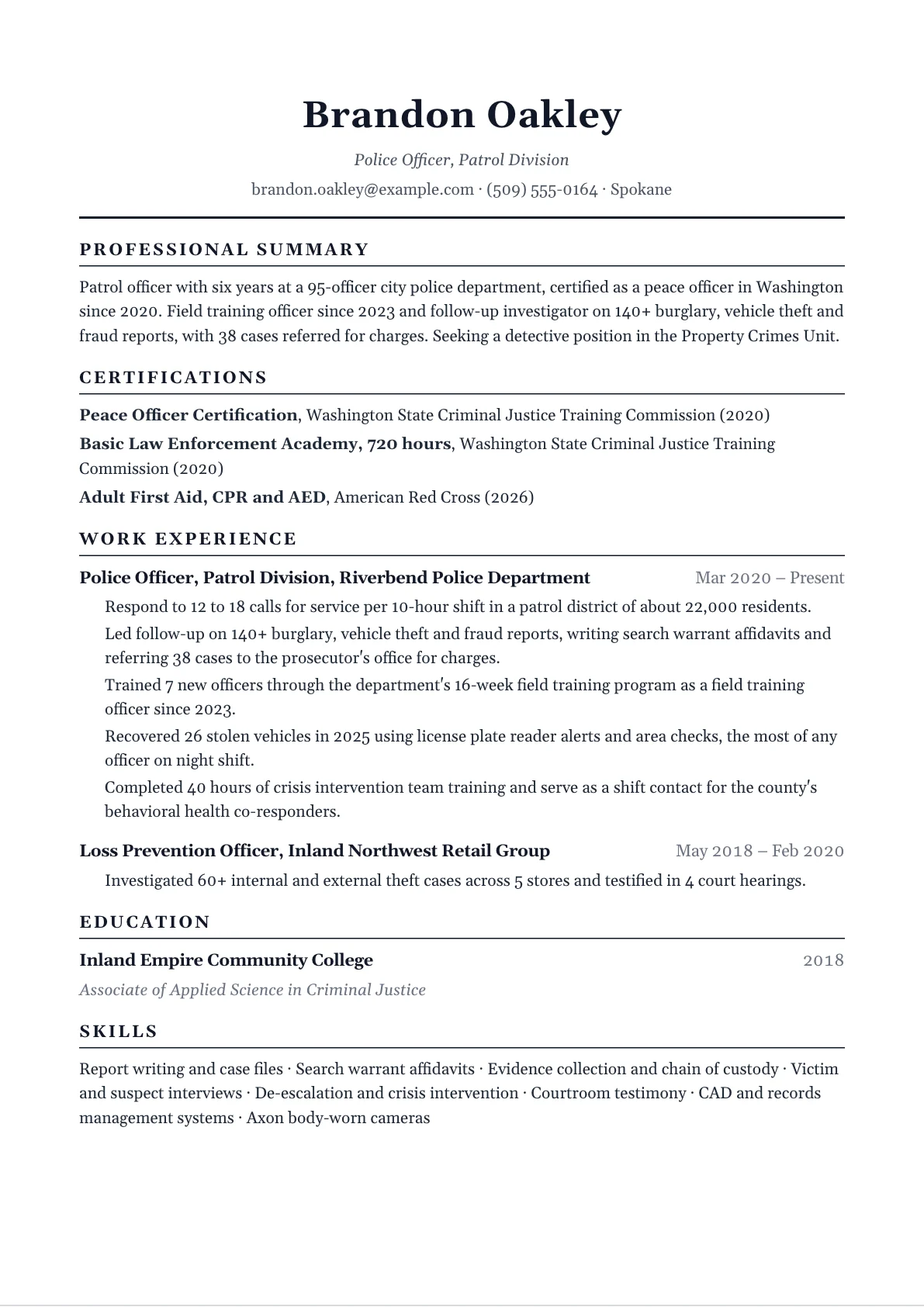
A patrol officer with six years of service applying for a property crimes detective opening in his department.

Why this resume works

  • State certification and the 720-hour academy are listed first, because every oral board and background investigator checks them before anything else.
  • The bullets lean toward investigation, the job he wants: 140+ property crime reports followed up and 38 cases referred for charges, plus 26 stolen vehicles recovered in 2025.
  • Training others (7 new officers as a field training officer since 2023) and crisis intervention work show judgment and trust, which detective selection panels weigh heavily.
Edit & download this resume

Edit it in the free builder, then download the PDF with no watermark. A free account is only needed to download.

Many police departments hire through an application form, a written test, a physical ability test and a background investigation, so it is fair to ask why a police officer needs a resume at all. The answer is that a resume does the work at the points where you are compared with other people: applying to a department that asks for one, moving to another agency as a lateral officer, and competing for a detective, training or specialty assignment. It also becomes the outline for your oral board interview and your background packet, so the dates and details need to be exact.

This guide covers what goes on a police officer resume, where your state certification belongs, summary and bullet examples for academy graduates, patrol officers and supervisors, the skills and systems agencies look for, the certification and training rules and who sets them, and a full example for a patrol officer applying for a detective position. If you are leaving the military for law enforcement, the military to civilian resume guide shows how to translate your service record first.

Police officer pay and job outlook

Official figures for Police and Detectives.

Median pay (2025)
$77,310 per year ($37.17 per hour)
Jobs in 2025
824,200
Job outlook, 2025 to 2035
3%, as fast as average
Change in jobs, 2025 to 2035
+24,200
Typical entry-level education
Varies (see the BLS profile)
Work experience needed
Varies (see the BLS profile)
On-the-job training
Moderate-term on-the-job training

BLS groups police and sheriff's patrol officers with detectives, fish and game wardens, and transit and railroad police as police and detectives.

Sources: U.S. Bureau of Labor Statistics, Occupational Outlook Handbook: Police and Detectives, checked September 2026; O*NET OnLine: Police and Sheriff's Patrol Officers, checked September 2026.

How to write a police officer resume

1

Head the page with your rank, division and target role

Under your name, your current rank and assignment, such as Police Officer, Patrol Division, or Police Officer Candidate if you are applying for your first sworn job. The summary then names the position you want: patrol, lateral officer, detective, school resource officer or another specialty.

2

List your state certification and academy first

Agencies need to know right away whether you are certified or licensed in their state, or can become so. Give the certification, the state body that issued it and the year, then your basic academy with its hours. Add first aid and CPR and any specialty certificates below them. Academy students list the academy with an expected graduation date.

3

Describe patrol work with volume and outcomes

Calls for service per shift, the size or type of your district, arrests, reports written, cases referred for charges, stolen property recovered. Numbers help a panel picture your pace, but choose ones that reflect judgment and service, not quotas. A bullet about cases you carried through to charges says more than a count of tickets.

4

Show investigation, training and trust

Selection panels for specialty jobs look for officers who write strong reports, follow cases through, and are trusted with responsibility. Field training officer duty, crisis intervention work, search warrants written, court testimony and collateral assignments such as evidence technician or defensive tactics instructor all belong in your bullets.

5

Keep every date exact

Your resume will sit beside a background packet that asks for every job, address and date. Use month and year for each position and make sure they match the application. A small mismatch can raise questions in a background investigation that the resume was meant to answer.

6

Finish with education, skills and nothing sensitive

Your degree or college credits (some agencies pay more for them or require them for promotion), then skills such as report writing, interviewing and the records systems you know. Leave off your badge number, case numbers, names of victims or suspects, and anything that is not public.

Skills and keywords for a police officer resume

These skills come up often in police officer and specialty postings. List the ones you use, and show the most important ones in your bullets as well.

Hard skills

  • Patrol procedures and calls for service
  • Report writing and case documentation
  • Search warrant and probable cause affidavits
  • Evidence collection and chain of custody
  • Interviewing victims, witnesses and suspects
  • Traffic enforcement and collision investigation
  • De-escalation and crisis intervention
  • Courtroom testimony

Soft skills

  • Sound judgment under stress
  • Calm, respectful communication with the public
  • Integrity and honesty in reporting
  • Teamwork with other officers and agencies
  • Patience with people in crisis
  • Teaching and mentoring new officers

Tools and software

  • Computer-aided dispatch (CAD) and mobile data terminals
  • Records management systems (RMS) for reports and cases
  • State crime information systems and NCIC queries
  • Body-worn and in-car cameras
  • License plate readers
  • Evidence tracking and digital evidence platforms

Police officer resume summary examples

Pick the summary that matches your stage. Each gives your status, your strongest experience and the role you want.

Academy graduate or entry-level candidate

Recent basic academy graduate with a bachelor's degree in criminal justice and three years as a campus security officer, responding to 10+ calls a shift and writing incident reports for campus police. Bilingual in English and Spanish, with current first aid and CPR. Seeking an entry-level police officer position.

Experienced patrol or lateral officer

Police officer with seven years of patrol experience at a county sheriff's office, including three as a field training officer. Handle a busy rural district alone, with strong skills in collision investigation and domestic violence cases. Certified in my state and seeking a lateral officer position with a city department.

Sergeant or specialty officer

Police sergeant with fourteen years of service, supervising a patrol squad of 9 officers on night shift and leading the department's crisis intervention program. Reviewed use-of-force and pursuit reports for the squad and built a peer support team. Seeking a lieutenant or professional standards position.

Police officer resume bullet examples

Each bullet starts with an action and has a number. Use your own figures, and never include details that identify a case, victim or suspect.

  • Handle 10 to 15 calls for service per shift in a mixed residential and commercial beat.
  • Investigated 90+ traffic collisions a year, including diagramming and measurement for 12 serious injury crashes.
  • Wrote 18 search warrant affidavits in two years, all approved by the reviewing judge.
  • Testified in 25+ court hearings and trials with no cases dismissed for reporting errors.
  • Coordinated with 3 neighboring agencies on a catalytic converter theft series that led to 6 arrests.
  • Served 2 years as a school resource officer for a high school of 1,400 students.
  • Taught defensive tactics to 30+ recruits a year as a certified department instructor.
  • Connected 40+ people in crisis with mental health services during patrol shifts, working with co-responder clinicians.
  • Processed 200+ items of evidence a year, keeping a clean chain of custody for every case sent to the lab.
  • Organized a monthly coffee with a cop meeting that drew 50+ residents and led to a new traffic calming plan.
  • Supervised a squad of 8 officers as acting sergeant for 6 months during a vacancy.

Certification and training for police officers

Every sworn police officer must finish a basic training academy and be certified or licensed by their state. Each state sets its own rules through a Peace Officer Standards and Training body, usually called POST, though the name varies: in Washington it is the Washington State Criminal Justice Training Commission, and in Texas it is the Texas Commission on Law Enforcement. You can find your state's POST agency in the directory kept by IADLEST, the association of state POST directors. The Bureau of Labor Statistics also notes that candidates must usually be at least 21 and pass physical and written exams. Requirements vary by state and agency, so check with the department you want to join. On your resume, list:

  • State peace officer certification or license: required for every sworn officer, issued by your state's POST agency. In Washington, all peace officers are certified through the Criminal Justice Training Commission, which can also suspend or revoke certification.
  • Basic academy: required before you can work alone. Washington's Basic Law Enforcement Academy is 720 hours as of September 2026 and is mandatory for all entry-level peace officers there. Other states set their own length and content.
  • First aid and CPR: basic academies teach first aid, and a current card from a provider such as the American Red Cross is worth listing with its date.
  • Specialty training: field training officer, crisis intervention, firearms or defensive tactics instructor, collision reconstruction or drug recognition. List each with the hours and the agency or academy that delivered it.

The example, line by line

The example is for Brandon, a patrol officer with six years in a mid-size city department who is applying for a detective opening. Here is what each part does.

Headline and summary: the headline states his current assignment. The summary gives six years at a 95-officer department and his Washington certification since 2020, then the two facts a detective panel wants most: field training officer since 2023 and 140+ property crime reports followed up with 38 cases referred for charges. The last sentence names the Property Crimes Unit.

Certifications: first, because an agency checks them first. His peace officer certification and the 720-hour academy name the state commission, and his first aid, CPR and AED card is dated 2026, so it is current.

Experience: five patrol bullets. The first sets the pace (12 to 18 calls per 10-hour shift). The next three point toward investigation and trust: the follow-up work and warrants, 7 officers trained in a 16-week program, and 26 stolen vehicles recovered in 2025. The last shows 40 hours of crisis intervention training. His loss prevention job adds 60+ theft cases and 4 court hearings, which is relevant to property crimes.

Education and skills: his criminal justice degree, then skills in the order a detective uses them, from report writing and warrants to courtroom testimony and the systems he knows.

Mistakes to avoid on a police officer resume

  • Dates that do not match your application. Background investigators compare everything. Use month and year and check them against your personal history packet.
  • Quota-style numbers. Leading with tickets written or arrests made can read badly to a panel focused on community trust. Use outcomes like cases charged, property recovered and people connected with services.
  • Confidential details. Case numbers, names and specifics of open investigations never belong on a resume.
  • Burying the certification. If a lateral agency cannot see your state certification and academy hours at the top, they may not read further.
  • Police jargon only another officer would know. Human resources staff often screen first. Write field training officer before FTO and computer-aided dispatch before CAD.
  • Leaving out non-police work. Security, loss prevention, military service, emergency medical work and volunteer roles all show relevant experience. Keep them in one or two lines each.

Other public service and career move examples close to this one:

Every example is in the resume examples hub, grouped by job and situation.

Build it free, no watermark

CVPoet's resume builder is free to use without an account. Start from this example or a blank page, pick one of four ATS-friendly designs, and download a PDF with no watermark on any plan.

Frequently asked questions

What should a police officer put on a resume?

Your rank and assignment, a short summary, your state certification and academy, each law enforcement job with calls, investigations, training and outcomes, any earlier work, your education and the skills and systems you use.

Do police officers need a resume?

Not always for an entry-level application, since many agencies use their own forms. A resume helps when the department asks for one, for lateral moves, and for detective, training and specialty assignments, and it keeps your background packet consistent.

Where do I put my POST certification on my resume?

Near the top, in a certifications section right after the summary. Give the certification, the state body that issued it and the year, then your academy and its hours.

How do I write a police resume with no experience?

Lead with your education and any academy you have finished or started, then jobs that show responsibility and contact with the public: security, loss prevention, military service, emergency medical work, coaching or volunteering. Add languages, first aid and CPR.

What is a lateral police officer?

An officer who is already certified and moves to a different agency. How much extra training a lateral officer needs is set by the state and the agency. Lateral resumes lead with certification, years of service and specialty experience.

Can I transfer my police certification to another state?

Each state decides whether and how it accepts officers certified somewhere else, so there is no single answer. Check with the new state's POST agency, which you can find in the IADLEST directory, before you apply.

How do I write a police resume for a detective position?

Put investigation first: follow-up cases, search warrants, interviews, evidence handling, court testimony and cases referred for charges. Add training and collateral duties that show the department trusts your judgment.

Should I include my badge number on my resume?

No. Leave off badge numbers, case numbers and any details that identify people or open cases. The agency will verify your service through your department.

How long should a police officer resume be?

One page for entry-level and patrol officers. Two pages is fine for sergeants and officers with many specialty assignments, as long as certification and your current role are on the first page.

Should I list use-of-force or complaint history?

No. The background investigation covers your full record. Focus the resume on your experience, training and results, and answer honestly when asked.

Build your police officer resume now

Start from Brandon's example or a blank page. Free, no account needed, and the PDF has no watermark.

Build your resume, free
Police officer resume example
Police officer resume example The example above as an image, to save or share. To change it, use Edit & download this resume at the top of the page. Open the full-size image