Accountant Resume: Examples (2026)

Accountant resume example with summaries, bullet points, skills and where to list the CPA, plus official pay and job outlook figures and a free template.

Template:

Fictional example: a licensed CPA with four years in audit and corporate accounting applying for a senior accountant job at a mid-size manufacturer. Names and career details in the samples are invented for illustration.

Why this resume works

  • The CPA license sits directly under the summary with the issuing board and year, so the reader can identify his stated credential and jurisdiction.
  • Every industry bullet measures the close or the audit: 9 down to 5 business days, audit adjustments cut from 11 to 2, a backlog of 230 unmatched items cleared.
  • The audit years stay on the page with 12 clients and 9 inventory observations, because a manufacturer values someone who has already tested inventory from the auditor's side.
Edit & download this resume

Create a free account to edit this example and download a PDF with no watermark. Classic is free; Compact, Creative, and Bold require a Job Search Pass.

Start an accountant resume with the kind of work you can demonstrate: close and reporting, audit, tax, cost accounting or another relevant specialty. Match the vacancy's education, license and software requirements, then explain the accounts, entities or clients you supported and the work you personally completed. A CPA is important for some roles, but it is not a universal requirement for every accounting position.

This page walks through what to put on an accountant resume and in which order, how to show the CPA whether you hold it or are still sitting for the exam, summary and bullet examples for staff, senior and management levels, the skills and systems employers name in postings, and a full example for a CPA moving from a staff role to a senior accountant job. If your work is mostly recording transactions and running payroll for small businesses, the bookkeeper resume example fits you better.

Accountant resume example: text version

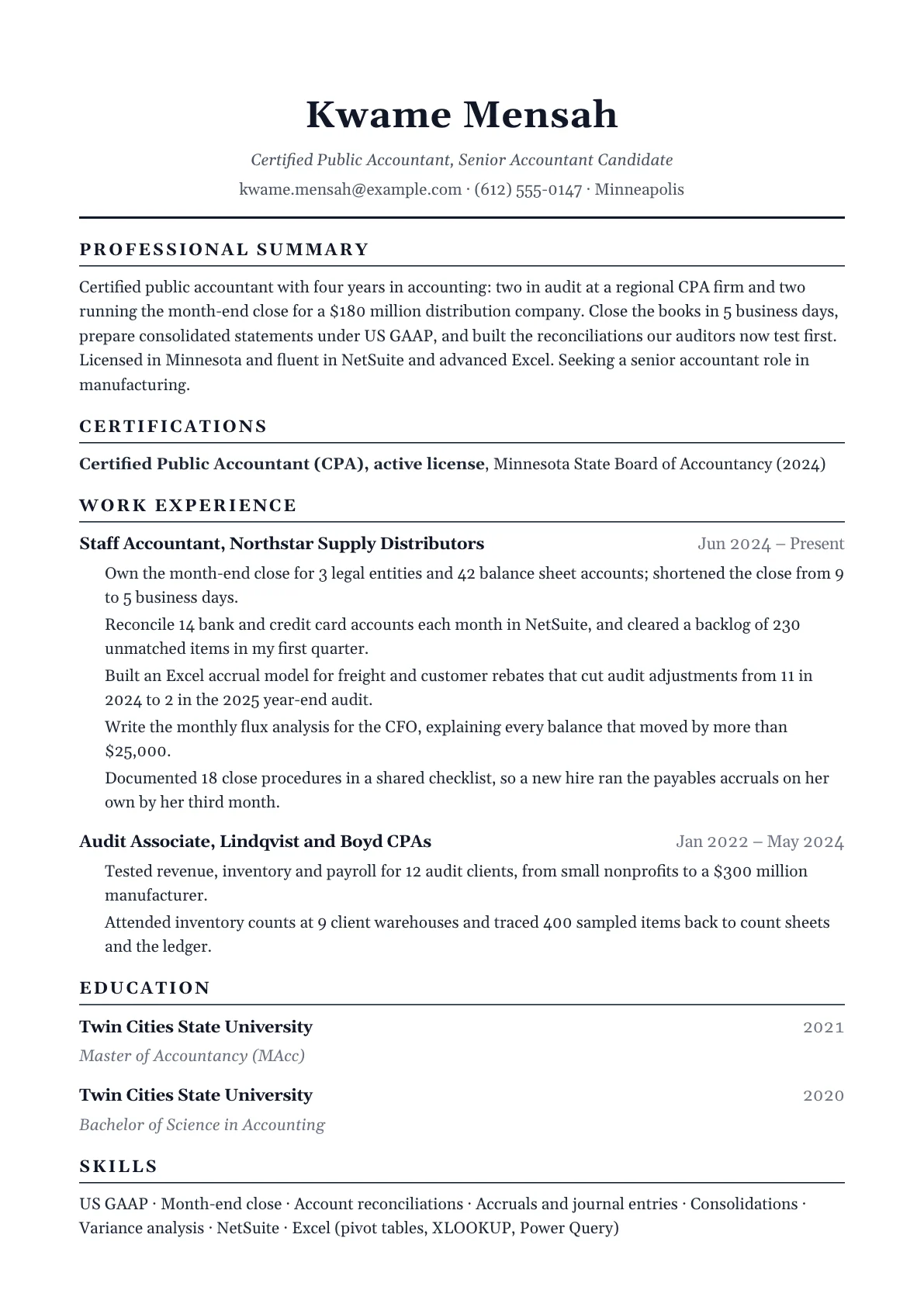
This is the fictional example shown above in selectable text. Use its structure, then replace every sample detail with your own. The image and editable example use the same resume data.

Kwame Mensah

Certified Public Accountant, Senior Accountant Candidate

kwame.mensah@example.com

(612) 555-0147

Minneapolis, MN, US

Summary

Certified public accountant with four years in accounting: two in audit at a regional CPA firm and two running the month-end close for a $180 million distribution company. Close the books in 5 business days, prepare consolidated statements under US GAAP, and built the reconciliations our auditors now test first. Licensed in Minnesota and fluent in NetSuite and advanced Excel. Seeking a senior accountant role in manufacturing.

Training and certificates

Certified Public Accountant (CPA), active license

Minnesota State Board of Accountancy

2024

Experience

Staff Accountant

Northstar Supply Distributors

From: Jun 2024

To: Present

  • Own the month-end close for 3 legal entities and 42 balance sheet accounts; shortened the close from 9 to 5 business days.
  • Reconcile 14 bank and credit card accounts each month in NetSuite, and cleared a backlog of 230 unmatched items in my first quarter.
  • Built an Excel accrual model for freight and customer rebates that cut audit adjustments from 11 in 2024 to 2 in the 2025 year-end audit.
  • Write the monthly flux analysis for the CFO, explaining every balance that moved by more than $25,000.
  • Documented 18 close procedures in a shared checklist, so a new hire ran the payables accruals on her own by her third month.

Audit Associate

Lindqvist and Boyd CPAs

From: Jan 2022

To: May 2024

  • Tested revenue, inventory and payroll for 12 audit clients, from small nonprofits to a $300 million manufacturer.
  • Attended inventory counts at 9 client warehouses and traced 400 sampled items back to count sheets and the ledger.

Education

Master of Accountancy (MAcc)

Twin Cities State University

To: 2021

Bachelor of Science in Accounting

Twin Cities State University

To: 2020

Skills

US GAAP

Month-end close

Account reconciliations

Accruals and journal entries

Consolidations

Variance analysis

NetSuite

Excel (pivot tables, XLOOKUP, Power Query)
Choose accounting evidence for the vacancy

Kwame's fictional example fits a move from audit and corporate close work into manufacturing. It should not become a generic template for every tax, student or public-accounting application.

Three useful directions

  • Student or first staff role: lead with relevant education, an internship or a clearly labeled class project when these are your strongest evidence. Show the reconciliation or analysis you performed, not an invented client engagement.
  • Audit to industry: connect the accounts and controls you tested with the company's work. Testing a client's close does not mean you owned that close.
  • Senior or specialist role: identify entities, reporting cycles, review responsibility and the standards you actually applied. A tax-focused vacancy needs tax evidence, not a longer list of unrelated close tasks.

Worked example: distinguish scope from outcome

Weak: Responsible for the monthly close.

Fictional revision using the sample: Own the month-end close for 3 legal entities and 42 balance sheet accounts; shortened the close from 9 to 5 business days.

The entities and accounts describe scope; the days describe a change. In your own resume, explain which steps you improved and whether other colleagues shared the result. If a faster close came with unresolved balances, do not imply that speed alone proves accuracy.

Show a credential's actual status

A current CPA license, completed exam sections and a planned test date are different facts. Use the issuing board and accurate status. A course or exam pass is not permission to practice. Check the relevant board of accountancy when describing licensure, and follow the application's request for supporting details.

To edit this sample, sign in to a free CVPoet account, choose Classic, replace all fictional details and save with Update. Open the downloaded PDF to check figures, dates and page breaks before uploading it.

Accountant pay and job outlook

Official figures for Accountants and Auditors.

Median pay (2025)
$83,680 per year ($40.23 per hour)
Jobs in 2025
1,595,200
Job outlook, 2025 to 2035
5%, faster than average
Change in jobs, 2025 to 2035
+79,400
Typical entry-level education
Bachelor's degree

Sources: U.S. Bureau of Labor Statistics, Occupational Outlook Handbook: Accountants and Auditors, checked September 2026; O*NET OnLine: Accountants and Auditors, checked September 2026.

How to write an accountant resume

1

Put the credential in your name line or headline

If you are licensed, write it the way clients see it on your signature: Kwame Mensah, CPA, or a headline such as Certified Public Accountant, Senior Accountant Candidate. If you are partway through the exam, the headline can still say Staff Accountant, CPA Candidate. Add your phone, a plain email address and your city and state. No street address is needed.

2

Open with a summary that names your side of accounting

Controllers want to know quickly whether you come from public accounting, corporate accounting or government, because the daily work is different. Give your years, where you did them, the size of the books you handled (revenue, entities or client count), the close or audit results you are proudest of, and the job you want next. Three or four sentences is enough.

3

Give the license its own section near the top

List the CPA with the state board that issued it and the year, and say it is active. Add a CMA or enrolled agent credential under it if you hold one. If you are still testing, list the sections you have passed with their names, for example Passed FAR and AUD; REG scheduled for November 2026. Do not print a license number; the employer can look it up with the board.

4

Describe each job by what you closed, reconciled or tested

Accounting duties sound alike on paper, so the detail has to come from scale and results. How many entities or accounts did you own? How many days did the close take before and after you? How many audit adjustments or findings were there? How many clients, and in which industries? Start each bullet with a verb (reconcile, prepare, built, tested, reduced) and include at least one number.

5

Name the systems and standards the posting names

If the job ad says NetSuite, Sage Intacct, SAP or Oracle, and you have used it, write that exact name. The same goes for US GAAP, ASC 606 revenue recognition, ASC 842 leases, SOX testing or fund accounting. Accurate system and task names help a reader understand your experience. Check any parsed application fields instead of assuming that a keyword guarantees a match.

6

Finish with education and a short skills list

Your accounting degree, the school and the year, plus a master's degree if you have one, since many candidates use graduate credits to reach the education requirement for licensing. Then a skills list of eight to ten items, each specific: account reconciliations, consolidations, Excel Power Query. Use the space needed for relevant evidence and follow the application's length instructions. Remove repeated duties before shrinking the type.

Skills and keywords for an accountant resume

Compare these accounting skills with the responsibilities in your target posting. Use the ones you can back up in an interview, in the same words the posting uses, both in your skills section and inside your bullets.

Hard skills

  • Month-end and year-end close
  • General ledger and journal entries
  • Balance sheet account reconciliations
  • Accruals, prepaids and fixed asset schedules
  • US GAAP, including ASC 606 and ASC 842
  • Financial statement preparation
  • Budget to actual and flux analysis
  • Audit preparation and PBC lists
  • Sales and use tax or income tax provision support
  • Internal controls and SOX testing

Soft skills

  • Explaining numbers to people who are not accountants
  • Meeting hard deadlines at month end and year end
  • Care with detail under time pressure
  • Asking questions until a balance makes sense
  • Keeping confidential financial information private
  • Training and reviewing the work of junior staff

Tools and software

  • Excel (pivot tables, XLOOKUP, Power Query)
  • NetSuite, Sage Intacct, SAP or Oracle
  • QuickBooks Online for smaller companies
  • BlackLine or FloQast for close management
  • CaseWare or other audit software
  • Power BI or Tableau for reporting

Accountant resume summary examples

Start from the one nearest your level and swap in your own facts. Each one states the kind of accounting you do, proof with a number, your credential, and the job you want.

Entry-level or staff accountant

Accounting graduate with a bachelor's degree, a public accounting internship covering two busy seasons, and a year as an accounts payable specialist processing about 600 invoices a month. Comfortable with journal entries, bank reconciliations and QuickBooks Online. Passed FAR and AUD on the CPA exam; seeking a staff accountant role with a clear path to senior.

Experienced senior accountant

Senior accountant with six years in corporate accounting for a multi-state healthcare group with 11 entities. Lead the consolidation and intercompany eliminations, review the work of two staff accountants, and implemented ASC 842 for 140 leases. CPA; looking for a senior or lead accountant position with more ownership of reporting.

Accounting manager or controller

Controller with twelve years across Big Four audit and industry, now responsible for a $450 million consumer products company's accounting team of eight. Cut the close from 12 to 6 days, led the move from Dynamics GP to NetSuite, and delivered four clean audits in a row. CPA; seeking a controller or assistant corporate controller role.

Accountant resume bullet examples

Each bullet names a piece of accounting work, puts a number on it, and where possible says what got better. Copy the structure, not the figures.

  • Prepared monthly financial statements and management reports for 4 operating companies with combined revenue of $95 million.
  • Reduced unreconciled cash differences from $48,000 to under $500 by rebuilding the bank reconciliation template.
  • Implemented ASC 606 revenue recognition for 35 multi-year service contracts, with no auditor comments on the new policy.
  • Managed the year-end audit relationship, delivering 120 requested schedules a week ahead of the auditors' fieldwork.
  • Automated the fixed asset depreciation schedule for 2,300 assets, saving about 10 hours of manual work each month.
  • Reviewed journal entries and reconciliations prepared by 3 staff accountants before each close.
  • Recovered $62,000 in duplicate vendor payments through a two-year accounts payable review.
  • Filed sales and use tax returns in 14 states each month with zero late-filing penalties over three years.
  • Tested 45 key controls for SOX compliance and wrote remediation plans for the 3 deficiencies found.
  • Built a 13-week cash forecast in Excel that the treasurer now uses to plan borrowing on the credit line.
  • Supported the conversion from QuickBooks to Sage Intacct, mapping 900 accounts and training 6 users.

Licenses and certifications for accountants

Credential requirements depend on the services, jurisdiction and vacancy. Distinguish a CPA license from passing exam sections or completing an accounting degree. Each state and territory licenses its own CPAs through a board of accountancy, and each board sets its own education and experience rules; NASBA lists every board. Every candidate takes the same Uniform CPA Examination. Since 2024, the AICPA explains, it has three Core sections that everyone passes (Auditing and Attestation, Financial Accounting and Reporting, Taxation and Regulation) and one Discipline section you choose (Business Analysis and Reporting, Information Systems and Control, or Tax Compliance and Planning). These are the credentials worth listing:

  • Certified Public Accountant (CPA), licensed by your state board of accountancy (see the NASBA directory of state boards): state authorization and practice requirements depend on the services performed. Check the relevant board and vacancy rather than assuming every senior role requires a CPA.
  • Certified Management Accountant (CMA) from the Institute of Management Accountants: active IMA membership, two exam parts, a bachelor's degree or related professional certification, and two continuous years of qualifying management accounting or financial management experience. Check IMA's completion deadlines. Common in corporate and cost accounting.
  • Enrolled Agent (EA) from the Internal Revenue Service: the IRS provides an examination route and a route for qualifying former IRS employees, with application and suitability requirements. Enrolled agents may represent taxpayers before the IRS. Useful for tax-focused roles.
  • CPA exam progress, if you are not licensed yet: list the sections you have passed by name and the date of the next one. Employers hiring staff accountants often ask about it.

The example, line by line

The example is for Kwame, a licensed CPA with four years of experience who wants to move up to a senior accountant job at a manufacturer. Here is what each part does.

Headline: Certified Public Accountant, Senior Accountant Candidate. It gives the credential and the next job in one line.

Summary: his two sides of accounting (audit, then corporate) and the size of the company ($180 million) come first. Then the close in 5 business days, the consolidated statements and the reconciliations the auditors rely on. It ends with his license state, his two main tools, and the industry he is targeting.

License: a section of its own right after the summary, naming the Minnesota State Board of Accountancy and 2024. It needs nothing else.

Staff accountant job: five bullets. The first two show the scope he owns: 3 legal entities, 42 accounts, 14 bank and card reconciliations. The next two show quality: an accrual model that took audit adjustments from 11 to 2, and a flux review of every change above $25,000. The last shows he makes the team better, with 18 documented procedures that let a new hire work alone.

Audit associate job: two bullets are enough for an earlier role. The 12 clients and the 9 warehouse counts tell a manufacturer he knows how inventory gets tested.

Education and skills: both degrees, then eight skills that match senior accountant postings, with NetSuite and the Excel features named.

Mistakes that hold accounting resumes back

  • Listing duties instead of results. Responsible for reconciliations is true of every accountant. Say how many accounts, how often, and what changed because you did them well.
  • Being vague about the CPA. CPA eligible or pursuing CPA leaves the reader guessing. Say which sections you have passed, or give the board and year if you are licensed.
  • Hiding the size of the books. Closing a single-entity company and consolidating twelve entities are different jobs. Give revenue, entity count or client count so the manager can place you.
  • Writing ERP or accounting software. Name the system. A NetSuite shop wants NetSuite users, and accurate tool names make your experience easier to find and assess; they do not guarantee a software ranking.
  • Typos in figures. A resume with $1,20,000 or totals that do not add up is read as a warning sign in this field. Check every number twice, and read it aloud once.
  • Keeping every busy season detail. After a few years in industry, cut the audit job to two strong lines. Controllers hire for what you do now.

Other finance and business resume examples that are close to this one:

Every example is in the resume examples hub, grouped by job and situation.

Build it free, no watermark

CVPoet's Classic resume builder is free with an account. Start from this example in the free Classic template or start a blank page, and download a PDF with no watermark. Compact, Creative, and Bold are available with a Job Search Pass.

Frequently asked questions

What should an accountant put on a resume?

Your name with any credential, contact details, a headline naming the job you want, a short summary, your CPA or other certifications, each job with the scope and results of your work, your degrees, and a list of accounting skills and systems that match the posting.

Where should I put my CPA on my resume?

In two places: after your name or in the headline, and in a Licenses and Certifications section right after the summary. Give the state that issued it, the year and that it is active. You do not need the license number.

How do I list the CPA exam if I have not finished it?

Write the section names you have passed and when you plan to take the next one, for example: CPA exam, passed FAR and AUD, REG scheduled for November 2026. That is clearer than CPA candidate on its own.

Should I include my GPA on an accounting resume?

Include GPA when the application asks for it or when it adds useful evidence for an early-career application. State the scale and distinguish a major GPA from the overall GPA. There is no single cutoff or removal date that applies to all employers.

How long should an accountant resume be?

Keep the document concise and follow any stated page limit. One page can suit a short record; additional relevant audit, reporting, tax or leadership experience may justify another page. Put your strongest current evidence and applicable license near the start.

What is the difference between an accountant and a bookkeeper resume?

A bookkeeper resume centers on recording transactions, payables, receivables, payroll and bank reconciliations. An accountant resume adds the close, adjusting entries, financial statements, audits, standards such as US GAAP, and usually a degree and a CPA or progress toward it.

How do I move from public accounting to industry?

Translate audit work into what a company needs: the industries you tested, the accounts you know well, and any client work where you proposed adjusting entries. Lead your summary with the kind of company you want to join, and add any close or reconciliation work you did on a client's books.

Which software should an accountant list?

Excel, with the features you use, and every accounting system you have worked in, named exactly: NetSuite, Sage Intacct, SAP, Oracle, QuickBooks. Add close tools like BlackLine or FloQast and reporting tools like Power BI if the posting mentions them.

Do I need a CMA if I have a CPA?

A CPA does not automatically make a CMA necessary. Compare the vacancy with the credentials you actually hold. The CMA covers management-accounting and financial-management knowledge; list both when relevant and accurate.

Should an accounting resume use a creative design?

Choose a readable layout with clear headings and selectable text. Classic is available free with an account. Inspect the actual exported file and any parsed application fields; a template does not guarantee how every hiring system will read it.

Build your accountant resume now

Start from Kwame's example or a blank page. Free, a free account is required to edit, and the PDF has no watermark.

Build your resume, free
Accountant resume example
Accountant resume example The example above as an image, to save or share. To change it, use Edit & download this resume at the top of the page. Open the full-size image
Premium

More ways to make your CV yours

Unlock all three premium designs with a Job Search Pass. Your written content stays exactly as it is. Classic is always free.

Included with your pass

$12 once for 30 days

No subscription. Nothing renews. A 90-day pass is also available.

See Job Search Passes

Pass options open in a new tab. Your draft stays here.