UX Designer Resume: Examples and Tips (2026)

Connect UX research, design decisions and portfolio evidence with a fictional UX designer resume, practical writing advice and a free template.

Template:

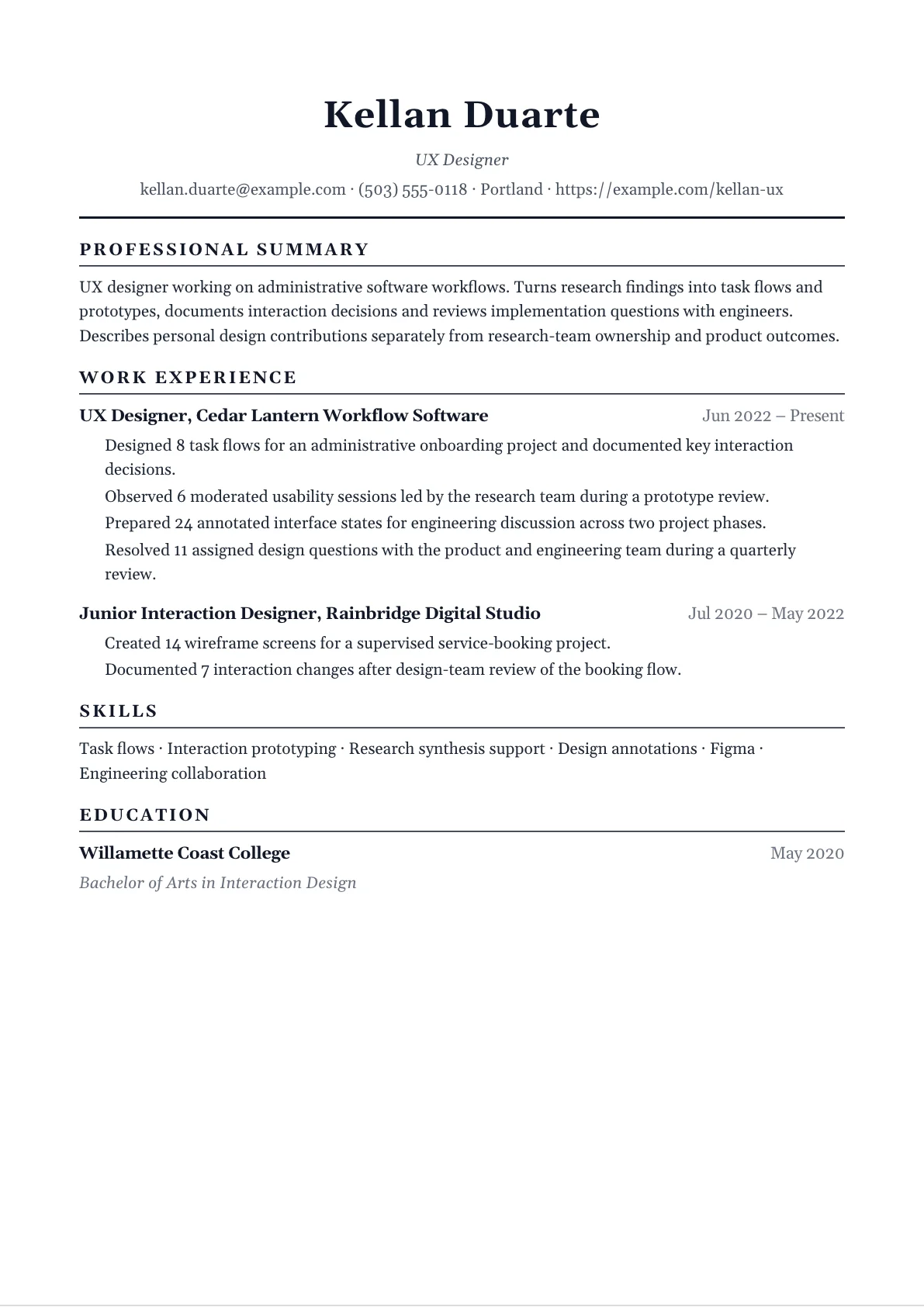
Fictional UX designer Kellan Duarte applying to a Portland software design team. Employers, education, projects and counts are invented. The example.com portfolio address is a fictional placeholder.

Why this resume works

  • The summary identifies administrative workflows and collaboration rather than claiming every product discipline.
  • Prototype flows, observed sessions and design annotations retain their different meanings.
  • The portfolio address is labeled as a placeholder, and the sample avoids unverified conversion or revenue claims.
Edit & download this resume

Create a free account to edit this example and download a PDF with no watermark. Classic is free; Compact, Creative, and Bold require a Job Search Pass.

A UX designer resume should make your contribution to a user problem understandable before someone opens the portfolio. Name the product, the task and the work you owned. Research, interaction design, visual design and engineering may overlap in a team, but they are not interchangeable claims. Select evidence for the actual opening instead of listing every method or tool you have encountered.

The fictional sample features Kellan Duarte applying to a Portland software design team. His employers, degree, projects and counts are invented. He designs administrative workflows and works with research and engineering colleagues. The example.com portfolio address is a fictional placeholder, not a reviewed body of work. The image, text version and editable data describe the same applicant so you can adapt the structure without borrowing an invented career.

UX designer resume example: text version

This is the fictional example shown above in selectable text. Use its structure, then replace every sample detail with your own. The image and editable example use the same resume data.

Kellan Duarte

UX Designer

kellan.duarte@example.com

(503) 555-0118

https://example.com/kellan-ux

Portland, OR, US

Summary

UX designer working on administrative software workflows. Turns research findings into task flows and prototypes, documents interaction decisions and reviews implementation questions with engineers. Describes personal design contributions separately from research-team ownership and product outcomes.

Experience

UX Designer

Cedar Lantern Workflow Software

From: Jun 2022

To: Present

  • Designed 8 task flows for an administrative onboarding project and documented key interaction decisions.
  • Observed 6 moderated usability sessions led by the research team during a prototype review.
  • Prepared 24 annotated interface states for engineering discussion across two project phases.
  • Resolved 11 assigned design questions with the product and engineering team during a quarterly review.

Junior Interaction Designer

Rainbridge Digital Studio

From: Jul 2020

To: May 2022

  • Created 14 wireframe screens for a supervised service-booking project.
  • Documented 7 interaction changes after design-team review of the booking flow.

Skills

Task flows

Interaction prototyping

Research synthesis support

Design annotations

Figma

Engineering collaboration

Education

Bachelor of Arts

Interaction Design

Willamette Coast College

To: May 2020

Official figures for Web and Digital Interface Designers.

Relevant work
Interface layout, functions and navigation
Preparation
Education and evidence requirements vary by employer

BLS covers a broader digital design group, not every UX research or product-design role. Use the actual job description to define the position you are targeting.

Source: BLS: Web developers and digital designers, checked October 2026.

How to connect UX work to a resume

1

Choose the role within the design team

Read whether the opening emphasizes interaction design, research, visual systems or a broader product remit. Use the title accurately and select work that demonstrates the requested responsibilities. If your background is mainly interface production, explain that contribution without renaming it research leadership. A general UX title can still have a specific product, audience and task focus.

2

Turn a project into a clear contribution

For each relevant project, identify the user task, your responsibility and the decision you helped make. Mention a constraint that explains the work, such as an existing permission model or a complex administrative process. Keep engineering, research and product-management ownership visible. The reader should understand what you did without having to infer it from a gallery of polished screens.

3

Connect the portfolio to the same story

Use a working portfolio address when requested and permitted. Match project names, dates and role descriptions across the resume and case study. A useful case study can show the question, evidence, alternatives, choice and limits of the evaluation. Verify permission before publishing client interfaces, research notes or internal results. Label an independent concept as a concept, not a customer launch.

4

Describe research participation honestly

Interviewing participants, observing sessions, synthesizing notes and leading a study are different responsibilities. State what you actually did and who owned the research when relevant. Keep participant information confidential. A small prototype evaluation can inform a design choice, but it does not establish how all customers will behave or prove that a released product improved revenue.

5

Use measures only within their scope

Keep participant counts, tested tasks, interface states and product outcomes distinct. If you report a before-and-after result, retain the denominator, period, conditions and your contribution. Do not turn a small usability observation into an unsupported population percentage. Without trustworthy outcome data, explain the decision, revision or review that your work enabled.

6

Test the application document

Choose a readable hierarchy and follow the employer's requested file type. In CVPoet, create an account or sign in, open the example in the builder, replace its fictional data and select Update. Download the PDF, check text selection and confirm that the portfolio address and final sections fit. Classic is free with an account; premium designs require a Job Search Pass.

Skills and keywords for a UX designer resume

Build a short skills section around work you can discuss with examples. A Figma prototype demonstrates a tool task; it does not automatically demonstrate research design, accessibility evaluation or frontend implementation. Mention the actual method and level of responsibility when needed. A resume can link the evidence, while a portfolio explains the decision in depth. Remove a tool name if you cannot explain how you used it.

Hard skills

  • Task-flow design
  • Interaction specification
  • Prototype development
  • Interpreting research findings within role

Soft skills

  • Explaining design tradeoffs
  • Receiving critique
  • Collaborating across disciplines

Tools and software

  • Figma features actually used
  • Approved prototyping and review tools
  • Team documentation systems

UX designer resume summary examples

These independent fictional versions illustrate different stages. They do not add research leadership or shipped outcomes to Kellan's sample. Use only the position and evidence that fit your background.

Junior designer with project evidence

Interaction design graduate with supervised project experience translating a service task into wireframes and a tested prototype. Explains the actual research participation and design decisions, with coursework and independent concepts labeled accurately.

Software workflow designer

UX designer focused on administrative software workflows. Creates task flows, documents interface behavior and reviews implementation questions with engineers. Connects each portfolio case study to a clearly bounded contribution and describes evaluation limits alongside findings.

Experienced design lead

Design lead with supported responsibility for project direction and critique. Distinguishes personal decisions from the work of other designers and researchers, and explains prioritization and delivery tradeoffs without claiming that leadership alone produced every product result.

UX designer resume bullet examples

These fictional descriptions show scope and decisions without requiring invented conversion rates. Substitute your own work, period and reliable records. If the most useful contribution is qualitative, describe it directly instead of forcing a number into the sentence.

  • Mapped 5 task flows for a service account setup project.
  • Created 17 annotated interface states for a development handoff.
  • Observed 8 research-led sessions and summarized questions for the design team.
  • Compared 3 navigation approaches against the agreed project constraints.
  • Revised 12 prototype screens after documented usability feedback.
  • Recorded 9 interaction decisions in a shared design-review log.
  • Prepared 4 permitted case-study summaries with individual contributions stated.
  • Reviewed 16 assigned interface states with an engineer before implementation.
  • Documented 6 content questions for the product and support team.
  • Updated 10 wireframes after a scheduled critique of the booking task.

Education, learning and portfolio evidence

The BLS digital design profile describes varied preparation routes and the relevance of demonstrated work. It is a broader occupation profile, not a universal UX hiring checklist. Use the actual employer requirements and describe your education or learning without inflating its status.

  • Use the actual degree, subject and completion date. If study is unfinished, label the stage and expected completion honestly. Kellan's sample assumes a completed May 2020 degree.
  • A course, bootcamp and issuer-awarded certification are different records. Use the exact award name and status, and verify any named credential with its issuer before listing it. The sample invents no professional certification.
  • Treat permitted project evidence as evidence of the work described, not a substitute for every employer qualification. Do not publish restricted client material merely because the application requests a portfolio.

The example, line by line

Audience: Kellan targets administrative software design. The summary does not claim that he is simultaneously a researcher, visual design lead and production engineer.

Project scope: eight task flows belong to one onboarding project. Twenty-four annotated interface states cover two phases. The figures describe different artifacts; adding them together would not produce a meaningful count of completed products.

Research role: he observed six moderated sessions led by the research team. That does not say he recruited the participants, designed the study or independently validated the released interface. His contribution is still useful when described accurately.

Earlier work: the junior position follows the completed design degree. Fourteen wireframe screens and seven reviewed changes explain supervised work. They do not imply seven launches or fourteen separate customer products.

Worked revision: explain the decision rather than a vague result

A fictional rough bullet says, "Made the app intuitive and boosted all conversions." A more informative version is, "Compared alternative navigation approaches against the agreed project constraints and documented the selected task flow for review." This independent illustration identifies the work and decision process. It does not claim a measured commercial outcome without supporting records.

Portfolio: example.com/kellan-ux is deliberately fictional. No reviewer has evaluated projects at that address. Replace it with your own permitted portfolio and confirm that it loads for the recipient. Explain your role in shared work and label concept, student and client projects correctly.

UX resume choices that weaken the evidence

  • Only showing polished screens: explain the task and your contribution in the resume, then let the portfolio develop the reasoning. A visual artifact alone cannot establish who researched, designed or implemented it.
  • Calling every project a launch: distinguish a concept, prototype, internal pilot and released product. Describe the stage you can verify rather than implying that every design reached customers.
  • Inflated usability percentages: retain participant counts, conditions and task definitions. A few observed sessions do not establish universal success or commercial impact.
  • Publishing work without permission: check client and employer restrictions before sharing screens, recordings or results. A redacted or independently created demonstration must remain accurately labeled.
  • A decorative document that hides the story: use headings, readable text and working links. Test the actual export rather than assuming that any design is universally compatible with applicant systems.
  • Rigid length or summary rules: choose relevant detail and an introduction when it clarifies the target. A concise objective may help a transition, while an experienced applicant can summarize supported work. Follow application limits.

Choose related guides by the responsibilities you actually want to present.

Every example is in the resume examples hub, grouped by job and situation.

Build it free, no watermark

Create a free CVPoet account before editing. Start from this example in the free Classic template or start a blank page, and download a PDF with no watermark. Compact, Creative, and Bold are available with a Job Search Pass.

Frequently asked questions

Should a UX resume include a portfolio link?

Include a working portfolio when relevant or requested and you have permission to share the material. Explain your role and project stage. The example.com address in this fictional sample is a placeholder, not a real portfolio or reviewed evidence.

Is UX design the same as UI design?

The responsibilities may overlap, but use the actual vacancy and your work to define the role. Interaction decisions, visual execution and research are different contributions. Do not add responsibilities merely because another employer combines them in one title.

What if I have only student or concept projects?

Label them as student or independently created work and describe the task, constraints and decisions. Do not present a concept as a released client product. Relevant project evidence can clarify preparation, subject to the employer's actual requirements.

How do I describe work on a shared design team?

Name the contribution you owned and the collaboration that shaped it. Distinguish observing sessions from leading research and producing interface specifications from implementing code. Use team outcomes only with appropriate evidence and clear attribution.

Do I need percentages in every UX bullet?

No. Use reliable numbers when they explain scope or a supported result. A clear design tradeoff or revision can be useful without a percentage. Do not turn a small prototype study into a claimed increase in total customer conversion.

Can I use confidential client work in a case study?

Verify permission before sharing interfaces, research or internal results. Follow the relevant restrictions and application process. If you create a separate demonstration, label it accurately and avoid implying that the client approved or shipped that new work.

Should education come before experience?

Place the most relevant evidence early. A recent graduate may emphasize education and projects, while a designer with relevant employment may lead with work. Kellan leads with work after a completed degree. Follow the actual application requirements.

Must a UX resume be exactly one page?

Use enough space to explain relevant work clearly, subject to employer limits. A short history often fits one page, while more relevant evidence may need careful selection or additional space. Keep the exported text readable rather than shrinking it to satisfy a general rule.

How do I edit and download this example?

Sign in or create a CVPoet account, open the sample in the builder and replace all fictional details. Select Update to save, then download the PDF. Classic is free with an account; premium designs require a Job Search Pass.

How do I check the final UX application?

Compare the resume and portfolio for consistent roles, dates, project stages and claims. Test the link and inspect the exported PDF for selectable text and complete sections. Follow the employer's format instructions. A template does not guarantee parsing, an interview or hiring.

Build your UX designer resume

Open the fictional sample with an account, add your own permitted project evidence, save with Update and download the PDF. Classic is free.

Build your resume, free
Software workflow UX designer example
Software workflow UX designer example The example above as an image, to save or share. To change it, use Edit & download this resume at the top of the page. Open the full-size image
Premium

More ways to make your CV yours

Unlock all three premium designs with a Job Search Pass. Your written content stays exactly as it is. Classic is always free.

Included with your pass

$12 once for 30 days

No subscription. Nothing renews. A 90-day pass is also available.

See Job Search Passes

Pass options open in a new tab. Your draft stays here.