Phlebotomist Resume: Examples and Tips (2026)

Phlebotomist resume example with summaries, bullets and skills, plus the certifications to list and states with their own phlebotomy license. Free template.

Template:

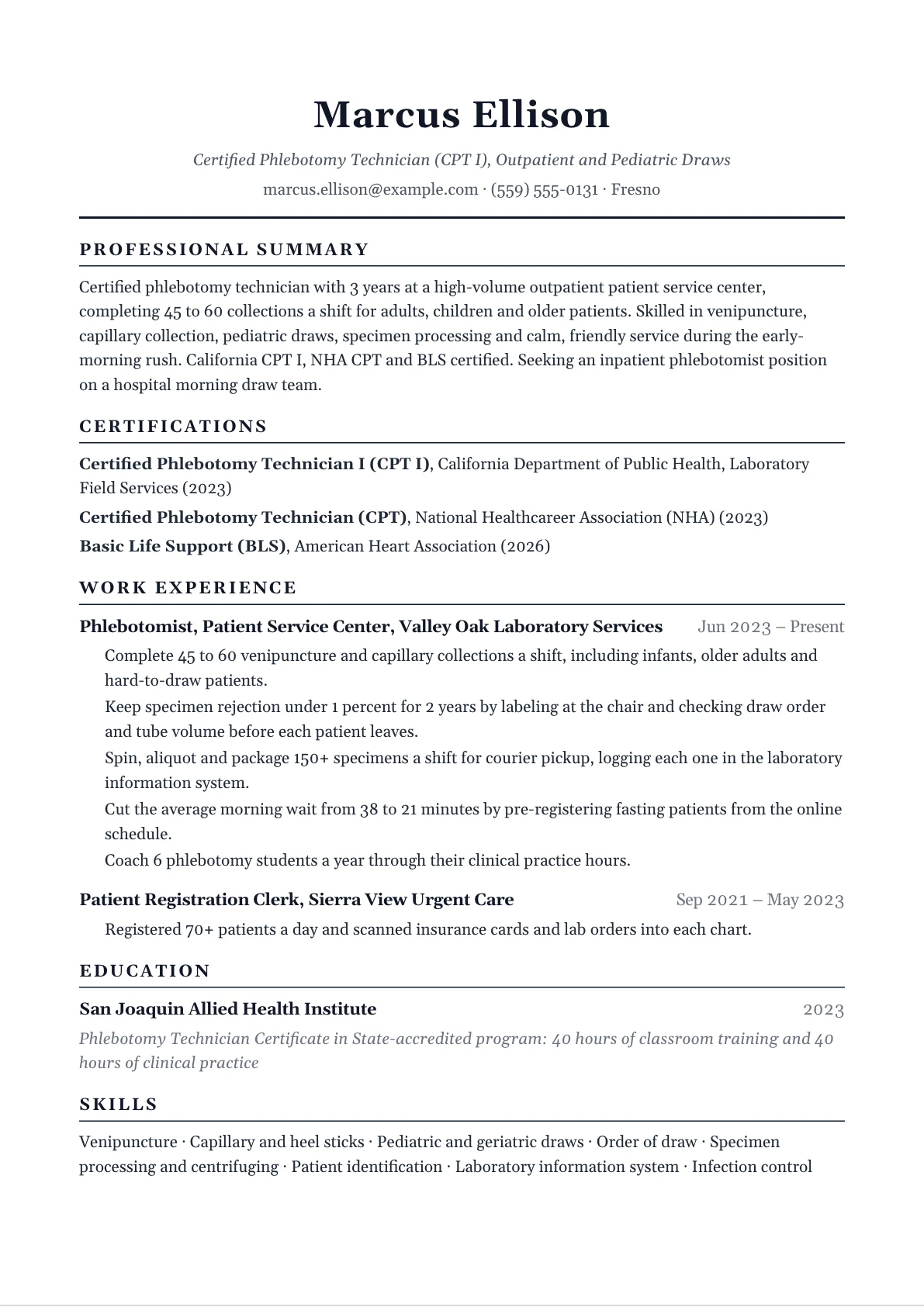
Fictional example: a certified phlebotomy technician with three years at an outpatient lab patient service center applying for an inpatient phlebotomist job on a hospital's early-morning draw team. Names and career details in the samples are invented for illustration.

Why this resume works

  • The California CPT I and NHA CPT entries identify separate credentials; current status and scope still need verification.
  • The sample distinguishes 45 to 60 collections from more than 150 specimens processed per shift and names the two-year rejection measure separately.
  • Outpatient and pediatric collection experience supports the hospital target without implying previous inpatient employment or authority for every collection procedure.
Edit & download this resume

Create a free account to edit this example and download a PDF with no watermark. Classic is free; Compact, Creative, and Bold require a Job Search Pass.

A phlebotomy supervisor reading your resume is asking three things. Are you certified, and licensed if the state requires it? How many draws do you do in a shift, and on whom: healthy adults at a patient service center, frail older patients on hospital rounds, babies, blood donors? And do your specimens reach the lab right the first time? Everything else, from customer service to courier logs, matters less than those answers.

This guide gives you a full example for an outpatient phlebotomist moving to a hospital, six steps for writing your own, summaries for new, experienced and lead phlebotomists, bullet examples, the skills labs search for, and the national certifications and state licenses, with links to the bodies that issue them. If you draw blood as one part of a clinic job, the medical assistant resume example may fit better.

Phlebotomist resume example: text version

This is the fictional example shown above in selectable text. Use its structure, then replace every sample detail with your own. The image and editable example use the same resume data.

Marcus Ellison

Certified Phlebotomy Technician (CPT I), Outpatient and Pediatric Draws

marcus.ellison@example.com

(559) 555-0131

Fresno, CA, US

Summary

Certified phlebotomy technician with 3 years at a high-volume outpatient patient service center, completing 45 to 60 collections a shift for adults, children and older patients. Skilled in venipuncture, capillary collection, pediatric draws, specimen processing and calm, friendly service during the early-morning rush. California CPT I, NHA CPT and BLS certified. Seeking an inpatient phlebotomist position on a hospital morning draw team.

Training and certificates

Certified Phlebotomy Technician I (CPT I)

California Department of Public Health, Laboratory Field Services

2023

Certified Phlebotomy Technician (CPT)

National Healthcareer Association (NHA)

2023

Basic Life Support (BLS)

American Heart Association

2026

Experience

Phlebotomist, Patient Service Center

Valley Oak Laboratory Services

From: Jun 2023

To: Present

  • Complete 45 to 60 venipuncture and capillary collections a shift, including infants, older adults and hard-to-draw patients.
  • Keep specimen rejection under 1 percent for 2 years by labeling at the chair and checking draw order and tube volume before each patient leaves.
  • Spin, aliquot and package 150+ specimens a shift for courier pickup, logging each one in the laboratory information system.
  • Cut the average morning wait from 38 to 21 minutes by pre-registering fasting patients from the online schedule.
  • Coach 6 phlebotomy students a year through their clinical practice hours.

Patient Registration Clerk

Sierra View Urgent Care

From: Sep 2021

To: May 2023

  • Registered 70+ patients a day and scanned insurance cards and lab orders into each chart.

Education

Phlebotomy Technician Certificate

State-accredited program: 40 hours of classroom training and 40 hours of clinical practice

San Joaquin Allied Health Institute

To: 2023

Skills

Venipuncture

Capillary and heel sticks

Pediatric and geriatric draws

Order of draw

Specimen processing and centrifuging

Patient identification

Laboratory information system

Infection control

Choose a phlebotomist example for your collection setting

Marcus's fictional outpatient example is useful for a move to hospital morning rounds because it separates collections, specimen processing and earlier registration work. It does not claim previous inpatient employment or authority to perform every type of blood collection.

Training and first employment

List the completed program and supervised clinical placement with dates, site and documented procedures. Distinguish successful live-patient collections from simulated practice. Do not copy another applicant's puncture counts to satisfy an examination route, and do not call an examination application an awarded credential. Prior registration or customer service work can demonstrate communication without becoming phlebotomy tenure.

Outpatient, inpatient and pediatric work

For outpatient work, show identification, collection, labeling and patient flow. For inpatient rounds, describe units and timed collections only if you have worked in them. Pediatric experience should specify the patient group and procedures actually within your training and authorization. A request for a difficult draw does not justify claiming a success rate you never measured.

Lead or specimen processing roles

Separate the blood you collected from specimens received from colleagues. Describe centrifugation, preparation for transport, tracking and escalation where relevant. A lead role can add scheduling, competency support and coaching, but teaching students does not mean you supervised all laboratory staff or interpreted diagnostic results.

Worked revision: collection and processing are different

Too broad: Handled 150 patients per shift with perfect accuracy.

Supported by this fictional sample: Collected 45 to 60 specimens per shift and processed more than 150 specimens for laboratory testing.

The processing total is not a second count of patients or proof of 150 venipunctures. The sample's rejection rate below 1 percent over two years is a separate quality measure. It does not establish first-stick success, zero contamination or absence of adverse events.

Explain a patient-flow result carefully

The morning wait changed from 38 to 21 minutes, a reduction of 17 minutes. Keep the comparison in minutes and verify the measurement period before adding it to a real resume. Do not invent a study design or claim that collection speed alone caused the result. The six students coached annually are a teaching contribution, not six direct reports or guaranteed examination passes.

Export and application check

Verify state and national credential status separately, confirm the target site's required duties and follow its file instructions. Use readable headings and inspect the exported text. Create a free CVPoet account, replace the fictional information in Classic, save with Update and download the PDF. Keep patient names, identifying records and confidential collection logs out of your application.

Phlebotomist pay and job outlook

Official figures for Phlebotomists.

Median pay (2025)
$45,230 per year ($21.75 per hour)
Jobs in 2025
143,900
Job outlook, 2025 to 2035
7%, much faster than average
Change in jobs, 2025 to 2035
+9,800
Typical entry-level education
Postsecondary nondegree award

Sources: U.S. Bureau of Labor Statistics, Occupational Outlook Handbook: Phlebotomists, checked September 2026; O*NET OnLine: Phlebotomists, checked September 2026.

How to write a phlebotomist resume

1

Headline your certification and the patients you draw

Under your name, write your credential and setting, such as Certified Phlebotomy Technician, Hospital Inpatient or Phlebotomist, Pediatric and Outpatient. Draw sites differ a lot, and the headline tells the supervisor you already know theirs.

2

List state licenses first, then national certifications

Identify the state credential required for your actual duties and list its issuer and verified status. List national certification separately and include BLS if relevant. Check applicable routes and exemptions rather than assuming every blood collection role has identical requirements.

3

Write a summary with draws per shift

Years of experience and the setting, the number of collections you do in a shift, the patients you are good with (children, older adults, difficult veins), your credentials and the job you want. Three or four sentences are plenty.

4

Prove speed and quality in your bullets

Draws per shift, first-stick success, specimen rejection or recollection rates, wait times, specimens processed and students trained are all numbers a lab tracks. Use them, and start each bullet with an action like collect, process, label or train.

5

Name special collections and equipment

Blood cultures, timed draws, glucose tolerance tests, heel sticks, therapeutic phlebotomy, drug screen collection with chain of custody, and the lab information system you use. List only procedures within your actual training, assigned duties and authorization.

6

Add training and check the application limit

Give your phlebotomy program with the school, year and hours, and your clinical practice site if you are new. Keep earlier customer service or healthcare jobs concise and use the space needed for relevant evidence within the employer's limit.

Skills and keywords for a phlebotomist resume

These skills appear in most phlebotomy postings for labs, hospitals and blood centers. List the ones you use, and show a few in your bullets with numbers.

Hard skills

  • Venipuncture with vacuum tubes, syringes and butterfly needles
  • Capillary, finger and heel sticks
  • Correct order of draw and tube handling
  • Two-identifier patient identification
  • Blood cultures and timed draws
  • Glucose tolerance testing
  • Specimen processing, centrifuging and aliquoting
  • Chain of custody for drug screens
  • Point-of-care testing
  • Infection control and sharps safety

Soft skills

  • Putting nervous patients at ease
  • Gentle, patient approach with children
  • Accuracy under a long line
  • Clear communication with nurses and lab staff
  • Professional handling of fainting or difficult patients
  • Dependable early-morning attendance

Tools and software

  • Laboratory information systems (Sunquest, Epic Beaker, Cerner PathNet)
  • Handheld specimen labeling devices
  • Vein finders
  • Centrifuges
  • Specimen transport and temperature logs
  • Electronic health records for order lookup

Phlebotomist resume summary examples

These are fictional alternatives for different stages. Replace every number and credential with supported information.

First phlebotomy role

Phlebotomy program graduate with supervised practice in a hospital outpatient laboratory, completing documented venipunctures and capillary collections. Earlier retail experience developed calm communication during busy periods. Seeking a first collection role; list awarded credentials and any pending examination separately.

Experienced inpatient phlebotomist

Hospital phlebotomist with six years on inpatient rounds, collecting timed specimens and coordinating transport with the laboratory. Experienced with patient identification, bedside labeling and escalation of collection difficulties. Seeking a lead phlebotomist role.

Lead phlebotomist

Lead phlebotomist with twelve years in hospital and reference laboratory settings, coordinating schedules for 14 staff across three shifts. Supported a collection practice review and trained new hires on the approved procedure. Seeking a phlebotomy supervisor position.

Phlebotomist resume bullet examples

Adapt these to your setting. Each one starts with an action and includes a number a lab would recognize.

  • Collect 70 to 90 inpatient specimens on 4 a.m. rounds across 6 nursing units, finishing before 7 a.m. results deadlines.
  • Draw 25+ pediatric patients a day, including heel sticks on newborns, at a children's outpatient lab.
  • Kept blood culture contamination at 1.2 percent, below the hospital's 3 percent target, for 18 months.
  • Screen and collect 30 to 40 blood donors a day at mobile drives, including hemoglobin checks and donor reactions care.
  • Performed 15 timed glucose tolerance tests a week, keeping every draw within 5 minutes of schedule.
  • Collected 20+ workplace drug screens a day under federal chain of custody procedures with no rejected forms.
  • Raised first-stick success from 88 to 96 percent after vein finder training for the team.
  • Trained 10 new phlebotomists on order of draw, labeling rules and the lab information system.
  • Processed and shipped 300+ specimens a day to a reference lab, meeting every courier cutoff for a full year.
  • Handled 12 fainting episodes in a year safely, with no patient injuries.
  • Covered 3 satellite clinic draw stations on rotation, serving about 150 patients a week.

Phlebotomy certifications and state licenses

Check the state credential and the employer's requirements for your actual duties. National certification is not a universal substitute for state authorization, and other licensed professionals may work under different rules. California's CPT I guidance covers skin puncture and venipuncture, not arterial puncture. Its eligibility routes differ with prior experience and it describes annual renewal. Louisiana's phlebotomist licensure instructions specify an approved national examination. Washington has a separate medical assistant-phlebotomist credential with its own training routes. List what you actually hold:

  • NHA CPT: check the current CPT-specific eligibility rules. The documented collection requirement includes successful venipunctures and capillary sticks on live individuals, not simulated practice alone.
  • ASCP PBT: identify the exact credential and issuer. Verify the current route with the Board of Certification before describing eligibility or an examination in progress.
  • AMT RPT: the current routes have different education or experience conditions and documented successful human collections. Completing a class alone does not establish that all requirements are met.
  • State credential: give its exact title, issuing authority and verified current status. An original award year is not proof of renewal or authority for every collection procedure.
  • BLS or CPR: include completed relevant training and accurate status when requested. Requirements differ by employer; a year alone does not establish an unexpired card.

The example, line by line

Marcus Ellison is fictional. His phlebotomy role starts in June 2023, about three years before this review. The earlier patient registration position is healthcare experience, not two extra years of blood collection.

Headline: the California CPT I credential and outpatient and pediatric focus identify the setting. His hospital target is a career move, not evidence that he already performs inpatient rounds.

Credentials: the state CPT I and NHA CPT are separate. Their 2023 award dates and a 2026 BLS entry are illustrative dates, not independent proof of current status. CPT I does not authorize arterial puncture.

Experience: 45 to 60 collections and more than 150 processed specimens per shift describe different activities. A rejection rate below 1 percent over two years does not establish a first-stick success rate. The wait-time change is from 38 to 21 minutes, not a change in percentage points.

Coaching and earlier work: six students annually demonstrate teaching. The prior role's 70 or more daily registrations demonstrate patient service, not blood draws. Keep both distinctions when adapting the example.

Education: the sample lists classroom and clinical hours. It does not provide the entire documentation needed for every certification route. Use your own verified program, placement and successful procedure records.

Phlebotomist resume mistakes to avoid

  • No draws per shift. A phlebotomist doing 20 draws a day and one doing 80 are applying for different jobs. Put your number in the summary and first bullet.
  • Leaving out the state credential. Check the state credential required for the actual duties, including applicable professional exemptions and the employer's application requirements. List it first.
  • Writing certified without the body. NHA, ASCP and AMT credentials are all different. Write the full name and issuer.
  • Only listing venipuncture. Pediatric draws, blood cultures, timed tests and chain of custody collections are what set you apart. Name the ones you do.
  • Nothing about quality. Labs track rejected and contaminated specimens. If your numbers are good, show them.

Other healthcare resume examples that are close to this one:

Every example is in the resume examples hub, grouped by job and situation.

Build it free, no watermark

Create a free CVPoet account before editing. Start from this example in the free Classic template or start a blank page, and download a PDF with no watermark. Compact, Creative, and Bold are available with a Job Search Pass.

Frequently asked questions

What should a phlebotomist put on a resume?

Your collection setting, employment dates, separate state and national credentials, relevant training, supported collection and processing examples and systems you use. Protect patient confidentiality.

How do I apply without paid phlebotomy experience?

Lead with your completed program and supervised clinical placement. Label simulation separately and use documented live-patient procedures. Earlier registration or service work can demonstrate communication without becoming phlebotomy experience.

Is national certification the same as a state credential?

No. Check the target state's requirements and list the exact issuer and status of each credential. California CPT I and NHA CPT are different credentials despite similar abbreviations.

Can California CPT I holders perform arterial punctures?

CPT I covers skin puncture and venipuncture. Do not claim arterial collection authority from that credential; check the relevant credential and professional scope for the actual duties.

How should I show collections per shift?

Give the actual procedure or specimen count and period. Separate collections from specimens processed or patients registered, and distinguish individual workload from the laboratory total.

Should I include a first-stick success rate?

Only if the measure and period are documented. A low specimen rejection rate is not a first-stick success rate and cannot be converted into one.

How do I move from outpatient to hospital work?

Show identification, labeling, timed collection and patient communication experience that transfers. Do not claim ICU, neonatal or inpatient experience unless you performed it within your duties.

Does a certification award year prove it is current?

No. Verify renewal and current status with the issuer. Check the employer's CPR or BLS requirements rather than treating a year alone as proof of an unexpired card.

How long should my phlebotomist resume be?

Follow the employer's instructions. A first-role resume can be concise; relevant lead, specialist or multiple-setting experience may need more space. Keep qualifications and recent work easy to find.

Can I use the free example for my application?

Create a free account, edit Classic with your own facts, save with Update and download the PDF. Review exported text, credential status and the application's file requirements before submitting.

Build your phlebotomist resume now

Start from Marcus's example or a blank page. Create a free account, edit the Classic template, save with Update and download a PDF without a watermark.

Build your resume, free
Phlebotomist resume example
Phlebotomist resume example The example above as an image, to save or share. To change it, use Edit & download this resume at the top of the page. Open the full-size image
Premium

More ways to make your CV yours

Unlock all three premium designs with a Job Search Pass. Your written content stays exactly as it is. Classic is always free.

Included with your pass

$12 once for 30 days

No subscription. Nothing renews. A 90-day pass is also available.

See Job Search Passes

Pass options open in a new tab. Your draft stays here.