SLP Resume: Speech-Language Pathologist (2026)

Show your SLP setting, clinical contribution and actual credentials with a fictional speech-language pathologist resume and a free template.

Template:

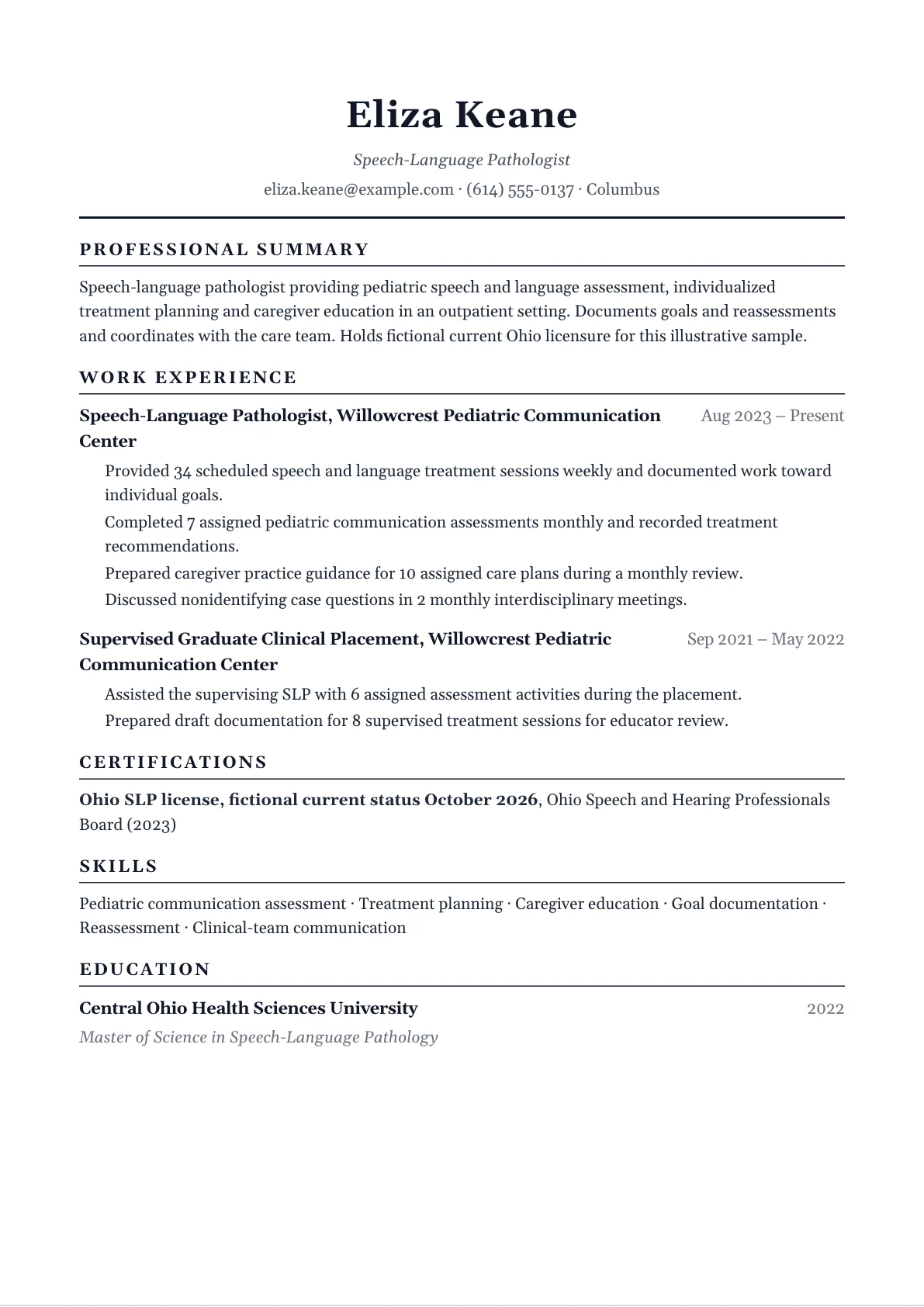
Fictional speech-language pathologist Eliza Keane applying to a Columbus pediatric outpatient practice. Names, education, employer, license history and counts are invented illustrations.

Why this resume works

  • The summary names pediatric speech and language care without claiming every clinical specialty.
  • Weekly sessions and monthly assessments retain their different units and periods.
  • The supervised graduate placement is separated from employed practice and the fictional Ohio license status is stated explicitly.
Edit & download this resume

Create a free account to edit this example and download a PDF with no watermark. Classic is free; Compact, Creative, and Bold require a Job Search Pass.

A speech-language pathologist resume should identify the people and setting you have worked with, the services you actually delivered and your current professional status. A pediatric outpatient practice, a school and an adult rehabilitation service need different evidence. Choose the setting first, then explain assessment, treatment planning, communication and documentation within your actual training and responsibilities.

The fictional example follows Eliza Keane applying to a pediatric outpatient practice in Columbus, Ohio. Her employer, university, clinical history, license status and activity counts are invented. Her employed role focuses on pediatric speech and language care; her earlier graduate placement remains supervised education. The guide does not add swallowing expertise, school credentials or ASHA certification to her history. Replace the illustration with your own verified details in the matching text and editable example.

Speech-language pathologist resume example: text version

This is the fictional example shown above in selectable text. Use its structure, then replace every sample detail with your own. The image and editable example use the same resume data.

Eliza Keane

Speech-Language Pathologist

eliza.keane@example.com

(614) 555-0137

Columbus, OH, US

Summary

Speech-language pathologist providing pediatric speech and language assessment, individualized treatment planning and caregiver education in an outpatient setting. Documents goals and reassessments and coordinates with the care team. Holds fictional current Ohio licensure for this illustrative sample.

Experience

Speech-Language Pathologist

Willowcrest Pediatric Communication Center

From: Aug 2023

To: Present

  • Provided 34 scheduled speech and language treatment sessions weekly and documented work toward individual goals.
  • Completed 7 assigned pediatric communication assessments monthly and recorded treatment recommendations.
  • Prepared caregiver practice guidance for 10 assigned care plans during a monthly review.
  • Discussed nonidentifying case questions in 2 monthly interdisciplinary meetings.

Supervised Graduate Clinical Placement

Willowcrest Pediatric Communication Center

From: Sep 2021

To: May 2022

  • Assisted the supervising SLP with 6 assigned assessment activities during the placement.
  • Prepared draft documentation for 8 supervised treatment sessions for educator review.

Training and certificates

Ohio SLP license, fictional current status October 2026

Ohio Speech and Hearing Professionals Board

2023

Skills

Pediatric communication assessment

Treatment planning

Caregiver education

Goal documentation

Reassessment

Clinical-team communication

Education

Master of Science

Speech-Language Pathology

Central Ohio Health Sciences University

To: 2022

Choose fellowship, outpatient or school evidence

A fellowship applicant can lead with graduate education and the supervised clinical settings that best match the opening. State what you assisted with and who reviewed the work. A short objective can explain the intended fellowship, while an experienced practitioner may prefer a summary of the relevant service. These are editorial choices; follow the application instructions and do not imply that a placement was independent employment.

For a school role, use the actual assessment, educational planning and collaboration responsibilities you have performed, and verify the relevant credential requirements. For outpatient care, explain the clinical population and communication with caregivers or referring professionals. Do not replace the setting name while leaving duties that belong to another environment. A move between settings can be described through genuine transferable experience and completed preparation.

Revise a claim about universal improvement

Weak: Fixed every child's speech and guaranteed rapid progress.

Fictional revision: Provided thirty-four scheduled speech and language treatment sessions weekly, documented individual goals and prepared caregiver practice guidance.

The revision describes work the sample actually supports. A reliable clinical measure can add context, but its scale, interval and attribution must remain intact. A change in an assessment score is not automatically a percentage improvement in everyday communication, and an attended session does not prove that every goal was achieved.

Do not attach identifiable reports, recordings or distinctive case stories to an application. Protect clinical information and obtain appropriate permission before sharing any teaching or portfolio material. A generic description of your reasoning can show skill without publishing a care record. Removing a name alone does not establish that clinical material is suitable to share.

Education, authorization and setting

Official figures for Speech-Language Pathologists.

Typical entry education
At least a master's degree
Licensure context
State requirements and work setting matter

BLS describes state licensure and typical entry education. Check the relevant board and employer; a national certification and a state license are separate facts.

Sources: BLS: Speech-Language Pathologists, checked October 2026; Ohio: License lookup, checked October 2026; ASHA: Certification, checked October 2026.

How to write a speech-language pathologist resume

1

Choose a clinical or educational setting

Identify the service and population named in the vacancy. For outpatient pediatric work, select evidence of communication assessment, treatment planning and caregiver education that you actually know. For a school or adult service, choose genuinely relevant history instead. Do not copy a broad list of disorders or procedures into the skills section merely because another SLP sample includes them.

2

State your actual professional stage

Keep student placement, clinical fellowship and established practice distinct. Use your real title and describe supervision where relevant. A completed degree, an exam result, a state authorization and national certification are different facts. If you are applying for a fellowship, make that stage clear instead of presenting yourself as already holding every credential required for a later role.

3

Describe the clinical contribution

Explain the assessment, goal, treatment activity, education or team handoff that belonged to you. Keep the description nonidentifying. A resume does not need a detailed patient history to show judgment. If a result involved a wider team, describe your contribution and use a measure only when it is reliable and appropriate to share. Do not promise that your work cured every communication difficulty.

4

Preserve workload and outcome units

Sessions count encounters, not necessarily unique people. Assessments, care plans and team meetings count different activities. Keep the period with each number and do not combine weekly and monthly totals into a supposed caseload. If you discuss a measured change, state the instrument, population and time interval accurately. Without a supported outcome, a clear care process or handoff is useful evidence.

5

Verify credentials for the actual job

BLS describes typical master's-level entry and state licensure, with requirements varying by state and setting. Schools may have additional credential requirements. Verify the relevant board and employer. Check current status separately from an original award date. Eliza's sample assumes a fictional current Ohio license and does not claim ASHA CCC-SLP, school authorization or permission to practice in another jurisdiction.

6

Check the application and saved PDF

Follow the employer's file instructions and any separate credential questions. In CVPoet, create an account or sign in, open the fictional sample in the builder and replace its details. Select Update before downloading the PDF. Check text selection, clinical titles, dates and the final sections. Classic is free with an account; premium designs require a Job Search Pass.

Skills and keywords for a speech-language pathologist resume

Build the skills section from your actual service responsibilities. Communication assessment, swallowing assessment and use of a particular assistive communication system should not be treated as interchangeable expertise. Explain the population and level of use when useful. A general course or observation does not establish competence in every intervention or instrument mentioned by an employer.

Hard skills

  • Speech and language assessment within competence
  • Individualized treatment planning
  • Progress and reassessment documentation
  • Caregiver education

Soft skills

  • Explaining goals clearly
  • Listening to family concerns
  • Communicating with the care team

Tools and software

  • Assessment instruments actually used
  • Clinical documentation systems
  • Communication supports within training

Speech-language pathologist resume summary examples

These independent fictional introductions show different stages and settings. They do not add qualifications to Eliza's example. Choose the facts that reflect your own preparation.

Clinical fellowship applicant

Speech-language pathology graduate seeking a supervised clinical fellowship. Describes completed graduate preparation and relevant supervised placements, with the actual application or authorization status stated accurately. Does not claim certification that has not been earned.

Pediatric outpatient clinician

Speech-language pathologist with pediatric communication assessment, individualized care planning and caregiver education experience. Explains the service population and current professional status, with session activity kept separate from measured clinical outcomes.

Experienced school clinician

SLP with documented school-based service and team collaboration experience. Describes the actual educational responsibilities, population and applicable credentials, without assuming that an outpatient license alone establishes every school requirement or administrative authority.

Speech-language pathologist resume bullet examples

These fictional examples illustrate useful clinical descriptions. Replace each activity, count and period with your own supported history. A non-numeric explanation of an assessment decision or family handoff can be useful; never invent a recovery rate to make a bullet look stronger.

  • Provided 29 scheduled communication treatment sessions weekly in the named outpatient service.
  • Completed 6 assigned communication assessments monthly and documented recommendations.
  • Reviewed the goals of 9 care plans during the monthly reassessment process.
  • Prepared practice guidance for 7 caregivers during a defined monthly period.
  • Contributed nonidentifying case questions to 3 team meetings in a quarter.
  • Drafted records for 5 supervised sessions during a graduate placement.
  • Updated 8 assigned education handouts after clinical-team review.
  • Coordinated the handoff of 4 care summaries to the referring team in a month.
  • Supported 2 supervised learning discussions with the designated educator.
  • Checked 11 assigned records for complete goal documentation during a team review.

SLP licensure, ASHA certification and training

The BLS speech-language pathologist profile explains typical preparation, state licensure and setting differences. The Ohio board provides primary-source license lookup guidance. ASHA describes its Certificate of Clinical Competence credentials; do not treat certification as the state license itself.

  • Use the exact relevant license or authorization, jurisdiction and current status. An original issue year is not proof of renewal, and a fictional sample is not a real license lookup.
  • List CCC-SLP only when earned and accurately maintained. Membership, a degree, an exam pass or a course should not be relabeled as that certification. Eliza does not claim it.
  • Describe additional school credentials, specialist awards and training only when genuinely held and relevant. Verify the employer and jurisdiction rather than assuming one credential covers every setting or procedure.

The example, line by line

Setting: Eliza targets pediatric outpatient communication care. Her summary does not claim adult swallowing practice or school service experience.

Sessions: thirty-four weekly sessions are encounters. Some children may attend repeatedly, so the number does not establish thirty-four different patients, a caseload limit or a productivity recommendation.

Assessments: seven monthly communication assessments describe a separate activity and period. The sample does not add them to weekly sessions or claim that every assessment produced the same treatment result.

Caregiver guidance: ten care plans during a monthly review show education prepared for the assigned service. The count is not a percentage of families who followed the guidance.

Team discussions: two monthly meetings use nonidentifying questions. They do not establish a specialty credential or authority to direct every profession on the team.

Placement and status: the 2021 to 2022 graduate placement remains supervised education before the 2022 degree. Employed practice begins in 2023. The fictional current Ohio license is an assumption for the illustration, with no invented identifier or national certification. A real applicant must supply verified status.

SLP resume mistakes to avoid

  • Every specialty listed: describe the actual population and services.
  • Fellowship stage hidden: keep preparation, supervision and certification accurate.
  • Sessions called caseload: preserve the real unit and period.
  • Degree treated as authorization: verify current professional status separately.
  • Outcomes invented: explain the clinical contribution without a universal recovery promise.
  • Patient material shared: use appropriate nonidentifying descriptions and check permission.

Compare nearby care and career-stage examples while retaining each profession's actual qualifications.

Every example is in the resume examples hub, grouped by job and situation.

Build it free, no watermark

Create a free CVPoet account before editing. Start from this example in the free Classic template or start a blank page, and download a PDF with no watermark. Compact, Creative, and Bold are available with a Job Search Pass.

Frequently asked questions

What belongs on a speech-language pathologist resume?

Identify the target population and setting, relevant assessment and treatment work, education and actual professional status. Explain documentation, caregiver communication and team handoffs. Keep employed practice, supervised placements and unfamiliar specialties distinct.

How should a clinical fellow describe experience?

Use the actual fellowship stage and supervision context. Show completed graduate preparation and relevant placements without claiming certification or independent practice that has not been established. Verify the applicable authorization and employer requirements for the position.

Is ASHA certification the same as a state license?

No. Describe each credential separately and verify current status. ASHA provides information about its certification, while state boards determine applicable licensing requirements. A credential may satisfy some requirements without automatically establishing every authorization for every setting.

Should I list a school credential for outpatient work?

List a genuine credential when relevant, but do not imply it replaces another authorization. School and clinical settings can have different requirements. Follow the actual vacancy and check the relevant board, education authority or employer rather than copying a credential list.

How do I describe caseload or session counts?

Use the unit your records support. A caseload counts assigned people under a defined basis; sessions count encounters, which may repeat for one person. Keep the period and population explicit, and do not combine assessments, meetings and sessions into one misleading total.

Do I need a recovery percentage in every bullet?

No. An assessment, care-plan decision, education task or handoff can show useful work without a numerical outcome. Include a measured result only when reliable, appropriately shared and accurately attributed. Do not turn attendance or activity counts into proof of improvement.

Can I list swallowing or assistive communication expertise?

Only describe the methods and responsibilities supported by your training and work. Observing a procedure or attending a general course is different from independently delivering a service. State the population and level accurately and verify any relevant requirements.

Can I include clinical records as samples?

Protect clinical information and check appropriate permission before sharing material. A nonidentifying description of your contribution can demonstrate judgment without publishing reports, recordings or unusual case histories. Removing a name alone does not establish that a record is safe to share.

Should education or work come first?

A graduate or fellowship applicant may place education and supervised preparation earlier when those provide the strongest evidence. An established practitioner may lead with relevant employment. Follow employer instructions, and keep a short introduction consistent with your actual stage.

How do I edit and download this example?

Create a free CVPoet account or sign in, open the fictional example in the builder and replace its information. Select Update before downloading and reviewing the PDF. Classic is free with an account; premium designs require a Job Search Pass.

Build your speech-language pathologist resume

Use the free Classic template to show your own setting, clinical work and verified professional status.

Build your resume, free

Sources and guidance

Occupation and qualification context were checked with BLS, the Ohio Speech and Hearing Professionals Board and ASHA on October 18, 2026. Resume ordering and wording are editorial advice. This fictional example does not determine an applicant's authorization or replace current board and employer instructions.

Pediatric outpatient SLP example
Pediatric outpatient SLP example The example above as an image, to save or share. To change it, use Edit & download this resume at the top of the page. Open the full-size image
Premium

More ways to make your CV yours

Unlock all three premium designs with a Job Search Pass. Your written content stays exactly as it is. Classic is always free.

Included with your pass

$12 once for 30 days

No subscription. Nothing renews. A 90-day pass is also available.

See Job Search Passes

Pass options open in a new tab. Your draft stays here.