Nurse Practitioner Resume: Examples (2026)

Nurse practitioner resume example with summaries, bullets, skills, and where to list your APRN license, board certification and DEA number. Free template.

Template:

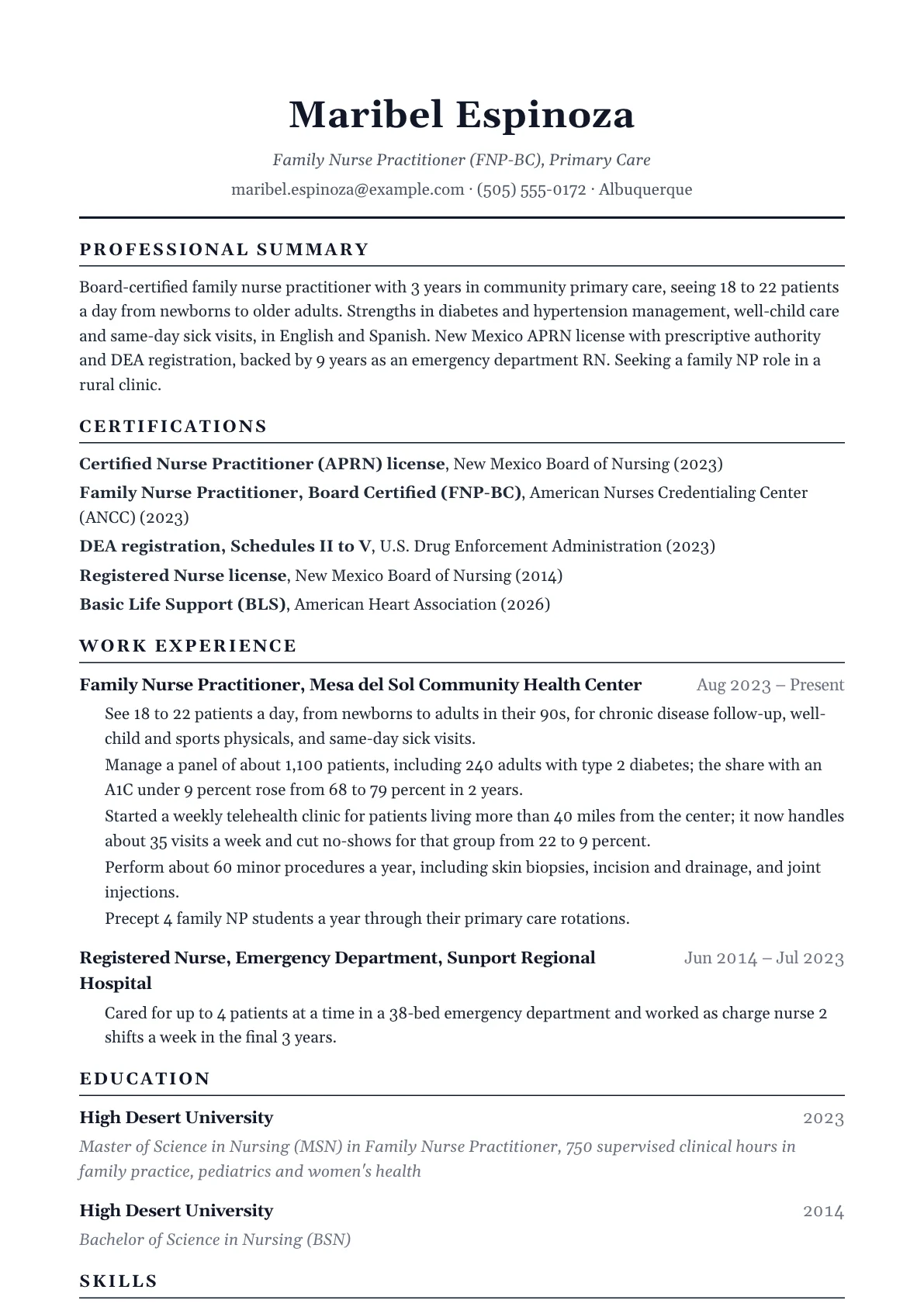
A board-certified family nurse practitioner with three years in community primary care applying for a family NP position at a rural health clinic.

Why this resume works

  • The APRN license, FNP-BC certification and DEA registration come first, each with its issuer, so the credentialing questions every clinic asks are settled before the work history starts.
  • Her panel bullet reports outcomes, not only volume: about 1,100 patients, 240 of them with type 2 diabetes, and the share under control rising from 68 to 79 percent.
  • Nine years of emergency nursing stay as one compact entry, because a rural clinic needs a provider who stays steady when a walk-in patient is sicker than expected.
Edit & download this resume

Edit it in the free builder, then download the PDF with no watermark. A free account is only needed to download.

A nurse practitioner resume has to prove something an RN resume never does: that you can diagnose, treat and prescribe on your own license. The people reading it, a medical director, a practice manager and the credentialing office, look for four things before anything else: your APRN license and the state it is in, your national board certification and population focus, your prescriptive authority and DEA registration, and the patients you have managed as a provider. Your years as a staff nurse still count, but they sit underneath that.

Below you will find a full example for a family nurse practitioner moving to a rural clinic, the order that works for NP resumes, summary lines for new, experienced and lead NPs, bullet examples built on panel size and patient outcomes, and the licenses and certifications to list, checked against the boards that issue them. If you are still working as a staff nurse, the registered nurse resume example is the better starting point.

Nurse practitioner pay and job outlook

Official figures for Nurse Anesthetists, Nurse Midwives, and Nurse Practitioners.

Median pay (2025)
$134,920 per year ($64.87 per hour)
Jobs in 2025
399,000
Job outlook, 2025 to 2035
36%, much faster than average
Change in jobs, 2025 to 2035
+144,000
Typical entry-level education
Master's degree

The Bureau of Labor Statistics reports nurse practitioners together with nurse anesthetists and nurse midwives, so the pay and job figures cover all three advanced practice roles.

Sources: U.S. Bureau of Labor Statistics, Occupational Outlook Handbook: Nurse Anesthetists, Nurse Midwives, and Nurse Practitioners, checked September 2026; O*NET OnLine: Nurse Practitioners, checked September 2026.

How to write a nurse practitioner resume

1

Put your credentials and population focus in the header

Write your name with degree, license and certification in the order your employer prefers, for example Maribel Espinoza, MSN, APRN, FNP-BC. The headline under it names the population focus and setting: Family Nurse Practitioner, Primary Care or Psychiatric Mental Health NP, Outpatient. A clinic hiring for pediatrics will skip an adult-gerontology NP, so make the focus impossible to miss.

2

Open with a licenses and certifications section

List the APRN license and issuing state, the national board certification with the certifying body and year, your RN license, and your DEA registration. Credentialing offices and payers check each of these before you can see a single patient, so a clean list here saves weeks. Life support cards (BLS, ACLS, PALS) go at the end of the section.

3

Write a summary about the patients you manage

Three or four sentences: years as an NP and the setting, the patients you see each day and their ages, the conditions you manage best, and your license and prescribing status. Add a language if you see patients in it. Finish with the role you want so the reader knows which opening you applied for.

4

Describe provider work, not nursing tasks

Your NP bullets should read like a provider's: patients per day, panel size, the conditions you diagnose and treat, procedures you perform and outcomes you moved, such as A1C or blood pressure control, screening rates, or wait times. Leave nursing tasks like vital signs and medication passes for the RN entry, if at all.

5

Keep RN experience short, but keep it

Years at the bedside tell a practice that you have seen very sick patients and know how a care team works. Give each RN job one or two lines with the unit and a detail that matters for the new role, such as emergency triage for urgent care or cardiac experience for a cardiology practice.

6

Finish with education, clinical hours and languages

List your MSN or DNP with the program and population focus, then your BSN. New NPs add the supervised clinical hours and the rotation settings, since that is most of their provider experience. Add languages spoken with patients, and skip hobbies, photos and personal details.

Skills and keywords for a nurse practitioner resume

Nurse practitioner postings mix clinical skills with the systems and paperwork that come with a provider role. Match the posting's wording where it is true for you, and show the most important ones again inside your bullets.

Hard skills

  • Comprehensive history and physical exams
  • Differential diagnosis and treatment planning
  • Prescribing, including controlled substances where authorized
  • Chronic disease management (diabetes, hypertension, COPD, asthma)
  • Ordering and interpreting labs and imaging
  • Preventive care and age-based screening
  • Minor procedures (biopsies, suturing, incision and drainage, joint injections)
  • Telehealth visits
  • Behavioral health screening and referral
  • Accurate coding and visit documentation

Soft skills

  • Explaining a diagnosis in plain words
  • Shared decision making with patients
  • Working with physicians, pharmacists and care coordinators
  • Judgment about when to refer or escalate
  • Cultural and language awareness
  • Teaching NP students and new staff

Tools and software

  • Epic, athenaOne, eClinicalWorks or NextGen EHR
  • Electronic prescribing, including EPCS for controlled substances
  • State prescription drug monitoring program (PDMP)
  • Telehealth platforms
  • Point-of-care testing (A1C, strep, urinalysis)
  • UpToDate or similar clinical reference

Nurse practitioner resume summary examples

Start with the one that matches your stage and swap in your own setting, patients and credentials. Each names the population focus in the first sentence, because that is the first filter a practice applies.

New graduate nurse practitioner

Newly certified adult-gerontology primary care NP (AGPCNP-BC) with 720 supervised clinical hours in internal medicine, geriatrics and a retail health clinic, plus 6 years as a cardiac step-down RN. Comfortable managing hypertension, heart failure follow-up and annual wellness visits for 12 to 15 patients a day. APRN license issued in 2026; DEA registration in process. Seeking an adult primary care NP position with structured onboarding.

Experienced nurse practitioner

Psychiatric mental health nurse practitioner (PMHNP-BC) with 5 years in outpatient behavioral health, managing medications and brief therapy for a caseload of about 600 adults and adolescents. Experienced with depression, anxiety, ADHD and substance use treatment, including buprenorphine. Seeking a PMHNP role that combines in-person and telehealth care.

Lead or senior nurse practitioner

Lead family nurse practitioner with 12 years in practice, including 4 years supervising 9 NPs and physician assistants across 3 urgent care sites. Built the onboarding program that brings new providers to a full schedule in 8 weeks, and led the switch that cut average door-to-discharge time from 71 to 48 minutes. Seeking a clinical director or APP lead position.

Nurse practitioner resume bullet examples

Strong NP bullets name a patient group, a number and what changed. Change the details to your own practice, and keep the pattern.

  • Evaluate and treat 30 to 40 patients per 12-hour shift in a walk-in urgent care, including fractures, lacerations and respiratory illness.
  • Raised colorectal cancer screening in a panel of 900 adults from 51 to 66 percent by adding at-home test kits to annual visits.
  • Brought blood pressure under 140/90 for 74 percent of hypertensive patients, up from 61 percent, through nurse-led follow-up calls.
  • Manage psychiatric medications for a caseload of 450 adults, with 90 percent of follow-ups completed on schedule.
  • Performed 200+ laceration repairs and 50 splint applications a year in a rural emergency clinic.
  • Launched a same-day diabetes education visit with the clinic dietitian, cutting diabetes-related emergency visits by 18 percent in 1 year.
  • Reduced antibiotic prescriptions for viral upper respiratory infections from 38 to 17 percent using a shared decision tool.
  • Precepted 12 NP students from 3 graduate programs over 4 years, with every student passing boards on the first attempt.
  • Completed 1,200 telehealth visits in 2025, keeping patient satisfaction at 4.8 out of 5.
  • Reviewed the state PDMP before every controlled substance prescription, supporting a zero-finding pharmacy audit.
  • Covered 2 satellite clinics one day a week each, adding 16 appointment slots per week in underserved towns.

Licenses and certifications for nurse practitioners

Becoming a nurse practitioner stacks several credentials on top of each other. You need an RN license first, earned through the NCLEX-RN exam, then a graduate degree (MSN or DNP) in one population focus. Under the APRN Consensus Model published by the National Council of State Boards of Nursing, advanced practice nurses must also pass a national certification exam. Each state's board of nursing then issues the APRN license, and the rules on prescribing and physician collaboration differ from state to state. List these on your resume:

  • APRN license (the title varies by state, such as CNP or APRN-CNP): issued by the state board of nursing where you practice. Name the state.
  • National board certification in your population focus. The American Nurses Credentialing Center awards FNP-BC, AGPCNP-BC, AGACNP-BC and PMHNP-BC. The Nurse Practitioner Certification Board (NPCB, known until 2026 as the AANP Certification Board) offers family, adult-gerontology primary care, psychiatric mental health and emergency NP exams and awards the NP-C credential, renewed every five years.
  • DEA registration, if you prescribe controlled substances: nurse practitioners register with the Drug Enforcement Administration as mid-level practitioners, within the authority your state allows.
  • RN license: keep it active and list it, since the APRN license is built on it.
  • Life support: BLS for every role; ACLS or PALS for urgent care, emergency and acute care positions.

The example, line by line

The example belongs to Maribel, a family nurse practitioner with three years at a community health center who wants to work in a rural clinic. Each part is chosen for that move.

Header and headline: Family Nurse Practitioner (FNP-BC), Primary Care. The certification and setting sit right under her name, so a recruiter matching her to a family practice opening does not have to look further.

Summary: 3 years as an NP and 18 to 22 patients a day from newborns to older adults in the first sentence; her clinical strengths and Spanish in the second; license, prescriptive authority, DEA registration and 9 years of emergency nursing in the third; the role she wants to close.

Licenses and certifications: five lines with the issuer and year for each: the New Mexico APRN license, FNP-BC from ANCC, DEA registration for Schedules II to V, her 2014 RN license and BLS.

Experience: the first bullet sets the scope of her practice. The second gives the panel (about 1,100 patients, 240 with type 2 diabetes) and the result, A1C control rising from 68 to 79 percent. The telehealth bullet speaks straight to a rural employer: patients more than 40 miles away, about 35 visits a week, and no-shows down from 22 to 9 percent. Procedures and precepting 4 students a year show range. The emergency RN job keeps a single line with the 38-bed department and her charge nurse shifts.

Education, skills and languages: her MSN with 750 supervised clinical hours, her BSN, eight skills that echo family practice postings, and Spanish listed as a language rather than buried in the summary.

Mistakes that hold back nurse practitioner resumes

  • Writing it like an RN resume with a new title. Medication passes and patient assignments describe nursing. An NP resume needs diagnoses, prescribing, patients per day and outcomes you changed.
  • Leaving out the population focus. FNP, AGPCNP, AGACNP, PMHNP and PNP are not interchangeable. If your certification does not match the patients in the posting, the application stops there, so state it plainly.
  • Missing DEA or prescribing status. Practices need to know whether you can prescribe controlled substances now or whether the registration is still pending. Say which.
  • No patient numbers. Patients per day and panel size tell a medical director how fast you work and how much you can take on. Without them, they have to guess.
  • Clinical rotations with no detail. New NPs often list only the clinic names. Add the specialty, the hours and what you managed, because these rotations are your provider experience.
  • A six-page CV for a clinic job. Most clinical NP roles want a resume of one or two pages. Save the full CV with publications and presentations for academic and research positions.

Other healthcare resume examples that are close to this one:

Every example is in the resume examples hub, grouped by job and situation.

Build it free, no watermark

CVPoet's resume builder is free to use without an account. Start from this example or a blank page, pick one of four ATS-friendly designs, and download a PDF with no watermark on any plan.

Frequently asked questions

What should a nurse practitioner put on a resume?

Your name with credentials, a headline with your population focus, a short summary, a section for your APRN license, board certification, RN license and DEA registration, your NP jobs with patients per day and outcomes, a short RN history, your graduate degree and clinical hours, and skills and languages.

Should a nurse practitioner use a resume or a CV?

For clinical jobs, a resume of one to two pages is usual. Use a longer CV when you apply for faculty, research or leadership roles that ask for publications, presentations and teaching.

How do I write a new grad nurse practitioner resume?

Lead with your new certification and APRN license (or the date you expect them), then list clinical rotations like jobs: the specialty, the site, the hours and the patients you managed. Keep your RN experience below that, with the details that match the NP job you want.

Where do I put my DEA number on my resume?

Say that you hold DEA registration, and for which schedules, in the licenses section. You do not need to print the registration number itself; employers verify it during credentialing.

Should I list my RN experience on an NP resume?

Yes, briefly. One or two lines per RN job with the unit and one relevant detail show clinical depth. Your NP experience goes first and gets most of the space.

What is the difference between FNP-BC and NP-C?

They come from different certifying bodies. FNP-BC is awarded by the American Nurses Credentialing Center, and NP-C by the Nurse Practitioner Certification Board, formerly the AANP Certification Board. Both are national board certifications; list the one you hold with its issuer, and check with your state board of nursing which exams it accepts.

Do I need to mention my state practice authority?

Not in detail. Name the state that issued your APRN license and say you have prescriptive authority. If you are moving to a state with different collaboration rules, the employer will explain what applies there.

How many clinical hours should I list as a new NP?

List the actual hours your program documented, broken into the main settings, such as family practice, pediatrics and women's health. The number itself matters less than the patients and conditions you managed during them.

What skills should a nurse practitioner list?

The clinical areas the posting names (chronic disease, women's health, urgent care procedures), prescribing and e-prescribing, telehealth, the EHR by name and a few soft skills shown in your bullets, like patient education or precepting.

How long should a nurse practitioner resume be?

One page for new graduates and two pages for most experienced NPs. Put your credentials and current NP role on page one so the key facts are seen even if the reader stops there.

Build your nurse practitioner resume now

Start from Maribel's example or a blank page. Free to use, no account needed, and every PDF downloads without a watermark.

Build your resume, free
Nurse practitioner resume example
Nurse practitioner resume example The example above as an image, to save or share. To change it, use Edit & download this resume at the top of the page. Open the full-size image