Musician Resume: Example and Credit Guide (2026)

Create a musician resume with a fictional keyboard sample, clear performance credits and portfolio guidance. Edit the exact sample in free Classic.

Template:

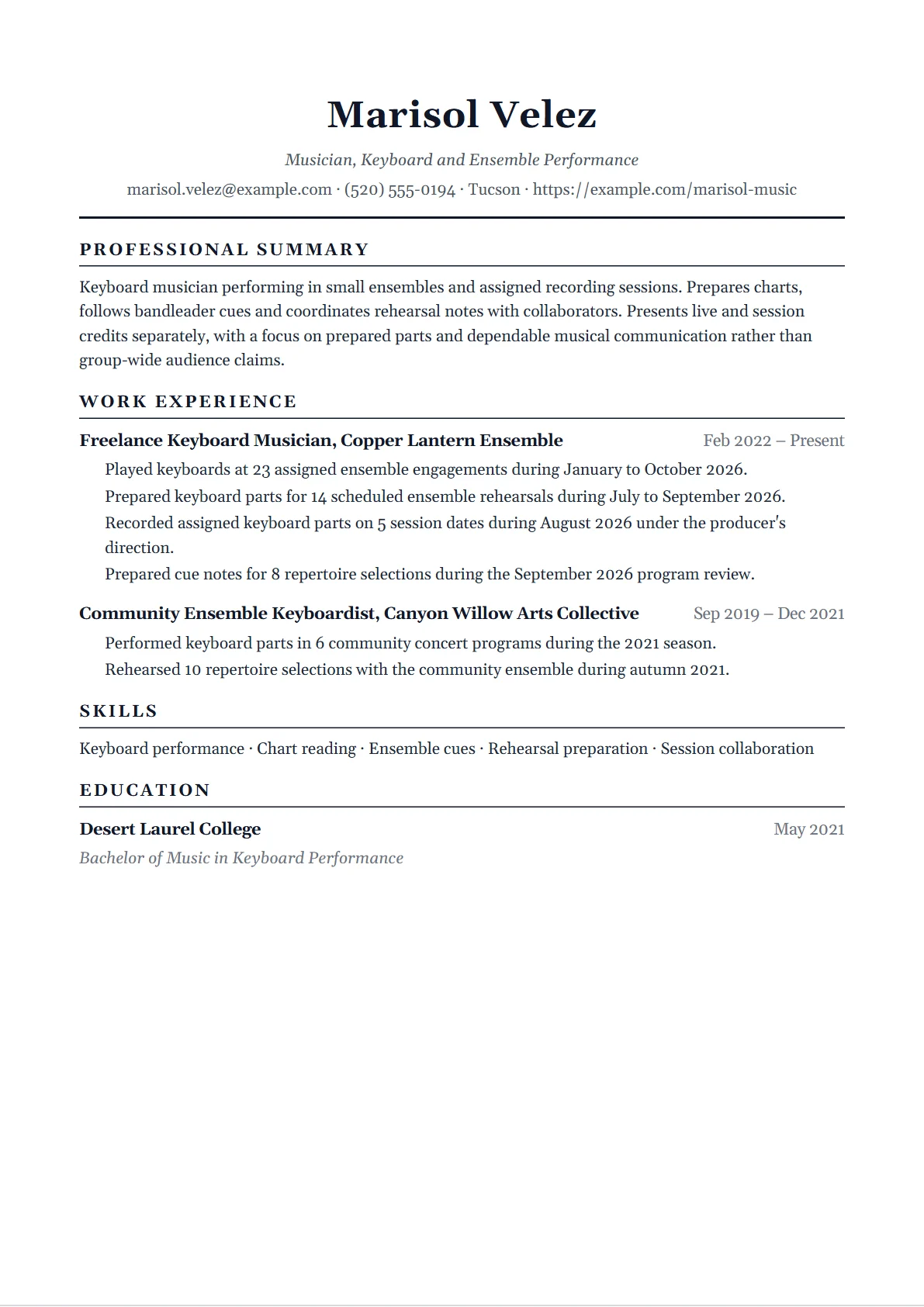
Fictional musician Marisol Velez applying for recurring keyboard ensemble engagements. Groups, degree, credits, performance counts and the example.com portfolio placeholder are invented illustrations, not verified performances or outcomes.

Why this resume works

  • Keyboard performance and ensemble preparation stay central without inventing singing, composition or engineering credits.
  • The 23 engagements, 14 rehearsals and 5 session dates are separate activities over stated periods, not ticket sales or audience growth.
  • A fictional portfolio placeholder is clearly distinguished from a reviewed recording, and the completed degree does not imply a teaching license.
Edit & download this resume

Create a free account to edit this example and download a PDF with no watermark. Classic is free; Compact, Creative, and Bold require a Job Search Pass.

A musician resume needs to answer a specific musical opportunity. A live keyboard engagement, an orchestral audition, a studio session and a school application ask for different evidence. Identify your instrument, relevant style and actual performance contribution. A list of famous venues, software or group streaming totals does not explain what you played, which work was paid or whether the recording is yours to share.

This guide uses fictional keyboard musician Marisol Velez applying for recurring ensemble engagements in Tucson. Her groups, degree, performance counts and example.com portfolio address are invented illustrations. The address is a placeholder, and no recordings have been heard or verified behind it. The exact text, Classic preview and editable sample show the same history. Use the sample for structure, then replace it with your genuine performance record and follow any audition or application instructions.

Musician resume example: selectable text

This is the fictional example shown above in selectable text. Use its structure, then replace every sample detail with your own. The image and editable example use the same resume data.

Marisol Velez

Musician, Keyboard and Ensemble Performance

marisol.velez@example.com

(520) 555-0194

https://example.com/marisol-music

Tucson, AZ, US

Summary

Keyboard musician performing in small ensembles and assigned recording sessions. Prepares charts, follows bandleader cues and coordinates rehearsal notes with collaborators. Presents live and session credits separately, with a focus on prepared parts and dependable musical communication rather than group-wide audience claims.

Experience

Freelance Keyboard Musician

Copper Lantern Ensemble

From: Feb 2022

To: Present

  • Played keyboards at 23 assigned ensemble engagements during January to October 2026.
  • Prepared keyboard parts for 14 scheduled ensemble rehearsals during July to September 2026.
  • Recorded assigned keyboard parts on 5 session dates during August 2026 under the producer's direction.
  • Prepared cue notes for 8 repertoire selections during the September 2026 program review.

Community Ensemble Keyboardist

Canyon Willow Arts Collective

From: Sep 2019

To: Dec 2021

  • Performed keyboard parts in 6 community concert programs during the 2021 season.
  • Rehearsed 10 repertoire selections with the community ensemble during autumn 2021.

Skills

Keyboard performance

Chart reading

Ensemble cues

Rehearsal preparation

Session collaboration

Education

Bachelor of Music

Keyboard Performance

Desert Laurel College

To: May 2021

Official musician-work context

Official figures for Musicians and singers.

Work settings
Live performance and recording
Preparation
Extensive training and regular practice
Schedules
Part-time and variable work are common

This broad occupation includes different instruments, genres and work arrangements. It is not an audition specification or a claim about this fictional musician's income or qualification.

Source: BLS musicians and singers profile, checked November 2026.

How to write a musician resume for the actual opportunity

1

Identify the instrument and engagement

Choose the primary instrument or voice and the work you want. Describe a relevant style and performance setting accurately. An orchestral audition may have a prescribed credit format, while a recurring ensemble engagement may call for a concise work history and suitable recordings. Follow the actual instructions.

2

Separate credits by the role you played

Distinguish live performance, session work, composition, arranging, production and teaching. Name your contribution to a group project rather than claiming every credit. Keep student, community and professional work labeled honestly, and do not describe an ensemble membership as a leadership role unless it was one.

3

Choose recordings that answer the musical brief

Offer relevant authorized examples and explain your instrument, role and recording context. Test the listening route without requiring unexpected access. A polished full-band recording may not demonstrate the isolated skill requested, and an unlabelled link leaves the listener guessing which part is yours.

4

Give performance evidence without inflated reach

Use dates, engagement types and supported activity counts when they clarify your experience. Distinguish a rehearsal from a concert and a session date from a released track. Ticket sales, streams and followers may belong to an entire group or campaign, so do not attribute them solely to your playing.

5

Present study and other qualifications accurately

List completed music study, relevant instruction and genuine awards with their scope clear. A performance degree does not by itself establish school-teaching authorization. Include teacher or reference names only when relevant and with appropriate permission, and keep a course, membership and awarded credential distinct.

6

Review the musical and application details

Check spelling of works, credits, dates and links, then inspect the final document. In CVPoet, open the sample through your account in free Classic, replace the fictional content and save with Save or Update as shown. Download and review the PDF. Supply any repertoire list, recording or audition material separately in the requested form.

Skills and keywords for a musician resume

Describe musical abilities at the level you can demonstrate. Instrument, style, chart reading, ensemble cues and preparation should connect to actual performance evidence. Playing from a chart, improvising in a style and sight-reading unfamiliar music are different claims. If the engagement requires a particular ability, choose a recording or experience entry that makes that ability understandable without adding unsupported proficiency labels.

Technology can matter, but avoid treating equipment ownership as competence. List notation, recording or performance tools only when they were part of your real contribution. Marisol's sample claims keyboard playing and session collaboration under direction; it does not claim that she composed the music, mixed the recording or led the group. A production team can make a strong finished recording without every performer holding each of those credits.

Hard skills

  • Keyboard parts and relevant repertoire
  • Reading charts at the actual demonstrated level
  • Following ensemble cues and rehearsal changes
  • Preparing assigned parts for a session

Soft skills

  • Listening and responding to collaborators
  • Clear communication about preparation
  • Organizing rehearsal and engagement details

Tools and software

  • Keyboard instruments actually used
  • Notation tools used for your own preparation
  • Recording or playback tools within actual experience

Musician resume summary examples

These fictional alternatives illustrate separate applications. They do not add orchestral, teaching or production credentials to Marisol's record.

Student performer

Music student with accurately labeled ensemble and recital experience. Identifies the primary instrument, relevant study and prepared repertoire. Offers appropriate performance material and follows audition instructions without presenting student credits as established paid engagements.

Freelance ensemble musician

Keyboard musician with live ensemble and assigned session experience. Prepares parts, follows cues and communicates changes with collaborators. Separates performance credits and dates from group promotion, recording production and other people's responsibilities.

Experienced specialist

Musician with a genuine record in the instrument and style required by the engagement. Selects relevant recent credits and clearly identifies solo, ensemble and session contributions. Uses suitable authorized recordings and supported results without relying on the group's reputation as proof of personal achievement.

Musician resume bullet examples

These invented illustrations describe preparation and performance, not real credits or musical standards. Replace their numbers with your own records. When a qualitative example communicates the musical contribution better, do not manufacture an engagement count or audience measure.
  • Prepared keyboard parts for 12 selections before a scheduled ensemble rehearsal cycle.
  • Played 7 assigned live engagements during a defined autumn program with the ensemble.
  • Recorded piano parts on 3 session dates under the producer's direction.
  • Organized cue notes for 9 repertoire entries after the bandleader's rehearsal revisions.
  • Performed in 4 student recital programs with the institution and role identified accurately.
  • Rehearsed 6 new selections with the group before their first scheduled public performance.
  • Prepared 5 annotated listening links identifying the instrument and individual performance credit.
  • Supported 2 supervised recording exercises while keeping the engineering credit with the student production team.
  • Coordinated availability and preparation notes for 8 scheduled ensemble calls during a monthly program.
  • Reviewed 11 chart revisions against the agreed rehearsal notes before the next engagement.

Music study, audition instructions and recording rights

The BLS musicians and singers profile describes live and recorded performance, extensive training and regular practice. It notes that formal postsecondary education is typically not needed for entry across the broad occupation, while some genres have different education patterns. That is occupational context, not a guarantee of eligibility for a particular orchestra, school or employer. Marisol's fictional completed degree is a performance qualification, not a claim to a teaching license.

Michigan State University's music resume resources offer separate first-year jazz, opera and performance templates. Their different purposes support checking the actual opportunity's format rather than assuming one universal music resume. The U.S. Copyright Office permission FAQ explains that permission and fair-use questions depend on the circumstances; there is no universal safe musical-note allowance. Check the basis for sharing recordings and other people's work. Performing on a session does not automatically settle every right in a composition or recording.

  • Give the actual degree, institution and completion status. Describe ongoing study accurately instead of presenting an expected award as completed.
  • List a relevant awarded qualification by its true name and issuer. Do not turn an audition invitation, masterclass attendance or ensemble membership into certification.
  • For a teaching application, check the specific institution, duties and jurisdiction separately. Do not infer teaching authority from a music performance degree.

The example, line by line

Instrument and purpose: Marisol's label leads with keyboards and ensemble performance. She is applying for recurring engagements, not claiming an orchestral chair, a school-teaching role or a recording-engineer position. Her summary describes prepared parts and collaboration rather than unsupported claims about ticket sales or audience growth.

Live work: the 23 engagements occurred from January to October 2026. The count does not establish 23 different venues, sold-out concerts or a full-time annual schedule. Freelance work can overlap with other activity, so the label and dates should explain the actual arrangement rather than implying an exclusive permanent position.

Preparation and sessions: the 14 rehearsals are from July to September, while five session dates belong to August. A session date is not a released track, album or composition credit. The eight cue-note selections relate to September preparation and should not be added to engagements as extra concerts. The sample leaves production direction with the producer.

Community experience: six programs and ten repertoire selections appear under the community ensemble with their own 2021 period. That setting stays visible. The Bachelor of Music was completed in May 2021, overlapping with community performance, which is plausible but does not establish that the earlier activity was paid professional employment.

The portfolio: example.com/marisol-music is only a fictional placeholder. Replace it with a real, appropriate listening route and label your part in each example. Nothing in this guide claims to have heard those fictional recordings or verified permissions. Check the recipient's access and the rights that apply before sharing actual material.

Worked revision: credit the playing, not the whole project

A separate fictional draft says, "Produced a hit album and drove all the band's streaming growth." The available record supports playing assigned keyboard parts on a session under a producer's direction. A defensible revision is, "Recorded assigned keyboard parts for the ensemble session, following the producer's cues and preparing the revised chart before the take." If you also composed, arranged or produced, give the genuine credit separately. Do not assume a track's popularity establishes your individual causal contribution.

Adapt for an audition rather than a general engagement

Read the notice before arranging your page. It may ask for selected ensemble credits, particular repertoire, recordings or a separate application form. A general freelance work history should not displace required material. For a student application, label school performances, instruction and expected study dates accurately. The aim is to make the relevant musical evidence easy to assess, not to imply that every music opportunity uses the same selection process.
Musician resume details that can misrepresent your work

  • Claiming every project credit. Separate playing, composing, arranging, production and engineering.
  • Confusing a session with a release. Keep rehearsal, recording date, performance and published track counts distinct.
  • Using group reach as personal impact. Attribute streams, followers and ticket sales accurately or omit them.
  • Leaving recordings unexplained. Identify your instrument, role and relevant context, then test the authorized listening route.
  • Presenting a degree as teaching authority. Check any specific teaching qualification separately.
  • Ignoring the audition notice. Give the requested repertoire and materials rather than forcing every opportunity into the same general format.

Use a neighboring guide when the primary work is different from instrumental performance.

Every example is in the resume examples hub, grouped by job and situation.

Build it free, no watermark

Create a free CVPoet account before editing. Start from this example in the free Classic template or start a blank page, and download a PDF with no watermark. Compact, Creative, and Bold are available with a Job Search Pass.

Frequently asked questions

What should a musician resume emphasize?

Start with the instrument or voice, the opportunity and relevant performance evidence. Select credits and recordings that show the work requested. A freelance ensemble engagement, orchestral audition and student application may need different formats, so follow the actual instructions.

Can I include community or student performances?

Yes, when the setting and role are clearly labeled. Give relevant repertoire or performance context without turning a student recital into a professional touring credit. Early experience can be useful evidence when described honestly and selected for the opportunity.

Is every music resume a chronological employment resume?

No. A general engagement application may use a work history, while an audition may request selected credits or a prescribed format. Check the notice first. Organize genuine experience around the information the reader needs rather than imposing one universal structure.

Should I include streaming numbers?

Include them only when they are relevant and you can support the measure, period and attribution. Group streams do not automatically measure your individual contribution. Clear performance credits, preparation and suitable recordings can be useful without audience-growth figures.

How do I describe session work?

Identify the instrument and assigned contribution, dates or relevant project context, and accurate credits. Playing a part does not by itself establish composition, arrangement, production or engineering credit. Distinguish a session date from a released recording and keep restricted client information private.

Can I share any recording I played on?

Check the rights and arrangements that apply before sharing. Your performance credit does not settle every right in the recording or composition. Use an authorized listening route and do not bypass a paywall or distribute restricted files. Seek appropriate advice for a difficult rights question.

Do all musicians need a music degree?

The BLS profile describes a broad occupation with varied education patterns, and formal postsecondary education is typically not needed for entry overall. A specific employer, genre, audition or study program can have different requirements. State your actual study and follow that opportunity's instructions.

Does a performance degree qualify me to teach in schools?

Do not assume that it does. Check the institution, teaching duties and jurisdiction and describe any actual teaching qualification separately. This fictional sample claims keyboard performance and a completed music degree, not school-teaching authorization.

How long should my musician resume be?

Use the length and format the opportunity requests. Keep relevant credits and qualifications readable, remove duplicate listings and place a separate repertoire or recording list where requested. A fixed page rule should not override explicit audition instructions.

Can I download this exact example?

Open it through your CVPoet account in free Classic, replace all invented facts and the portfolio placeholder, then save with Save or Update as shown. Download the PDF and inspect text selection, full sections and links. Prepare any requested recordings or repertoire documents separately; the guide does not provide real audio samples.

Make your musical contribution clear

Edit the fictional keyboard sample in free Classic and present your own performance record.

Build your resume, free
Freelance keyboard musician example
Freelance keyboard musician example The example above as an image, to save or share. To change it, use Edit & download this resume at the top of the page. Open the full-size image
Premium

More ways to make your CV yours

Unlock all three premium designs with a Job Search Pass. Your written content stays exactly as it is. Classic is always free.

Included with your pass

$12 once for 30 days

No subscription. Nothing renews. A 90-day pass is also available.

See Job Search Passes

Pass options open in a new tab. Your draft stays here.