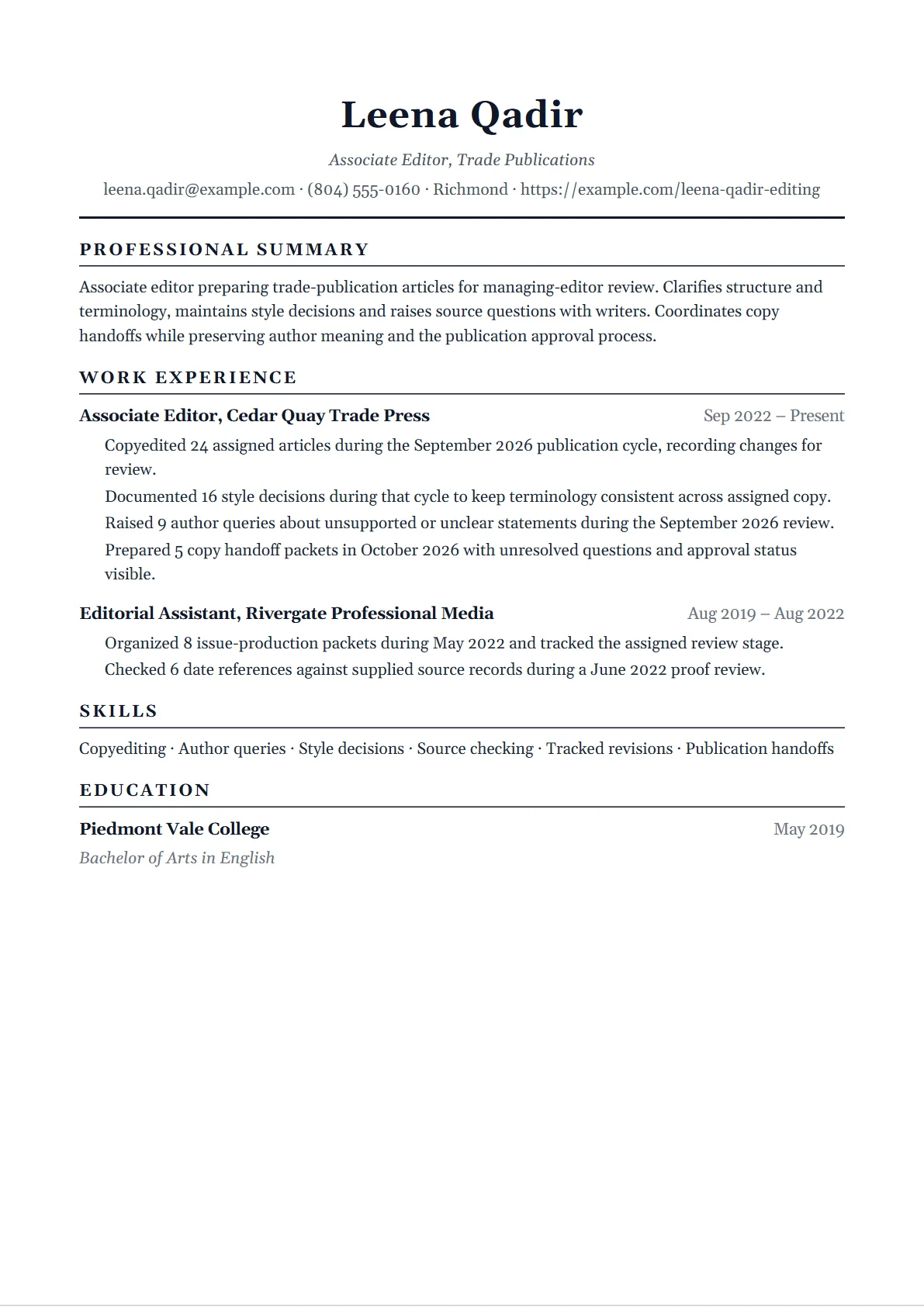
Scope and sequence: Leena completed a fictional English degree in May 2019, became an editorial assistant in August 2019 and moved to associate-editor work in September 2022. The target is a trade publication. Her label does not imply editor-in-chief authority, video-production skills or specialist credentials.
Article workload: twenty-four assigned articles belong to the September 2026 publication cycle. The sixteen style decisions were documented during that cycle, not sixteen additional publications. Neither count establishes a publication-wide accuracy rate or a total annual workload.
Queries and handoffs: nine author queries concern unsupported or unclear statements. Asking the questions is useful evidence of review, but the sample does not claim every question was resolved or every assertion independently verified. Five October handoff packets retain unresolved issues and approval status so the next reviewer can act.
Earlier production support: eight issue packets in May 2022 and six checked date references in June 2022 show organization and proof work. They do not become eighteen separately edited articles or responsibility for the publisher's whole output. The assistant title remains accurate.
Portfolio placeholder: example.com/leena-qadir-editing is fictional. We have not inspected a real portfolio at that address. Replace or remove it before applying, and identify your own role in any permitted sample. An edited final article may not reveal the changes you made, so a brief contribution note can be more informative than an unexplained link.
Worked revision: a send record is not proof of reading
In a separate fictional editing exercise, a draft says, "Every member received and read the updated guide." The supporting record shows an email send to a member address list, without recipient reading evidence. A defensible revision is, "The team sent the updated guide to the listed member addresses." An editor can query the stronger claim rather than turning a distribution record into confirmed reading. This illustrates a source-based wording decision, not a real publication result.
Explain a substantial change respectfully
For a permitted sample, describe the reader's difficulty, the source question and the change you proposed. Retain the writer's intended meaning and explain where you requested clarification instead of filling a gap with an assumption. If a managing editor or subject specialist decided the final wording, say so. The case note should show your judgment without exposing confidential criticism of an author or claiming sole ownership of collaborative work.