Nanny Resume: Examples and Tips (2026)

Nanny resume example for families and agencies: skills, childcare bullets, CPR and first aid to list, official pay figures and a free template.

Template:

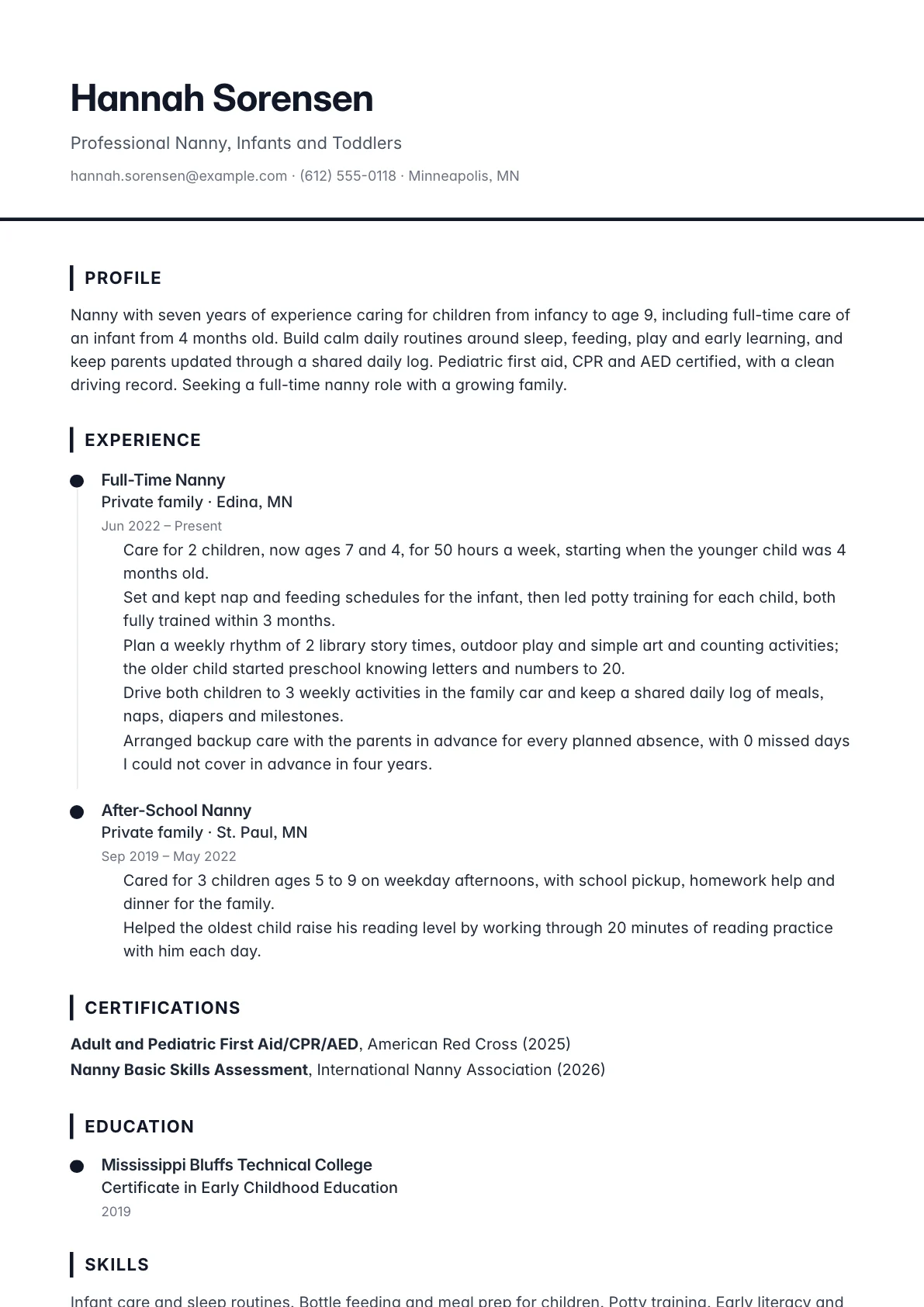
A nanny with seven years of experience, including infant care, applying for a full-time nanny position with a family expecting a second child.

Why this resume works

  • Each family is listed with the children's ages and how long she stayed, including one family for 4 years, which answers a parent's first worry about turnover.
  • Safety is concrete: current pediatric first aid, CPR and AED from the Red Cross, a clean driving record and 0 missed days she could not cover in advance.
  • The daily work is specific, from nap and feeding schedules for a 4-month-old to potty training and reading routines, so parents can picture her in their home.
Edit & download this resume

Edit it in the free builder, then download the PDF with no watermark. A free account is only needed to download.

A nanny resume is read by a parent, not a recruiter, and parents read it with a very personal question: can I trust this person with my children? They look for how long you stayed with each family, the ages you cared for, what a day with you looks like, and whether you are ready for an emergency. Placement agencies ask the same questions before they send your profile to a family.

This guide covers what to put on a nanny resume, how to describe private family jobs without sharing their details, the safety training families expect, skills, summary and bullet examples, and a full example for an experienced nanny applying for a full-time role with a newborn and a toddler. Working in a classroom instead of a home? See the preschool teacher resume example.

Nanny pay and job outlook

Official figures for Childcare Workers.

Median pay (2025)
$34,980 per year ($16.82 per hour)
Jobs in 2025
1,010,300
Job outlook, 2025 to 2035
-2%, decline
Change in jobs, 2025 to 2035
-19,900
Typical entry-level education
High school diploma or equivalent
On-the-job training
Short-term on-the-job training

BLS groups nannies with other childcare workers, such as daycare staff; O*NET also has a separate profile for nannies.

Sources: U.S. Bureau of Labor Statistics, Occupational Outlook Handbook: Childcare Workers, checked September 2026; O*NET OnLine: Nannies, checked September 2026.

How to write a nanny resume

1

Headline the ages and type of care you offer

Parents search by age and schedule. Professional Nanny, Infants and Toddlers, After-School Nanny or Live-In Nanny, Twins tells them right away whether you fit. Add your city so they know you are local.

2

List each family as a job, without private details

Write Private family as the employer, then the city, your title and your dates. In the bullets, give the number of children and their ages, the hours and what you did. Leave out the family's names and address; you can share them as references when asked.

3

Describe a real day

Parents want to picture you with their children. Bullets about routines (naps, meals, school runs), learning (reading, crafts, outings) and milestones (potty training, first words, starting school) show what they are paying for.

4

Put safety right after your experience

List pediatric first aid and CPR with the issuer and year, and mention a clean driving record if you will drive the children. Say you are willing to do a background check. Families and agencies often ask about all three before an interview.

5

Show you are reliable and easy to work with

Long stays with families, backup plans for absences and clear communication with parents are what families value most. A number of years with one family is the strongest line on a nanny resume.

6

Add education, training and languages

Early childhood courses, a degree in education or child development, special needs experience and a second language all set you apart. Keep the resume to one page, and have a list of references ready.

Skills and keywords for a nanny resume

These are the skills families and agencies ask for in nanny job posts. Choose the ones that are true for you and match the ages in the post.

Hard skills

  • Infant care: feeding, diapering, safe sleep
  • Nap and meal routines
  • Potty training
  • Age-appropriate learning activities
  • Homework help and reading practice
  • Healthy meal and snack preparation
  • Pediatric first aid and CPR
  • Safe driving and correct car seat use
  • Children's laundry and tidying
  • Managing schedules and activities

Soft skills

  • Patience and a calm manner
  • Clear, honest communication with parents
  • Positive discipline and consistency
  • Discretion and respect for family privacy
  • Flexibility when plans change
  • Reliability and punctuality

Tools and software

  • Shared calendars and family messaging apps
  • Baby monitors and sleep trackers
  • Daily log apps or paper logs
  • Car seats and strollers
  • School and activity portals
  • Payroll apps families use for household employees

Nanny resume summary examples

Pick the version closest to you, then add the ages you care for, your safety training and the schedule you want.

First nanny job

Babysitter for four families over three years, caring for children ages 2 to 10 on evenings and weekends, including bedtime routines and homework. Pediatric first aid and CPR certified and studying early childhood education. Seeking a part-time or after-school nanny position.

Experienced nanny

Nanny with five years of full-time care for families with toddlers and school-age children, including three years with one family. Plan play-based learning, manage school and activity schedules and cook simple family meals. Clean driving record and pediatric CPR certified. Seeking a full-time nanny role.

Newborn care or household manager

Career nanny with twelve years in private homes, including newborn care for six families and three years as a nanny and household manager for a family of five. Coordinate schedules, staff and travel while keeping the children's routines steady. Seeking a senior nanny or family assistant position.

Nanny resume bullet examples

Each bullet names the task, includes a number such as ages, hours or years, and shows what it meant for the children or the parents.

  • Cared for twins from 3 weeks to 2 years old, keeping them on a shared feeding and sleep schedule.
  • Stayed with one family for 5 years, from the first child's birth through kindergarten.
  • Led potty training for a 2-year-old, finished in 6 weeks with a consistent routine shared with the parents.
  • Drove 3 children to school and activities 5 days a week with no accidents or late pickups.
  • Planned 4 outings a week to parks, libraries and museums, choosing each for the children's ages.
  • Supported a 7-year-old with ADHD using a visual schedule designed with his therapist and parents.
  • Cooked healthy lunches and dinners for a family of 5, following a food allergy plan for one child.
  • Kept a daily log of meals, sleep and milestones that parents used at 3 pediatrician visits.
  • Taught 2 children basic Spanish through songs and books over 18 months.
  • Managed the children's schedules across 2 schools and 6 weekly activities.
  • Traveled with the family on 4 trips, keeping the children on routine across time zones.

Safety training and checks for nannies

There is no license to work as a private nanny, and the American Red Cross notes that no formal training is required. Families and agencies still expect proof that you can keep children safe. The Red Cross lists a high school diploma or GED, a background check and pediatric first aid and CPR among the basic qualifications for nanny jobs, plus a driver's license if you will drive the children. What to list:

  • Pediatric first aid, CPR and AED, such as the American Red Cross adult and pediatric course. Give the issuer and year, and renew before it expires.
  • Background check: say you are willing to complete one. In California, TrustLine is the state's background check registry for nannies and babysitters, administered by the California Department of Social Services with the state's child care resource and referral network. In other states, families and agencies arrange their own checks.
  • Water safety training from the American Red Cross if you will take children swimming.
  • Child Passenger Safety Technician certification from Safe Kids Worldwide, the certifying body for National CPS Certification: optional, but useful if you install and check car seats for infants.
  • Nanny Basic Skills Assessment from the International Nanny Association: an optional online test of child health, safety, development, nutrition and professionalism; the certificate shows the year you passed.

The example, line by line

The example is for Hannah, a nanny in Minneapolis with seven years of experience who is looking for a full-time family with a new baby. Here is what each part does.

Headline: Professional Nanny, Infants and Toddlers. The ages she wants to care for, in the words parents search.

Summary: seven years and the age range (infancy to age 9) first, then what her days look like and how she keeps parents informed, then her safety training and driving record, then the kind of family she wants.

Experience: each family is listed as Private family with the city, so their privacy is protected. The current job has five bullets: 2 children, 50 hours a week, starting at 4 months old; routines and potty training done within 3 months; learning with 2 library story times a week and numbers to 20; driving to 3 activities and a daily log; and reliability, with 0 missed days she could not cover in advance. The after-school job adds 3 children ages 5 to 9 and 20 minutes of reading practice a day.

Certifications: her Red Cross adult and pediatric first aid, CPR and AED from 2025 and the International Nanny Association skills assessment from 2026.

Education, skills and languages: her early childhood education certificate, nine skills in plain words parents use, and conversational Norwegian.

Mistakes that cost nannies interviews

  • Sharing a family's private details. Names, addresses and personal stories about the children do not belong on a resume. Use Private family and the city.
  • No ages or number of children. Caring for a newborn and caring for three school-age kids are different jobs. Give ages and numbers for every family.
  • Leaving out CPR and first aid. Parents look for it first. If yours expired, renew it before you apply.
  • Hiding short jobs without a reason. Nanny jobs end when children start school or families move. Add a short note like position ended when the family relocated so the reader does not assume the worst.
  • Only listing tasks. Watched children says little. Show routines, learning and milestones with numbers.
  • No references ready. Families almost always call past families. Ask them before you apply and have their contact details ready.

Other education and care resume examples that are close to this one:

Every example is in the resume examples hub, grouped by job and situation.

Build it free, no watermark

CVPoet's resume builder is free to use without an account. Start from this example or a blank page, pick one of four ATS-friendly designs, and download a PDF with no watermark on any plan.

Frequently asked questions

What should I put on a nanny resume?

A headline with the ages and type of care you offer, a short summary, each family as a job with the children's ages, your hours and what you did, your pediatric first aid and CPR, your driving record if you will drive, any childcare education, skills and languages.

How do I list a nanny job on a resume without naming the family?

Write Private family as the employer, add the city, your title and dates, and describe the children by number and age. Share the family's name and contact details only as a reference, and only with their permission.

Do nannies need a license?

Not for private in-home nanny work. The American Red Cross notes that no formal training is required. Families and agencies usually expect pediatric first aid and CPR, a background check and, if you will drive, a clean driving record.

What certifications help a nanny resume?

Pediatric first aid, CPR and AED are the most requested. Water safety, car seat safety training, early childhood courses and the International Nanny Association's skills assessment can also help you stand out.

How do I write a nanny resume with no experience?

List babysitting, caring for younger siblings or relatives, camp counseling, church nursery or school volunteering. Give ages and numbers, get pediatric first aid and CPR, and aim your summary at a part-time or after-school role.

What skills should a nanny put on a resume?

Infant care, routines, potty training, learning activities, homework help, meal prep for children, first aid and CPR, safe driving, communication with parents, patience and reliability. Match them to the ages in the job post.

Should I include babysitting on my nanny resume?

Yes, especially early on. Group regular babysitting under one heading with the number of families, ages and years.

How long should a nanny resume be?

One page. Families want the key facts fast: ages, years with each family, safety training and availability.

How do I explain short nanny jobs?

Add a brief reason in parentheses, such as family relocated or child started full-time school. It is common in nanny work and parents understand it.

What is the difference between a nanny and a babysitter resume?

A babysitter resume shows occasional care and basic safety. A nanny resume shows regular, often full-time care with routines, learning, schedules and a long relationship with each family.

Build your nanny resume now

Start from Hannah's example or a blank page. Free, no account needed, and the PDF has no watermark.

Build your resume, free
Nanny resume example
Nanny resume example The example above as an image, to save or share. To change it, use Edit & download this resume at the top of the page. Open the full-size image